Nye County water plan shows limits shaping growth and services
Water, not just land, sets Nye County’s growth line. Southern communities depend on wells and springs, while Tonopah’s fixed Ralston Valley supply limits how fast permits can move.
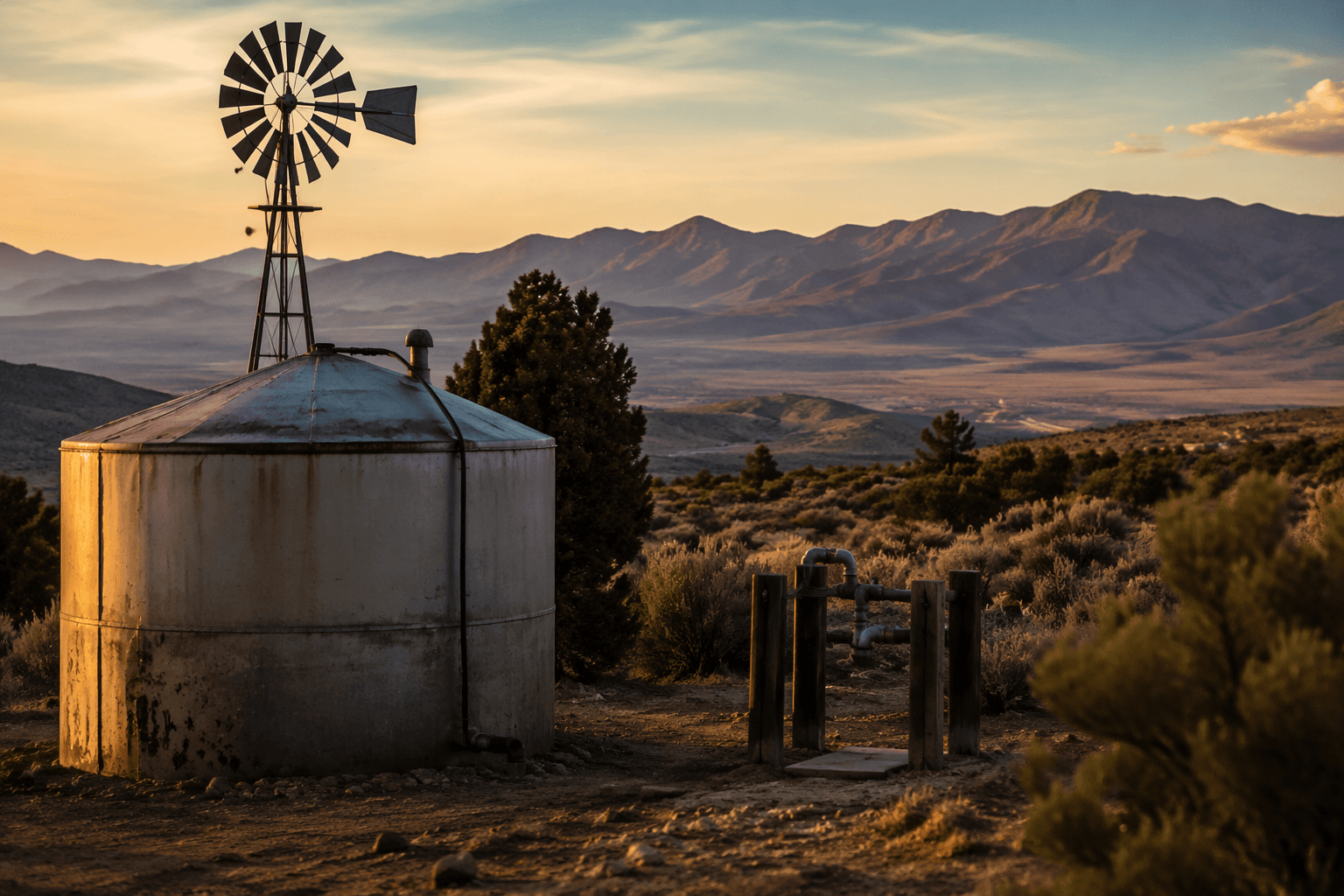
In Nye County, water is the gatekeeper for growth. It decides where homes can be permitted, how quickly businesses can expand, and whether basic services can keep pace from Tonopah to the southern valley. The county’s own water plan says southern Nye relies mainly on groundwater wells or springs, while Tonopah is pumped from Ralston Valley, and one county water document puts Tonopah’s municipal water rights at 1,554 acre-feet.
Water planning is the county’s land-use filter
The Nye County Water Resources Plan was built around a simple question that still drives local decisions: whether enough water exists to support existing business, industry, population and growth trends. That is why water in Nye County is not a separate utility topic, but part of the same conversation as zoning, building permits and long-range infrastructure.
The county’s Comprehensive Plan makes the stakes explicit. It says the Nye County Board of County Commissioners recognizes the critical nature of the county’s limited water resources and the increasing demands placed on them as the population grows. It also says many surface-water resources are already committed to existing uses, while groundwater supplies in many areas have been appropriated for current uses. In practical terms, that means a project may look viable on a map and still run into a water-rights or supply ceiling before it ever reaches construction.
A county too large for one water story
Nye County’s scale is part of why its water system is so uneven. University of Nevada, Reno Extension describes it as the largest county in Nevada by land area and one of the largest in the United States, with only a small share of land privately owned and most of the county under federal management. That geography concentrates people in places like Pahrump, Tonopah, Beatty and smaller outlying communities, while leaving long stretches of open country in between.
The county’s basin summary materials show just how fragmented the water picture is. Nye County has 44 hydrographic basins, 27 of them shared with other Nevada counties and two shared with California. Twelve of the 44 are designated basins. Those boundaries matter because water decisions are rarely countywide in practice, even when they are countywide on paper. A well field, a valley aquifer and a spring system can each face different rules, different pressure and different limits.
Pahrump remains the clearest pressure point
Pahrump is where the tension between growth and water supply shows up most sharply. A U.S. Geological Survey report found that about 540,000 acre-feet of groundwater were pumped from Pahrump Valley between February 1962 and February 1975, a reminder of how heavily the basin has been used over time. The long arc of that pressure is part of why water remains such a central part of every major development discussion in the valley.
A 2018 Pahrump Basin 162 Groundwater Management Plan said that for more than 15 years the Nevada Division of Water Resources and Nye County required over-dedication of water rights in the basin. That kind of requirement affects what can move forward, because a landowner or developer cannot treat water as an afterthought when the basin itself is under management constraints. In February 2024, Nye County Water District staff sought direction to begin updating the district’s Groundwater Management Plan, and the last update had been completed in 2018. That update process is a sign that the county’s water rules are not frozen; they are being revisited as conditions, data and development pressure change.
The Bureau of Reclamation also got involved in the basin’s future. In 2023, the Nye County Water District sought a grant to improve the Pahrump Valley Basin 162 groundwater model so it could better forecast conditions and help preserve native environments. Better modeling matters because it shapes how confidently the county can plan for subdivisions, service lines and long-term pumping without overcommitting the basin.
Tonopah runs on a finite well field
Tonopah’s water story is different, but the constraints are just as real. The Nye County Water Resources Plan says Tonopah’s water supply is pumped from Ralston Valley, specifically Basin 141, and county materials put the town’s municipal water rights at 1,554 acre-feet. That number is not just a technical figure. It is the ceiling that helps explain why growth discussions in Tonopah tend to focus on supply limits rather than abundance.
Interflow Hydrology says Tonopah Public Utilities’ Rye Patch well field in central Ralston Valley has supplied municipal water to Tonopah for more than 100 years. That history underscores a central point for residents and local officials alike: Tonopah’s system is established, but it is not limitless. When the county talks about identifying, developing and maintaining adequate water supplies, Tonopah’s long-running dependence on a single valley-based source is exactly the kind of system that makes those words practical rather than abstract.
Conservation and public trust shape the next decisions
Nye County Water District has also framed conservation as part of the county’s water future. Its conservation program says it is designed to build public support and participation in conservation efforts suited to a rural desert lifestyle. That approach matters because conservation in Nye County is not just about using less water at home. It is tied to whether the county can stretch existing supplies long enough to support the communities already here.
Public education also runs through local institutions. University of Nevada, Reno Extension operates county offices in Pahrump and Tonopah, a reminder that water management in Nye County is tied to local outreach, not just agency rules. The county’s water debates have also been politically charged. The Nevada Independent reported on a state water ruling in Nye County that sparked fear and misinformation, and the Guinn Center for Policy Priorities has analyzed the water-allocation debate in Pahrump Valley. Those episodes show that water in Nye County is not only a technical problem, but a public trust issue that can affect how quickly officials, landowners and residents accept a plan.
For Nye County, the practical question is not whether water matters. It is which communities can keep growing under the limits of their basins, where new service demands can be met, and how fast the county can adapt when supply and demand stop lining up. The answer continues to shape permits, development timelines, well reliability and the pace of growth from Tonopah to the southern valley.
This article was produced by Prism’s automated news system from verified source data, official records, and press releases, then run through automated quality and moderation checks before publishing. The system is built and supervised by the people who set the standards it runs under. Read our full AI policy.
Did this article answer your question?