Old Tonopah Cemetery draws visitors into Tonopah's mining history
Beside the Clown Motel, Tonopah’s old cemetery turns mining deaths, plague history and roadside branding into one compact local draw.
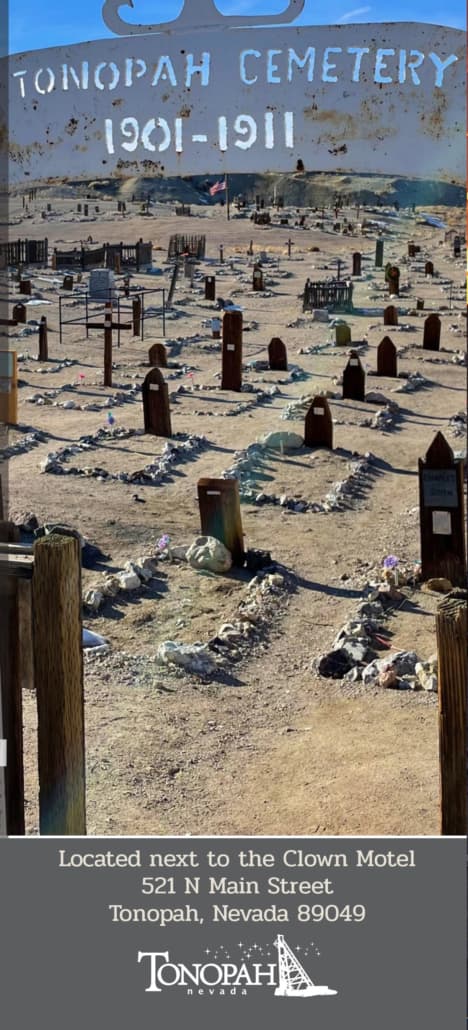
The Old Tonopah Cemetery sits beside one of Nye County’s strangest landmarks, and that pairing is exactly why people stop. A walk among more than 300 graves becomes a guided look at Tonopah’s boom years, its mine disasters, its public-health scares and the way the town now packages all of that into a marketable visit.
How to visit the cemetery
The Town of Tonopah keeps the visit straightforward: you can download a walking-tour map or pick one up at the cemetery entrance. That map matters because this is not just a scatter of old stones, but a place where names and death dates lead into deeper local records, from Chronicling America to the Central Nevada Museum’s research library.
A separate Old Tonopah Cemetery website, funded by a Nye County grant, adds grave-site listings and another downloadable map. That combination gives the town several layers of interpretation, and it keeps the history close to the ground instead of hiding it in a museum case.
What the ground tells you about Tonopah
The cemetery first opened on May 7, 1901, with the burial of John Randel Weeks, also rendered John R. Weeks in some sources. It served as Tonopah’s main burial ground until April 1911, when the town had outgrown the site and opened a new cemetery about a mile west of town.
This old burial ground was built on silver mining tailings, which is part of what makes it such a direct window into Tonopah’s mining past. Travel Nevada says tailings from the Tonopah Extension Mine washed over graves and markers, so the site was never just a quiet cemetery on the edge of town. It was a working piece of a mining district, and the mining district eventually swallowed parts of it.

Some visitor guides note that burials did not stop completely in 1911, which means the old grounds continued to receive occasional use after the main burial function shifted elsewhere. Even so, the pattern is clear: the town moved on, but the old cemetery stayed behind as a record of the first generation that built Tonopah.
The names that make the history personal
The walking tour turns the cemetery from an abstract relic into a set of specific lives. George “Devil” Davis, remembered as Tonopah’s first African American political leader, is one of the names that gives the site civic as well as mining history. So do Big Bill Murphy, remembered for heroism during the 1911 Belmont Mine Fire, the Marojevech Brothers, who died in a mine accident, Sheriff Tom Logan and the Merten Brothers, whose deaths prompted community support.
Those names matter because they show how Tonopah grew through labor, violence, leadership and mutual aid, not just silver prices. The cemetery functions as a local genealogy trail as much as a heritage attraction, which is why the town’s map and the site’s grave listings are so useful. They turn a quick stop into a place where a visitor can match family names to the history of the camp.
A historical marker at the site calls it the “First Tonopah Cemetery” and says 14 victims of the Tonopah-Belmont Mine fire of Feb. 23, 1911 are buried there. The same marker says the cemetery was fenced in 1979 by the Central Nevada Historical Society, a reminder that the place has needed deliberate protection if it is going to remain readable to the public.
The public-health story buried in the records
The cemetery also carries Tonopah’s public-health history. Contemporary newspaper evidence and public-health reporting show that the so-called Tonopah plague was not bubonic plague at all, but pneumonia, and that the 1905 outbreak set off concern over a high mortality rate before officials determined the disease was pneumonia and pushed house inspection and disinfection.
That detail matters because it shows how a mining town’s fear traveled through institutions. The Nevada board of health, the U.S. Public Health and Marine-Hospital Service, Dr. H. E. Piper and Passed Assistant Surgeon Currie all sit in the paper trail of that response, which turned a local scare into a broader public-health lesson. In a town built on extraction, the record also preserves the cost of crowded living and medical uncertainty.
Why the Clown Motel belongs in the same story
The Clown Motel, which opened in 1985, sits steps from the cemetery and gives the area its most recognizable roadside identity. Its collection has grown from an early display of about 150 clown figures into more than 6,500 clown figurines, paintings and memorabilia, which helps explain why the property remains such a strong visual hook for travelers.
That odd pairing does real work for Tonopah. The motel brings people to the block, the cemetery gives them a reason to stay longer, and the town’s other heritage stops, including the Central Nevada Museum and Tonopah Historic Mining Park, extend the visit beyond a single photo stop. Tonopah Main Street and the town’s cemetery materials help keep that experience legible, so the trip does not end at the front gate.
The tension is plain enough: the cemetery is a genuine burial ground tied to mine tailings, fire deaths and disease, but it is also part of a branded roadside package. The preservation tools, from fencing to maps to grave listings, keep the history intact; the clown motel next door makes that history easy to sell. Together, they give Tonopah one of its most durable invitations to stop, look closely and spend time in the center of its mining past.
This article was produced by Prism’s automated news system from verified source data, official records, and press releases, then run through automated quality and moderation checks before publishing. The system is built and supervised by the people who set the standards it runs under. Read our full AI policy.
Did this article answer your question?