Pahrump residents rally to protect Ash Meadows from solar development
A 10,000-acre solar plan and renewed mining pressure are turning Ash Meadows into a fight over water, wildlife and who controls southern Nye County’s future.
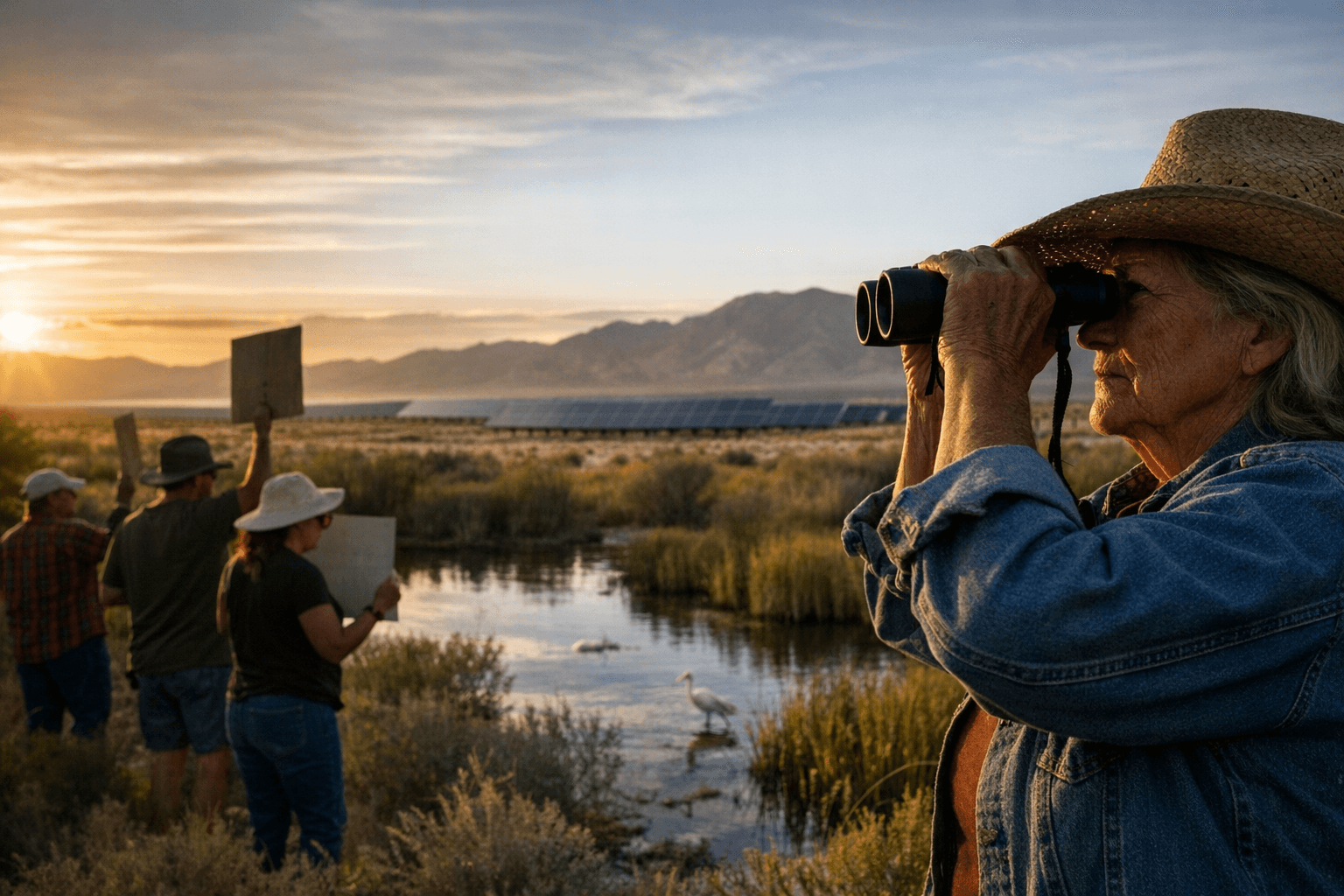
Ash Meadows is where the next land-use fight starts
A 10,000-acre solar proposal and renewed mining pressure are putting Ash Meadows at the center of a high-stakes fight over southern Nye County’s future. Residents and conservation advocates say the real issue is not just one project, but who has the power to decide what happens around a fragile wetland system that sustains water, habitat and rural life.
Ash Meadows National Wildlife Refuge sits in the middle of that struggle. Managed by the U.S. Fish & Wildlife Service, the refuge was established on June 18, 1984, and now covers more than 23,000 acres of spring-fed wetlands and alkaline desert uplands. The agency says it protects threatened and endangered species found nowhere else in the world, which is why local advocates describe the area as far more than open desert.
Who controls Ash Meadows and the land around it
The refuge itself is under federal management by the U.S. Fish & Wildlife Service, but the surrounding land-use decisions are spread across several authorities. The Bureau of Land Management controls nearby public lands, including the acreage tied to the proposed withdrawal now being debated. Any longer-term mineral withdrawal would need approval from the Department of the Interior, and Congress could also play a role if a broader legislative fix were pursued.
That division matters because residents are not just asking for sympathy, they are asking for legal protection. The protection they want has ranged from a mineral withdrawal to a possible National Conservation Area designation, which advocates see as a stronger long-term shield for Ash Meadows National Wildlife Refuge and the surrounding wash and spring system. In practical terms, they want a framework that can stop future claims, utility corridors and industrial buildout before they reach the refuge’s groundwater-dependent core.
Why the water is the real prize
The battle over Ash Meadows is really a battle over water, and that is what makes it so consequential for Nye County. The springs are fed by a much larger aquifer that extends well beyond the refuge boundary, which means projects outside the refuge can still affect the system inside it. That is why residents warn that once the hydrology changes, the damage could be permanent.
The landscape itself makes the stakes plain. Visitors have been photographed walking by Fairbanks Spring, with cactus blooms, a desert horned lizard, Ash Meadows Amargosa pupfish and a tortoise area near Greenlink construction and Rock Valley Wash. Those details are not decorative, they show how close utility work, wildlife habitat and wetland water sources sit to one another in a place many people still think of as empty desert.
The refuge also carries deep cultural meaning. The U.S. Fish & Wildlife Service says Southern Paiute, or Nuwuvi, and Timbisha Shoshone, or Newe, have lived around the spring pools there for thousands of years, and the refuge remains culturally important to descendants living nearby today. That history makes the current fight not just an environmental dispute, but a question of stewardship over ancestral land and water.
The local coalition pushing for protection
The residents and advocates pressing for stronger protections are not abstract voices from outside the county. Amargosa Conservancy executive director Mason Voehl, Amargosa Valley Town Board chair Carolyn Allen and longtime resident Sherry Oettinger have all been part of the effort to build support for added protection. Their argument is that the community cannot wait until a major project is already under construction to decide how much risk is acceptable.
Local officials have already signaled that concern. On January 3, 2024, the Nye County Board of Commissioners unanimously approved a letter opposing mining activities near Ash Meadows and urged the Department of the Interior and Congress to pursue a mineral withdrawal for the area. Supporters say that vote showed the county recognizes the issue as a land-use decision with countywide consequences, not a narrow conservation request.
That same protection push is rooted in hard numbers. The Amargosa Conservancy says the refuge is home to at least 26 species of fish, plants, insects and snails found nowhere else on Earth, and 12 are protected under the Endangered Species Act. The United Nations has also designated Ash Meadows a Ramsar Wetland of International Importance, a label that reinforces the global significance of the site.
What mining and solar interests stand to gain
If those protections fail, the upside for developers and extractive interests is access to land that has long been treated as a frontier for future use. BLM in January 2025 proposed withdrawing approximately 308,890 acres of public lands in Nye County for up to 20 years to protect biological and hydrological resources, including Ash Meadows, while also seeking to avoid mining impacts to nearby communities. The agency said it wanted input on ongoing and projected mining activities for sepiolite, saponite and bentonite, and it scheduled a public meeting in Amargosa Valley for February 27, 2025.
The solar side of the equation is just as significant. In December 2024, NextEra Energy Resources submitted plans for the Rock Valley Solar Project, a 10,000-acre proposal about 16 miles north of Ash Meadows. The project was described as capable of powering about 360,000 homes in Nevada and California, and the reported lease bid was $21 million. That scale explains why the project has become so politically charged: it is large enough to reshape land use, transmission planning and expectations for what comes next in southern Nye County.
The Timbisha Shoshone Tribe has already warned BLM that the project should be rejected or downgraded from high-priority status because of risks to groundwater-dependent species. The tribe’s objection goes to the heart of the issue, because a solar field on paper can look clean while still placing heavy pressure on the water system that supports the refuge.
Why this fight could set the precedent for southern Nye County
The Ash Meadows fight is now being watched as a precedent for the rest of southern Nye County. If mining claims, solar projects or other industrial uses keep moving closer to the refuge, the county could face a new normal in which every open stretch of public land becomes a candidate for development pressure. That would affect not just habitat, but roads, utility lines, water planning and the way communities like Amargosa Valley, Beatty and even Pahrump think about growth.
The urgency has only intensified. On April 15, 2026, American Rivers added the Amargosa River to its list of America’s Most Endangered Rivers for 2026, pointing again to the river’s connection to the groundwater-fed springs in Ash Meadows. That warning lands at a moment when the temporary halt on new mining claims near the refuge is nearing expiration, and the clock is still ticking on any broader mineral withdrawal before January 2027.
For residents trying to protect Ash Meadows, the message is simple: this is not a one-project controversy. It is a decision about whether the water, habitat and cultural landscape that define this corner of Nye County will be preserved first, or parceled out one proposal at a time.
This article was produced by Prism’s automated news system from verified source data, official records, and press releases, then run through automated quality and moderation checks before publishing. The system is built and supervised by the people who set the standards it runs under. Read our full AI policy.
Did this article answer your question?