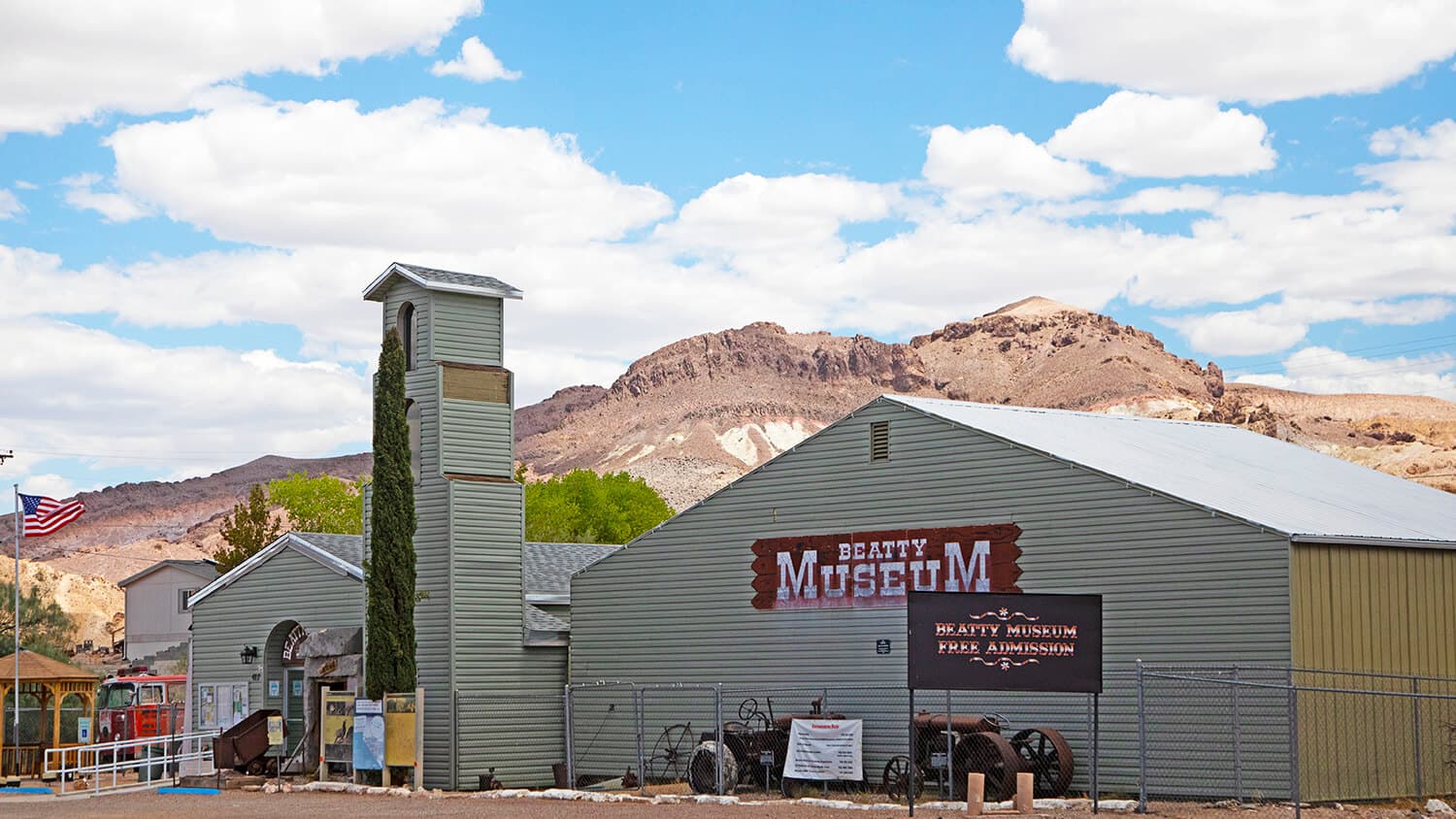
Rhyolite’s boomtown ruins still tell Nye County’s gold rush story
Rhyolite’s ruins turn Nye County’s gold rush into something you can still walk through, from a 1906 Bottle House to a boom that vanished by 1916.
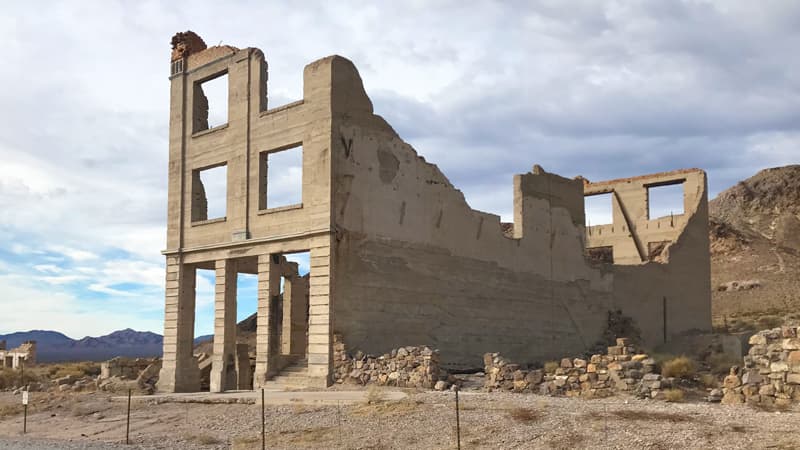
Rhyolite sits just west of Beatty as a reminder that in Nye County, speculation can build a town almost overnight and then leave it for the desert to keep. The old streets still carry the shape of the rush that made the Bullfrog district famous, and the ruins now draw a steady stream of visitors who come to see what a mining boom looked like before it collapsed.
How the rush started
Gold first turned heads in the Bullfrog district in the summer of 1904, when Shorty Harris and E. L. Cross found quartz rich with free gold. What followed was a rapid claim-staking frenzy across the silica-rich volcanic rock that gave Rhyolite its name, with more than 2,000 claims eventually tied up in the district. The townsite took shape fast, and the scale of the gamble was obvious from the start: people were building for a future that had not yet been proved.
Rhyolite’s rise was not a makeshift camp story. It became a full boomtown with hotels, stores, an opera house, and a school for 250 children, along with two electric plants, an ice plant, foundries, machine shops, and a miner’s union hospital. The town also had a stock exchange and a Board of Trade, signs that local business leaders expected the district to last long enough to justify formal markets and civic institutions.
What the boom looked like on the ground
At its peak, Rhyolite was the largest town in the Death Valley area, with an estimated population of 5,000 to 10,000 people. The National Park Service describes its heyday as roughly 1905 to 1911, and the town’s commercial life reflected that scale: 2 churches, 50 saloons, 18 stores, 2 undertakers, 19 lodging houses, 8 doctors, 2 dentists, a stock exchange, and an opera. The mix of business, vice, and entertainment made it more than a mining outpost. It was a short-lived city with all the friction that came with one.
That social scene reached from baseball games and dances to basket socials, whist parties, tennis, symphony performances, Sunday school picnics, basketball games, Saturday-night variety shows, and pool tournaments. The red-light district drew women from as far away as San Francisco, and an Alaska Glacier Ice Cream Parlor opened in 1906 under Countess Morajeski. One three-story building reportedly cost $90,000 to construct, a blunt measure of how much money, confidence, and speculation poured into a place that had barely finished forming.
A separate school building also reflected the rush’s ambitions. Historic resource material from the National Park Service identifies it as a two-story concrete-and-steel structure that cost $20,000, a more practical marker of how quickly families had arrived and how firmly people expected the town to endure. The town’s architecture ranged from showpiece investments to utility buildings, all of them thrown up with the assumption that the Bullfrog district would keep paying.
Why Rhyolite fell so fast
The collapse was as quick as the rise. The financial panic of 1907 hit the district hard and helped push it into decline, undercutting the speculative money that had fueled the boom. By 1910, Rhyolite’s population had dropped to 611, a steep fall from the thousands who had filled its streets only a few years earlier.
The shutdowns kept coming. The Montgomery Shoshone mine and mill closed in 1911, and electric power to Rhyolite was turned off in 1916. Once the mine stopped and the utilities went dark, the town could no longer support the dense web of hotels, shops, and social clubs that had made it look permanent. What had seemed like a finished city was revealed as a narrow economy built almost entirely on a single district’s promise.
What remains for visitors today
The old town still has enough structure left to show how complete the boom had been. The Bureau of Land Management identifies the Cook Bank Building as one of the most photographed buildings in the West, and it also protects Nevada’s best-preserved bottle house. Tom T. Kelly built that Bottle House in 1906 using about 50,000 beer and liquor bottles, turning refuse into a wall that has outlasted the mining rush that produced it.

The train depot, also built in 1906, adds another layer to the scene, since rail access was part of what made Rhyolite feel like a real town instead of a camp. The BLM manages 277.05 acres there as a day-use site for protection and interpretation, a reminder that what survives now is not just scenic rubble but a managed historic landscape. In a county where development pressure, heritage tourism, and open desert often collide, that management matters.
Why Beatty and Nye County still have a stake in it
Rhyolite’s value today is not only historical. The BLM says the site has received more than 1,756,506 visitors since 2022, which makes it one of the clearest examples in Nye County of a place where memory has become an economic asset. Travelers coming through Beatty stop for the ruins, and that traffic supports the same basic pattern that has long shaped the area: a remote landscape turned into a destination by scarcity, story, and access.
The lesson is plain in the surviving buildings. Rhyolite was built on claims, confidence, and a rush of people who believed the district would keep expanding. Beatty and the rest of Nye County now face a different version of the same calculation, where tourism, preservation, and land use all depend on whether development can be sustained without repeating the cycle that emptied the old town in the first place.
This article was produced by Prism’s automated news system from verified source data, official records, and press releases, then run through automated quality and moderation checks before publishing. The system is built and supervised by the people who set the standards it runs under. Read our full AI policy.
Did this article answer your question?