State Grants Fund Four Invasive Species Projects Across Orange County
New York awarded nearly $297,000 to four Orange County projects fighting hemlock woolly adelgid on Bellvale Mountain, water chestnut in Middletown, and Japanese knotweed in Walden.
New York awarded nearly $297,000 in invasive species grants to four Orange County sites as part of a $5.1 million statewide package, putting state dollars to work against threats that hikers along the Appalachian Trail, anglers on Middletown waterways, and park visitors in Montgomery and Walden encounter on an ordinary weekend.
The Department of Environmental Conservation announced the 51-project statewide round on March 30, with Commissioner Amanda Lefton identifying the awards as central to protecting forests, water quality, and local economies. The Orange County breakdown illustrates how differently invasive species play out across a single county.
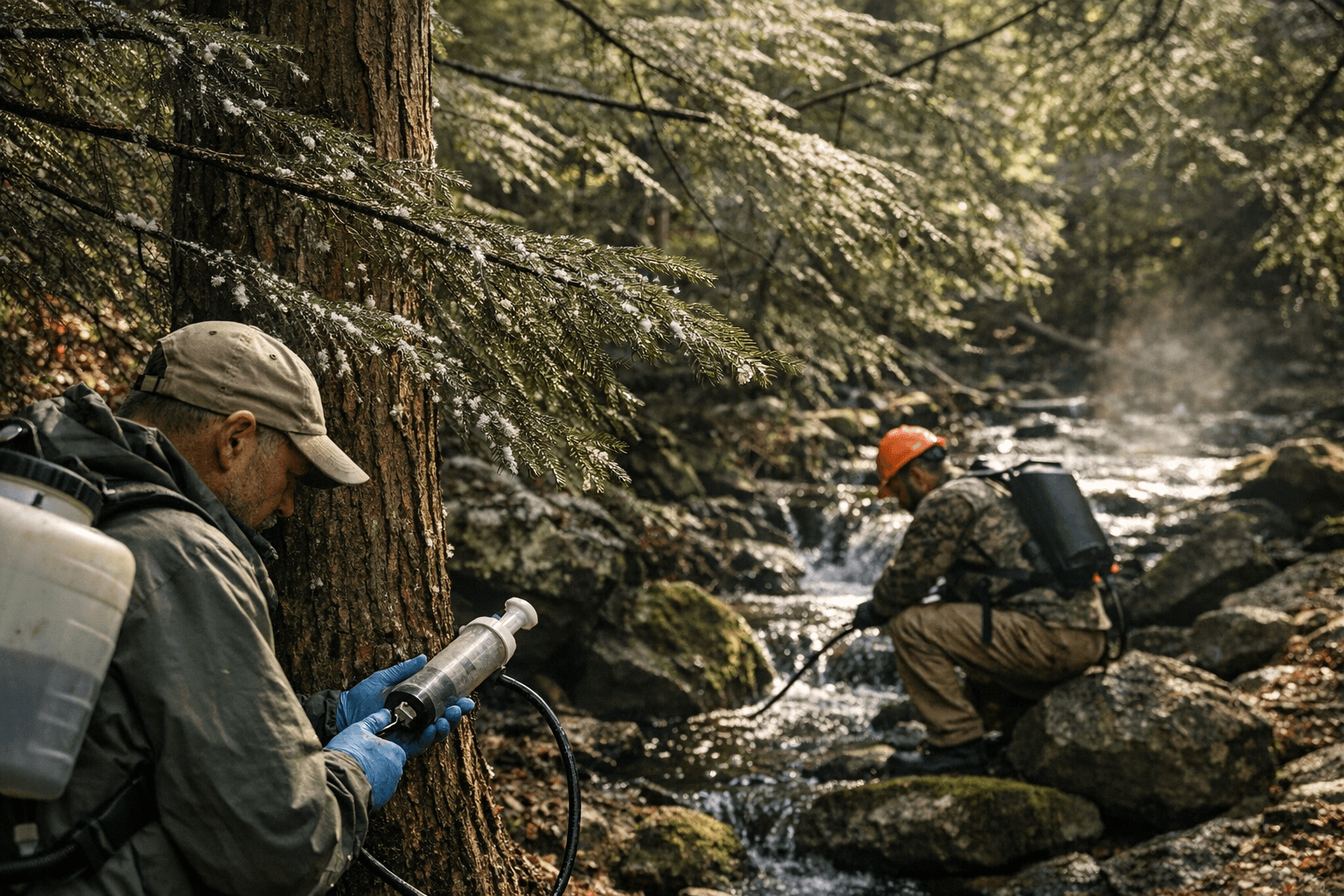
The Appalachian Trail Conservancy received $60,000 to strengthen the ecosystem resiliency of the hemlock-northern hardwood forest along the AT on Bellvale Mountain, where hemlock woolly adelgid has been attacking trees. Hemlocks shade the cool, moist slopes that define much of the Bellvale ridge hike; their collapse would fundamentally alter trail conditions, stream temperatures, and the watershed ecology that supports trout habitat below the mountain.
Middletown secured $88,530 for mechanical and manual removal of water chestnut, an aquatic invasive that forms floating mats dense enough to block sunlight, strip oxygen from the water column, and render a waterway effectively impassable for fishing or boating. The grant targets existing growth and is explicitly scoped to prevent further expansion within the project area.
Montgomery's $136,620 award, the largest of the four, funds phased invasive removal, native replanting, and long-term stewardship at both Benedict Farm Park and Riverfront Park along the Wallkill River corridor. Invasive plants along riparian buffers degrade the natural filtration that keeps sediment and nutrients out of the water supply.
The Village of Walden rounds out the county's haul with an $11,000 rapid response grant targeting approximately 0.4 acres of Japanese knotweed at Micky Millspaugh Park. Japanese knotweed, if left untreated, can regenerate from root fragments and damage infrastructure; catching 0.4 acres before it expands is precisely the kind of early intervention the DEC program is designed to fund.
"Investing in science-based management and strong local partnerships is strengthening New York's efforts to combat invasive species, protect biodiversity, build more resilient ecosystems, and protect our forests, waters, farms, and communities," Lefton said.
What accountability looks like varies by site. Walden's 0.4-acre target is concrete and measurable. Montgomery's multi-park restoration carries the highest burden of proof, requiring the town to demonstrate native plant establishment through multiple growing seasons. Middletown's success metric will center on reduced water chestnut coverage and documented containment. The Appalachian Trail Conservancy's Bellvale work, tied to resiliency rather than eradication, will depend on follow-up monitoring of hemlock health across the AT corridor.
Completed grant projects also set the conditions for future funding: documented outcomes strengthen subsequent applications to DEC and help attract volunteer stewardship programs that can sustain treatment work between grant cycles.
This article was produced by Prism’s automated news system from verified source data, official records, and press releases, then run through automated quality and moderation checks before publishing. The system is built and supervised by the people who set the standards it runs under. Read our full AI policy.
Did this article answer your question?