Booneville’s Legacy Artisan’s Corner showcases local art and youth handprints
Booneville’s town-square art corner pairs children’s handprints with a place for local makers to sell, turning downtown into a working showcase for Owsley County.
Booneville’s Legacy Artisan’s Corner is built around a simple idea with real downtown consequences: give local makers a visible place to set up, share, and sell their work, and anchor it with a public artwork made from children’s handprints. On the Booneville town square, the project links youth, artists, shoppers, and civic partners in a single space that is meant to do more than decorate.
A town-square corner with a market purpose
The Legacy Artisan’s Corner sits in Booneville, the county seat of Owsley County, at the junction of Kentucky Route 11 and Kentucky Route 30 on the South Fork of the Kentucky River. That location matters because Booneville is small, with a population of 168 in the 2020 census, and Owsley County itself had 4,051 residents, making it the second-least populous county in Kentucky.
In a place that small, a public square only works if it pulls double duty. The corner is intended to host members of the Only in Owsley Artisan Collective, giving local creators a defined downtown footprint where visitors and residents can encounter handmade goods without leaving the center of town. The point is not ceremonial art for its own sake, but a visible selling space tied to everyday foot traffic and local commerce.
The Legacy Tree turns children into part of the landscape
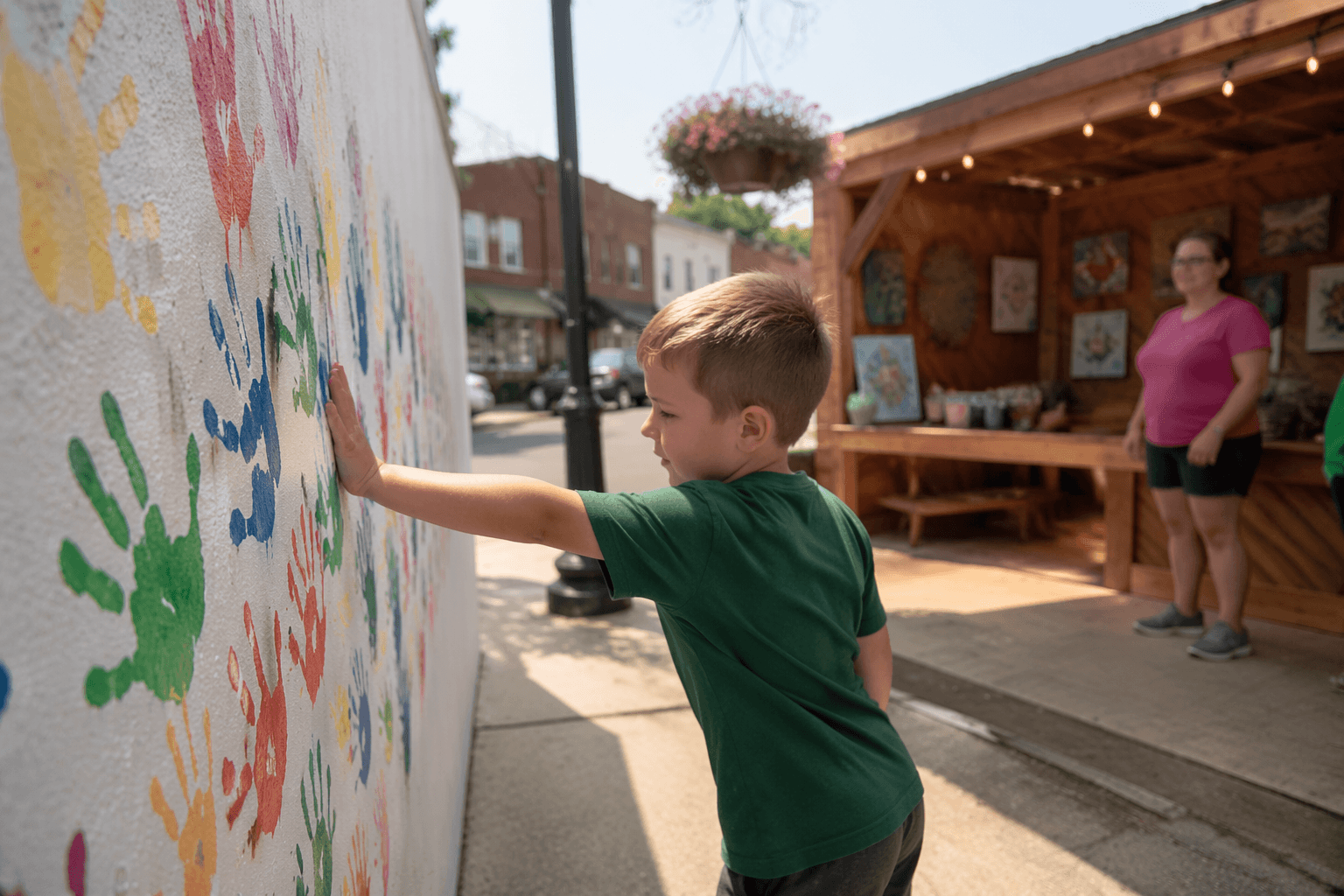
The visual centerpiece is the Legacy Tree, built from children’s handprints collected in the fall of 2023. That choice gives the project a strong local identity: it is both a marker of who lives here now and a record of the next generation’s place in the community.
Because the tree is made from children’s handprints rather than a generic sculpture, it works as a public memory piece that people in Booneville can recognize immediately. It also reinforces the idea that downtown improvements are not being made in isolation from the county’s families and schools. The handprints turn the corner into a living symbol of continuity, one that connects classroom-age children to the square where their community gathers, shops, and hosts events.
Who helped build it
The project was funded in part by a Center for Rural Development mini-ARC Grant awarded to the City of Booneville in 2023. That outside funding gave the town the resources to create the corner, but the design depends on local institutions to keep it rooted in Owsley County.
OCARE says the city will lead the compiling, collecting, and coordinating of the schedule for use of the space, which makes the project operational rather than ornamental. The setup also reflects a broader pattern of collaboration among the City of Booneville, the Owsley County School District, the Owsley County Public Library, Sugar Camp Christian School, Small Town Threads, Multi Serve, and other community contributors. Those names matter because the corner is not a one-off installation. It is being shaped by the same web of civic and school partners that already influence life in Booneville.
OCARE itself was formed in a place-based education effort that began in 2010 with 10th graders at Owsley County High School and teacher Brett Burns. It became an official 501(c)(3) in 2014. That history explains why youth, local identity, and practical community programming keep appearing in its work: the organization started in a classroom and grew into a group focused on building local capacity.
How the space changes downtown activity
The best way to understand the Legacy Artisan’s Corner is as an economic-development tool that happens to be artistic. OCARE ties the project to tourism, recreation, entertainment, and local development, and the selling space is the clearest expression of that goal. When artisans have a place on the square to display and sell their work, the downtown gain is not abstract. It is a reason for people to stop, look, spend time, and potentially spend money.
That matters in Booneville because the town’s commercial district is small and every new draw has outsized value. A handprint tree can pull in families who want to see the children’s work. An artisan corner can extend the visit by making it possible to browse local creations on site. Combined, the two features create a place where people do not just pass through town square traffic, they linger in it.
The project also gives the county a way to convert local talent into visible commerce. The Only in Owsley Artisan Collective is the key bridge between art and economic activity: makers are not being asked only to display their work, but to sell it in a setting that is publicly branded and locally coordinated. That is a practical use of public space, and it is especially meaningful in a county where long-term economic distress and high child poverty have shaped daily life for years.
Why this matters in a county that has struggled
Owsley County has been described as one of the poorest counties in the United States, with persistent poverty and high child poverty. That context gives the Legacy Artisan’s Corner more weight than a simple beautification project would have in a larger or wealthier town. In Booneville, a downtown space that puts children’s handprints next to local vendors is also a statement about who the county wants to be and how it wants to grow.
The project’s strength is that it is concrete. It is tied to a named grant, a specific town-square location, a defined artisan collective, and a city-led schedule for use. It gives schools, families, and local makers a shared place in the center of Booneville, and it uses public art to support activity that can be seen, used, and sold. In a small county seat where every square foot of downtown matters, that is economic development in plain view.
This article was produced by Prism’s automated news system from verified source data, official records, and press releases, then run through automated quality and moderation checks before publishing. The system is built and supervised by the people who set the standards it runs under. Read our full AI policy.
Did this article answer your question?