Faith Hill keeps Owsley County's history alive on Lucky Fork
Faith Hill on Lucky Fork is Owsley County’s living memory site, where a 1932 mission church now hosts reunions, funerals, weddings, and shared heritage.
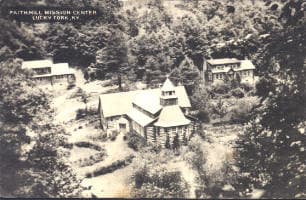
Faith Hill on Lucky Fork is not a preserved building frozen in time. In the southeast corner of Owsley County, the former mission church now works as a community center where families gather for funerals, weddings, reunions, and social events, carrying a 1932 story into daily county life.
From mission outpost to community landmark
Faith Hill began as a Christian mission site in 1932, established by Missionary Chester Ranck after he and Margaret Kane Ranck had already been talking about mission work in eastern Kentucky in the spring of 1931. Ranck’s own history traces the couple’s path from a Faith Mountain Mission invitation to time at Morris Fork, then to preparation for work at Lucky Fork after local people invited them to establish a presence there.
The original complex included a log church, a parsonage, and additional buildings, which gave the site a much broader function than a simple house of worship. That early layout helps explain why Faith Hill still carries so much local meaning: it was built to serve life in a small rural place, not to stand apart from it. Chester and Margaret Ranck were married on June 27, 1931, just before the work at Lucky Fork took shape.
Why the 1990s restoration mattered
The church did not survive on memory alone. Major restoration work began in 1991, starting with replacement of rotted logs, and the Baker family donated a new roof for the project. That repair effort turned the site into a visible example of what happens when former residents, descendants, and current neighbors decide a place still matters.
The volunteer list attached to Faith Hill shows how broad that effort was. Among the people named for leveling off the land were Paul Baker, Dan and Gail Caudill, Norma Thomas, Delcie Hall, Dot and Leroy Riley, Pat and Don Turner, Wayne Yeary, Lonnie Yeary, Wilson and Sherry Frazier, and Conley Baker. The work was not symbolic; it was physical, shared, and rooted in family names that still carry weight in Owsley County.
How Faith Hill serves people now
Faith Hill is described today as a multi-denominational facility, and that is the most useful way to understand its present role. It is used for funerals, weddings, and social gatherings, which means the site still marks the biggest moments in local family life as well as the ordinary ones. It serves Upper Buffalo and surrounding communities, keeping the building active as a place where people come together rather than only a place they pass by.

The property is managed by Faith Hill Community Inc., a nonprofit made up of former residents, descendants of original church members, and current Owsley County residents. That structure matters because it keeps decision-making in local hands and ties the site’s future to the same community memory that saved it. The Faith Hill pages also describe the site as a community center, not just a church, which reflects how its purpose has expanded while its identity has stayed rooted in the same hilltop setting.
A place where the past still gathers people
Faith Hill’s story is also visible in the kinds of events it hosts. The site includes photos of a recent first annual Baker reunion and Historical Society meeting, along with images of the manse, the church interior, and the organ inside the church. Those details show a place that is still being used, documented, and handed forward, not sealed off as a museum piece.
The site’s local history status reinforces that role. Faith Hill is listed among Owsley County historical locations and church histories, and that places it alongside other county landmarks that help define how residents remember themselves. In a county where churches have long been part of the backbone of community life, Faith Hill still functions as both a worship space and a memory bank.
Why this place carries extra weight in Owsley County
Owsley County has only 4,051 residents in the 2020 census, it was organized in 1843, and it was named for William Owsley, who later served as Kentucky governor from 1844 to 1848. In a county that small, one restored mission church can matter far beyond its walls. Faith Hill stands in the southeast corner of the county on Lucky Fork, in a place shaped by close kinship, shifting population, and the loss of everyday institutions.
Lucky Fork’s post office closed in June 1972, another sign of how much local geography has changed over time. Against that backdrop, Faith Hill offers continuity. It keeps a specific part of Owsley County visible, keeps family names attached to place, and gives residents a site where history is still used instead of merely remembered.
A local tourism page lists the Faith Hill Community Center as a point of interest on Lucky Fork Road and provides contact information for site visits, which adds another layer to its life as both heritage site and community landmark. For Owsley County, Faith Hill is not just something to preserve. It is a place that still gathers people, still carries names, and still helps define what Lucky Fork means today.
This article was produced by Prism’s automated news system from verified source data, official records, and press releases, then run through automated quality and moderation checks before publishing. The system is built and supervised by the people who set the standards it runs under. Read our full AI policy.
Did this article answer your question?