Delta Heritage Trail Connects Phillips County Communities Along 960-Acre Corridor
Arkansas trails secretary Shea Lewis pledged full completion of the nearly 85-mile Delta Heritage Trail, but two retrofitted railroad bridges still separate Phillips County from an unbroken $83M corridor.
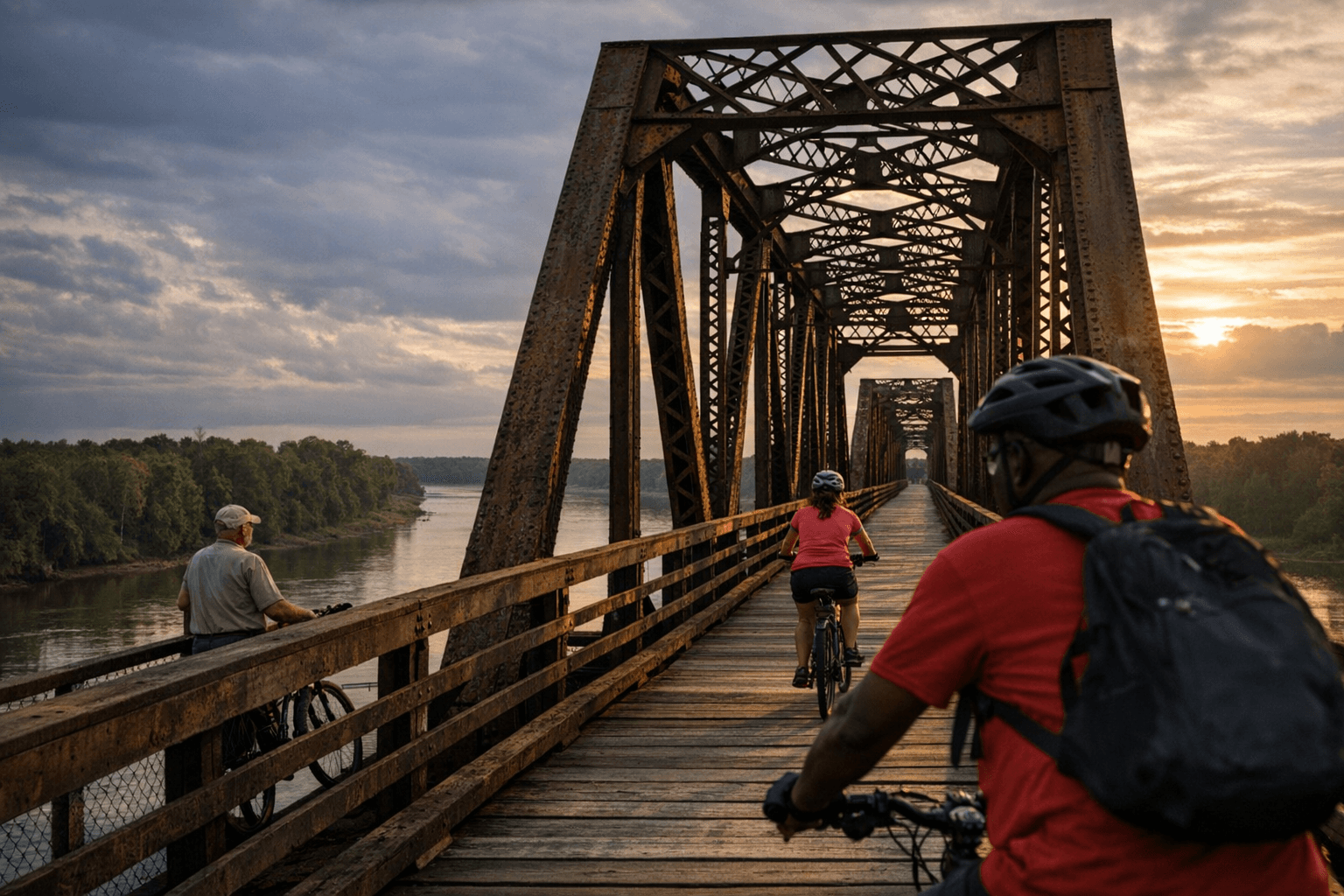
Arkansas Department of Parks, Heritage and Tourism Secretary Shea Lewis committed in December 2024 to full completion of the nearly 85-mile Delta Heritage Trail, and with 69.8 miles now open across ten trailheads, the agency stands two railroad bridge retrofits away from delivering on that promise to Phillips County residents. Those two crossings, the 0.72-mile Yancopin Bridge over the Arkansas River and the Benzal Bridge over the White River, represent both the final 14.7-mile gap in the corridor and the project's most expensive single engineering challenge in an $83 million buildout that began converting abandoned Union Pacific right-of-way in the early 1990s. A 2019 economic impact study projected $13 million in annual benefit to surrounding communities when the trail runs unbroken from Lexa to Arkansas City.
What the Trail Is and Who Runs It
The Delta Heritage Trail State Park encompasses 960 acres across Phillips, Desha, and Arkansas counties, laid out along a former Union Pacific freight corridor through the Mississippi Delta's agricultural flatlands. The Arkansas Department of Parks, Heritage and Tourism manages the park and owns the accountability for its phased construction, operating under a funding model that pairs competitive federal grants with state appropriations and private philanthropy. The total investment in awarded and completed contracts now exceeds $40 million; the final figure is expected to top $83 million.
Three funding pillars have driven the buildout. The Walton Family Foundation pledged a $20 million matching grant in 2020, tied contractually to full trail completion. The U.S. Department of Transportation awarded a $20.5 million RAISE grant for the final 13.4-mile section connecting Snow Lake through both river crossings to the southern corridor. A separate FY2021 RAISE grant funded the 36.4-mile middle section, with completion targeted by 2025. Together, these streams represent a three-way accountability structure between the state agency, the federal government, and a major private foundation with a contractual deadline.
Phillips County's Four Active Trailheads
Four trailheads serve Phillips County directly, each with distinct access infrastructure and character.
The Barton Trailhead near the northern corridor's anchor functions as the trail's civic and logistical center. The park's visitor center is located there, offering 24-hour restrooms (no showers), five primitive campsites with tent pads, picnic tables, standing grills, a community water spigot, a gift shop, and bike rentals. It is the most comprehensively developed public amenity on the entire 84.5-mile system and the primary entry point for visitors coming into Phillips County from the north.
Lake View's trailhead features a covered seating area facing Old Towne Lake, a cypress-filled remnant of an ancient Mississippi River channel that shifted course roughly 1,000 years ago. The 8.4-mile crushed-gravel segment from Lake View south to Elaine is one of the northern corridor's most traveled stretches, threading through bottomland hardwood forest and farmland with virtually no vehicular traffic competing for the corridor.
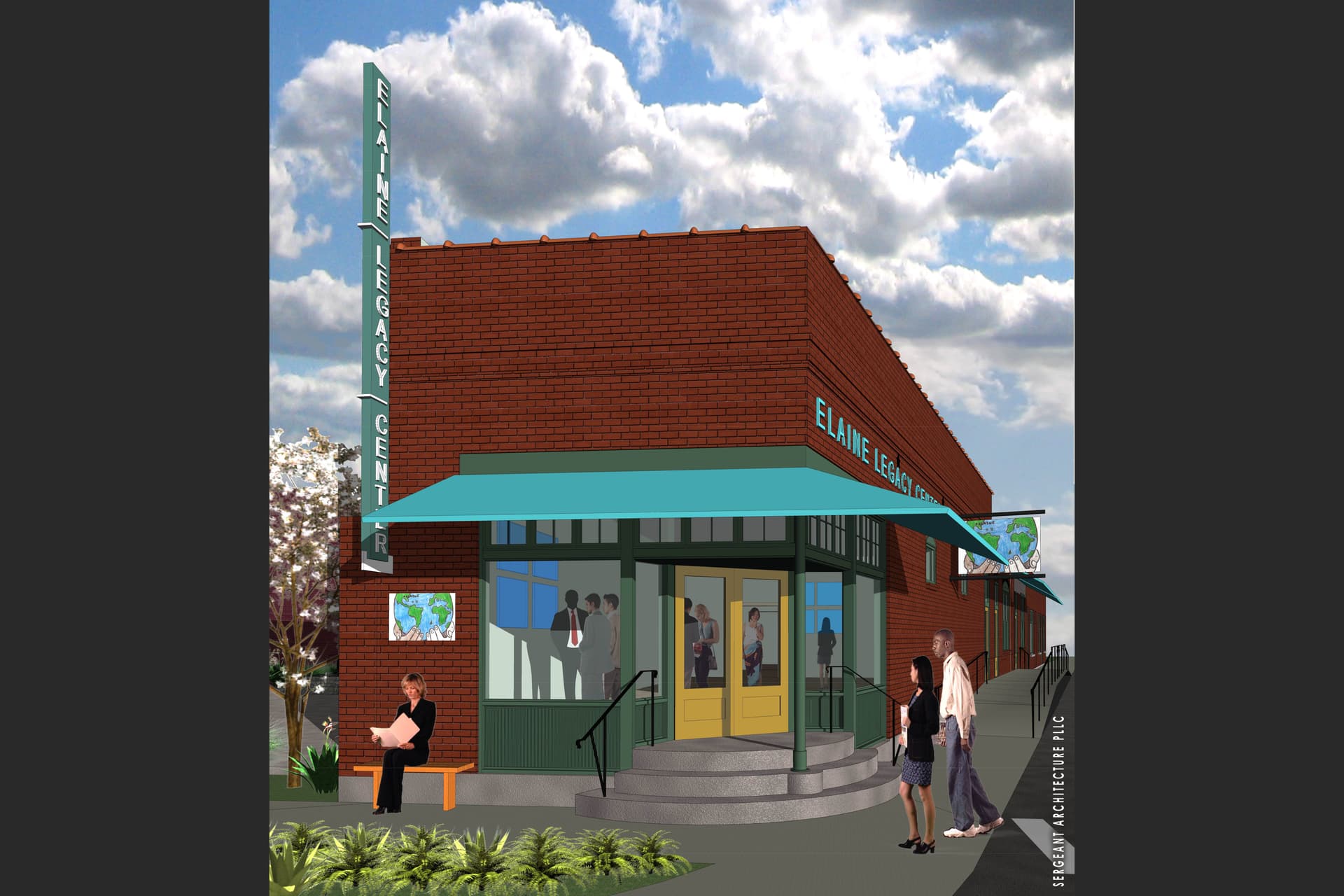
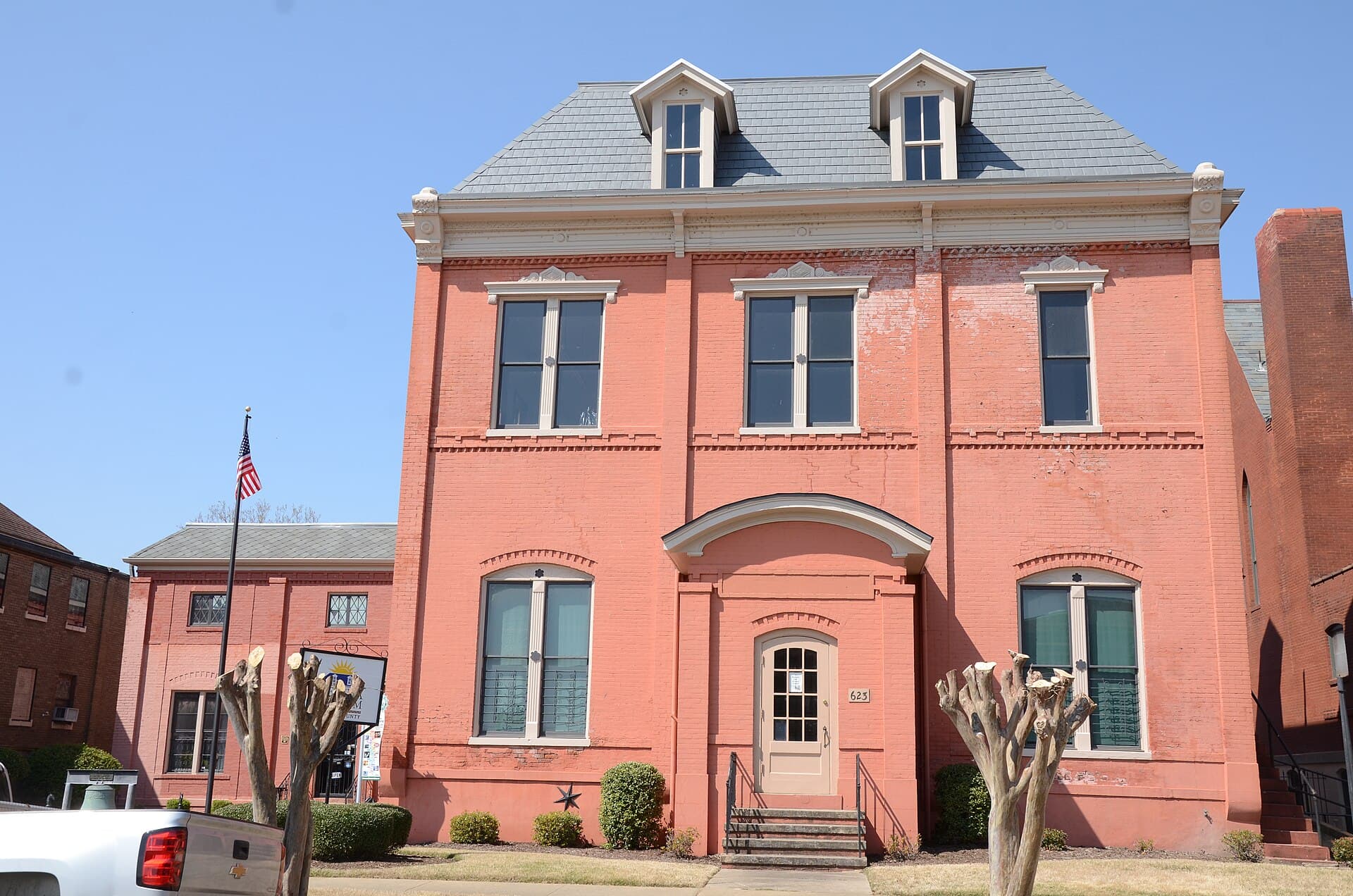
The Elaine Trailhead sits in downtown Elaine and carries more historical weight than any other stop on the trail. Restrooms, a bike repair station, a water fountain, and interpretive panels are available, along with a culturally significant willow tree planted as part of the community's memorial to the 1919 Elaine Massacre, one of the bloodiest episodes of racial violence in American history. A local nonprofit is actively constructing a museum directly across the street from the trailhead to interpret those events in depth. Trail users arriving in Elaine are, by design, arriving at a living civic memorial as much as a recreation node, a convergence that gives this stretch of the Delta Heritage Trail a purpose no comparable rail-trail project in the South can replicate.
The Mellwood Trailhead, the newest addition, opened when the nine-mile Elaine-to-Mellwood segment reached substantial completion in late 2024. That $3 million project, built by Mobley Contractors Inc. of Morrilton, extended the northern corridor's reach to the Phillips County southern boundary and added Mellwood to the list of trailheads with operating restrooms. Mellwood Grocery, adjacent to the trailhead, serves as an informal resupply point in an otherwise remote stretch, and has become one of the trail's few spots where cyclists encounter working rural commerce firsthand.
The Remaining Gap: What's Unfinished and Who Is Responsible
The accounting of what remains is precise. Of the 84.5 miles planned, 69.8 are open: 41.7 miles in the northern corridor from Lexa to Snow Lake, and 28.2 miles in the southern corridor from Yancopin to Arkansas City, including 15 miles of shared-use roadway on the Mississippi River Mainline Levee. The 14.7-mile gap between Snow Lake and Yancopin divides the trail into two disconnected halves and is the central accountability question for the Arkansas Department of Parks, Heritage and Tourism.
Design services manager Jordan Thomas authorized a notice to proceed for the $11.7 million Yancopin Bridge contract, the most expensive single contract in the project's history, covering the conversion of the 0.72-mile rail bridge for cyclists and pedestrians and associated trail surface work. A separate six-mile segment from Snow Lake to Mozart, funded through the FY2021 RAISE grant's Phase IX component, was moving through the bid process with construction anticipated for late 2024 and fall 2025 targeted for substantial completion. The Benzal Bridge over the White River is included in the final 13.4-mile contract and must be retrofitted alongside the Yancopin span. When both crossings open, trail users will be able to ride through a section where author Ernest Hemingway once hunted ducks between Rohwer and Yancopin, a fact the interpretive programming along the corridor is positioned to amplify.
Economic Stakes: The Numbers Behind the Buildout
The projected returns on this investment are not vague. A 2019 economic impact study commissioned for the project found that a completed trail would generate $13 million in annual benefit for surrounding communities, driven by tourism spending on transportation, lodging, food, and retail. Former Governor Asa Hutchinson, announcing the Walton Foundation grant at a Phillips County event, cited projections of $7 million in direct tourism revenue and 600 jobs tied to trail completion.
For the towns with active Phillips County trailheads, those numbers translate into specific gaps that still need to close. Trail users need places to stay overnight, eat, rent additional gear, and organize multi-day rides. Delta Hardware in Elaine and Mellwood Grocery at the Mellwood Trailhead already function as informal gathering points for cyclists, but neither represents the kind of deliberate tourism infrastructure that captures sustained visitor spending. The Elaine trailhead's proximity to the emerging 1919 museum, the Delta Cultural Center in Helena-West Helena, and the John H. Johnson Commemorative Plaza at the southern terminus in Arkansas City, honoring the Arkansas City-born founder of Ebony and Jet magazines, gives this corridor more interpretive density than almost any comparable trail in the region. Visitor spending follows interpretive assets when local businesses are ready to receive it.
Practical Access and Trail Conditions
Trail use is free. The visitor center at Barton rents bikes, making the trail accessible to visitors who arrive without equipment. Restrooms are available at Barton, Elaine, Mellwood, Snow Lake, Arkansas City, Watson, and Rohwer, giving users reliable sanitation infrastructure across both completed corridors. The trail surface throughout Phillips County is finely crushed gravel, suitable for hybrid and gravel bicycles as well as foot travel. AllTrails users consistently recommend April through September as the best visiting window; Delta wetland conditions can affect surface quality outside that range, and Arkansas State Parks advises checking the park's current trail map and any seasonal advisories before planning a trip.
Local chambers and regional partners, including Delta Magic, list organized rides and interpretive events tied to the trail, providing entry points for community groups and small businesses to host programming that draws visitors into Phillips County towns. The park's own Pedal and Paddle Tour packages combine trail cycling with water-based recreation, reflecting the broader multi-use vision of a corridor that runs through one of the most ecologically and historically rich landscapes in the American South.
What Phillips County Needs to Do Before the Bridges Open
The completion of the Yancopin and Benzal Bridge projects will trigger the trail's transition from a regional curiosity to a national-caliber cycling destination. Phillips County's economic development plans, wayfinding infrastructure, trailhead parking capacity, and small-business readiness programming need to be in place before that transition happens, not after. The communities best positioned to convert trail visitors into sustained local economic activity are the ones that treat the bridge completion date not as an endpoint for public investment, but as a starting gun for private and civic mobilization. The trail's $83 million buildout will have run its course; what Phillips County makes of it is the accountability question that follows the last bridge bolt.
Know something we missed? Have a correction or additional information?
Submit a Tip