Fisher, Blegay Host Public Safety Town Hall for County Residents
Prince George's had 100+ homicides four years in a row. Now stats are improving, but federal cuts threaten the safety and health programs meant to sustain the gains.
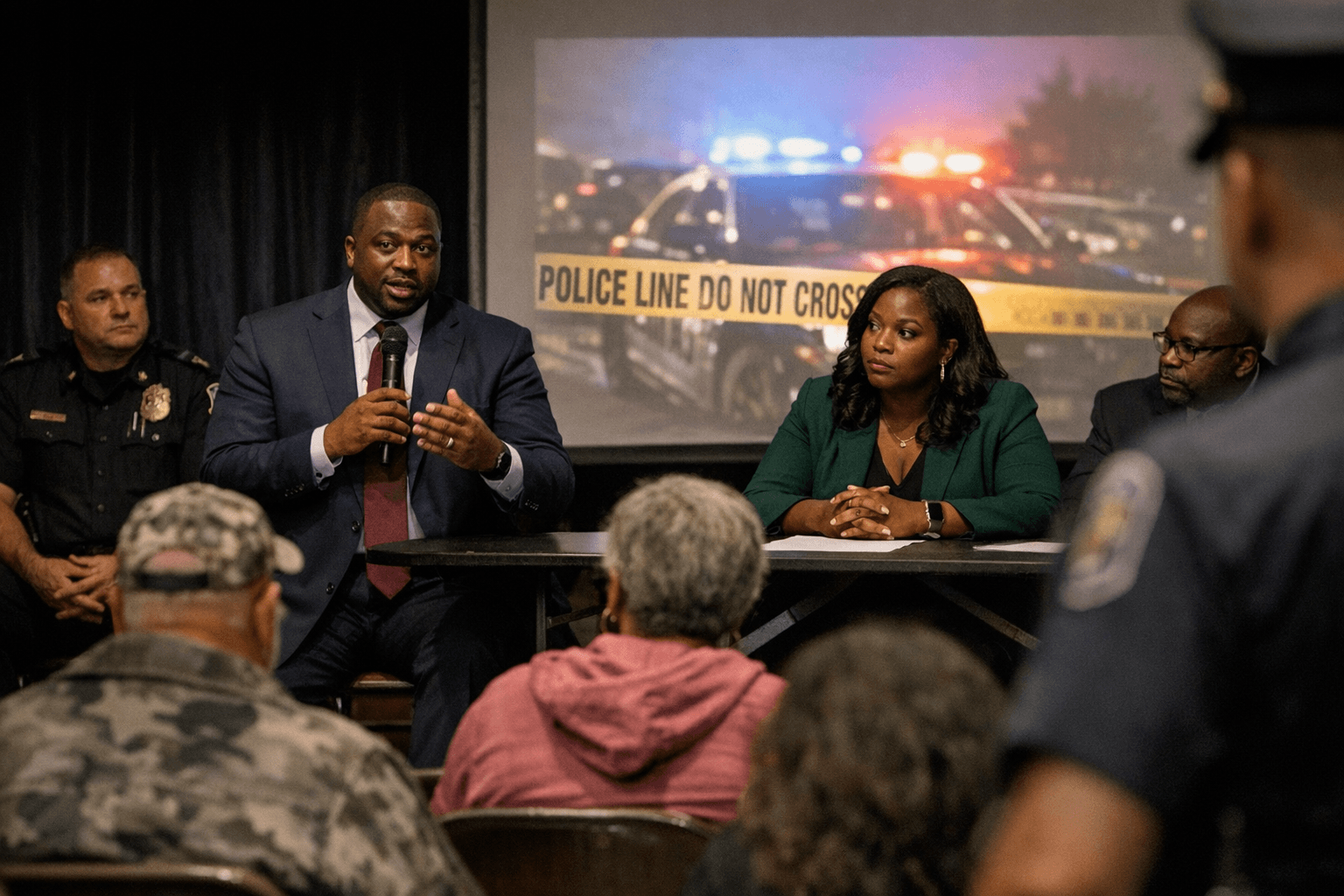
For four consecutive years, Prince George's County closed its books on more than 100 homicide investigations. That streak appears set to end. Whether residents actually feel the change in their daily lives was the central question Council Chair Wanika Fisher and Vice Chair Wala Blegay put before the community Sunday at their public safety town hall.
The numbers are legitimately striking. Homicides fell 41 percent through late 2025, with 58 confirmed compared to 99 at the same point in 2024, and a Washington Post analysis placed the county-wide total at 65 for the year, below Police Chief Malik Aziz's stated threshold for the first time since 2020. Carjackings dropped 57 percent over the same period. The county's latest police recruit class is also its largest in a decade.
But Chief Aziz has flagged the harder problem: when "the stats say one thing and you don't feel another," data alone cannot close the gap. That divide, between trendlines improving on paper and persistent anxiety in communities from Langley Park to Forestville, shaped the agenda Fisher and Blegay set for Sunday.
The unresolved pressure points are specific. Gun violence continues to fall disproportionately on young people; Prince George's recorded the second-highest number of firearm-related incidents in Maryland last year, and a county workgroup recommended mandatory mental health interventions for youth involved with gun violence, along with expanded trauma-informed services in schools. Those recommendations sit on paper. Residents at Sunday's event had standing to ask how many have been implemented and when the rest will follow.
Federal funding cuts added urgency to the conversation. Blegay, appointed in January to the at-large seat vacated by Calvin Hawkins, had been direct after taking office: "the budget is the biggest thing for 2026," she warned, citing "some of the federal programs that were funded by the feds that have been taken away." The county's FY 2026 public safety budget stands at $975.3 million, roughly 20 percent of total county spending, but that figure does not capture the health and social service programs now losing federal support, including the mental health response units and youth diversion programs that operate between 911 calls.
Fisher brought her own accountability dimension to the event. As chair of the Health, Human Services and Public Safety Committee and a candidate for Prince George's County State's Attorney, she launched her prosecutorial campaign in October around criminal justice and public safety reform. With incumbent State's Attorney Tara Jackson having held her own public safety town hall in December, Sunday's gathering served as a contrast moment, a chance for Fisher to demonstrate constituent-level accountability before election-year competition sharpens further.
For the town hall to produce something more than civic ritual, officials face pressure to put commitments on the record. The county held a Mental Health Town Hall in November 2023; how thoroughly that follow-through was realized will frame how residents receive Sunday's promises. Governor Wes Moore's preliminary 2025 statewide data, showing homicides at their lowest in nearly 40 years, provides welcome context. But context does not replace a data release schedule, a staffing breakdown for the new recruit class, a timeline on youth mental health services, or a public accounting of which federally funded programs are being cut and what, if anything, fills the gap.
This article was produced by Prism’s automated news system from verified source data, official records, and press releases, then run through automated quality and moderation checks before publishing. The system is built and supervised by the people who set the standards it runs under. Read our full AI policy.
Did this article answer your question?