Stadium authority disputes county claims on Largo Civic Plaza shutdown
The Maryland Stadium Authority says a county official gave inaccurate information about Largo Civic Plaza as the fenced-off site heads toward a redesign. The fight now centers on who controls the $10 million public space.
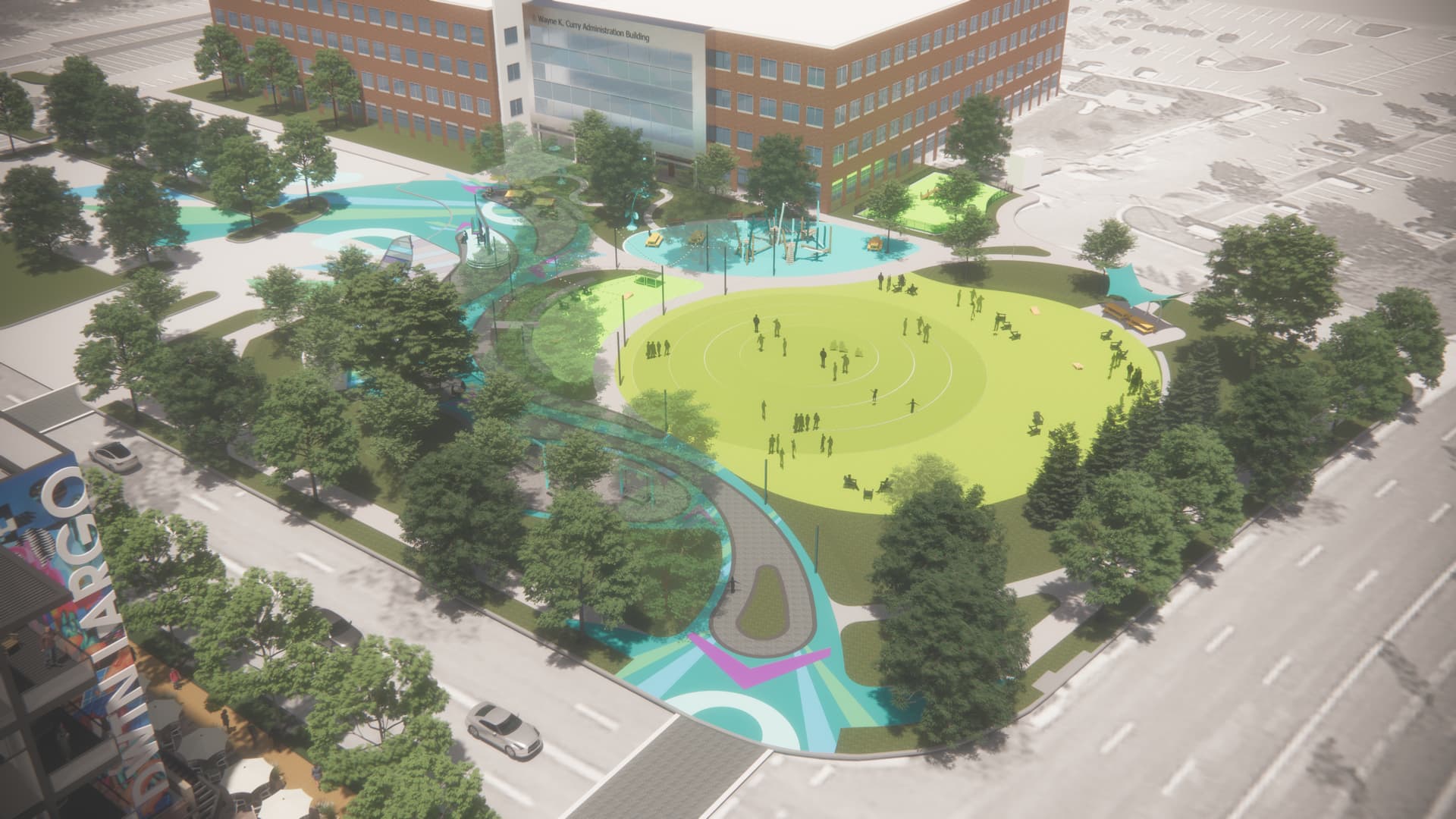
The Maryland Stadium Authority has pushed back on Prince George’s County’s handling of Largo Civic Plaza, saying a county official gave inaccurate information about the project as the public space remained fenced off near the Wayne Curry Administration Building.
The dispute has turned a $10 million plaza into a test of control over one of the county’s most visible public investments. Substantially completed in December 2025, the site was later shut off from public use even though it was designed as a civic destination with a stage, playground, game area, art walk and dog park.

Largo Civic Plaza is the first phase of the larger $400 million Blue Line Corridor Project, a redevelopment plan tied to the Largo, Garrett Morgan Boulevard, Addison Road-Seat Pleasant and Capitol Heights Metro stations. When county and state leaders broke ground on the project April 9, 2025, they said the corridor could draw as much as $2 billion in investment.
County officials under County Executive Aisha Braveboy say the plaza has safety, liability and accessibility problems. They have cited concerns about some of the play equipment, the absence of restrooms and a wheelchair ramp that was reportedly paved over during construction. The county says the site will be “redesigned and reimagined,” and that the play equipment will be removed and donated to a nonprofit.
Artist and designer Graham Coreil-Allen, who helped create the plaza and a 14,000-square-foot mural, has rejected the county’s safety claims. He said there were no design or equipment problems and argued that the fence should come down so residents can use the public space as intended. He also warned that county officials are wrongly treating artwork as graffiti and could damage his “Free Speech Frame” sculpture.
David Byrd, director of Prince George’s County’s Office of Central Services, said the current administration had no role in the original project and is preparing discussions with county agencies and community members about what should happen next. He said those talks could include ways to honor historical figures in the county through images or names on bricks.
The county has described the Civic Plaza at WKC as its first-ever project with the Maryland Stadium Authority, made possible through state Blue Line Corridor funding and years of planning under former County Executive Angela Alsobrooks. Now, with the plaza fenced off beside county government offices and the public process still unsettled, the question is whether a finished civic asset can be rewritten before residents ever get to use it.
This article was produced by Prism’s automated news system from verified source data, official records, and press releases, then run through automated quality and moderation checks before publishing. The system is built and supervised by the people who set the standards it runs under. Read our full AI policy.
Did this article answer your question?