Marks Amtrak Station Connects Quitman County to Regional Rail, Delta Tourism
Marks' Amtrak station took nearly two decades and $1.2 million to build — now it links one of Mississippi's poorest counties directly to New Orleans and Chicago.
Twenty years of work by Quitman County civic leaders came to a close on the morning of May 4, 2018, when the northbound City of New Orleans pulled into downtown Marks for the first time as a scheduled stop. The station, designated MKS in Amtrak's system, sits on the City of New Orleans route and gives Quitman County its only direct passenger-rail connection to the broader regional network.
Two Decades of Civic Effort
Before Amtrak arrived, Marks had no passenger rail service at all. The Illinois Central Gulf railroad never operated passenger trains through the town, leaving Quitman County without a station of any kind. That absence shaped the long push for a stop, which the Clarksdale Press Register first covered in July 1999 when reporter Diane Harris-Donnelly wrote that county leaders hoped train service would begin that September. By October 13, 1999, the Associated Press reported in the Greenwood Commonwealth that Amtrak had added Marks as a flag stop, and the City of Marks and Quitman County spent $79,500 to build a platform with wheelchair access and a glass-and-steel "Amshack" structure to mark the occasion.
That early stop, however, did not lead quickly to a permanent facility. Mississippi Senator Roger Wicker met with Canadian National Railway officials in 2010 to negotiate a more durable arrangement, since CN owns the tracks Amtrak uses through that corridor. Five years of negotiations followed, and in 2015 Senator Wicker announced that Quitman County, Amtrak, and Canadian National had reached an agreement to establish a permanent stop in Marks. The Panolian reported a groundbreaking on October 11, 2016, and Quitman County issued a press release on April 10, 2018 announcing a ribbon cutting for what it called "the Newest Northwest Mississippi Regional Amtrak Station."
A $1.2 Million Station, Built on Layered Grants
The finished project cost approximately $1.2 million, assembled from multiple funding sources. The largest single contribution was a $500,000 grant from the Federal Highway Administration, appropriated through the Mississippi Department of Transportation. Quitman County was responsible for a 20 percent local match, which it secured through two additional grants: $150,000 from the Mississippi Development Authority and $300,000 from the Delta Regional Authority. Together those two grants total $450,000, covering and exceeding the local match requirement, though the precise reconciliation of the full $1.2 million project budget across all funding sources is not fully detailed in available records and warrants confirmation with MDOT, MDA, and DRA directly.
The layered funding structure reflects both the ambition and the challenge of bringing infrastructure investment to one of the country's most economically stressed regions. Quitman County consistently ranks among the poorest counties in Mississippi and in the nation, making federal and regional grant programs the practical pathway to a project of this scale.
What the Station Looks Like
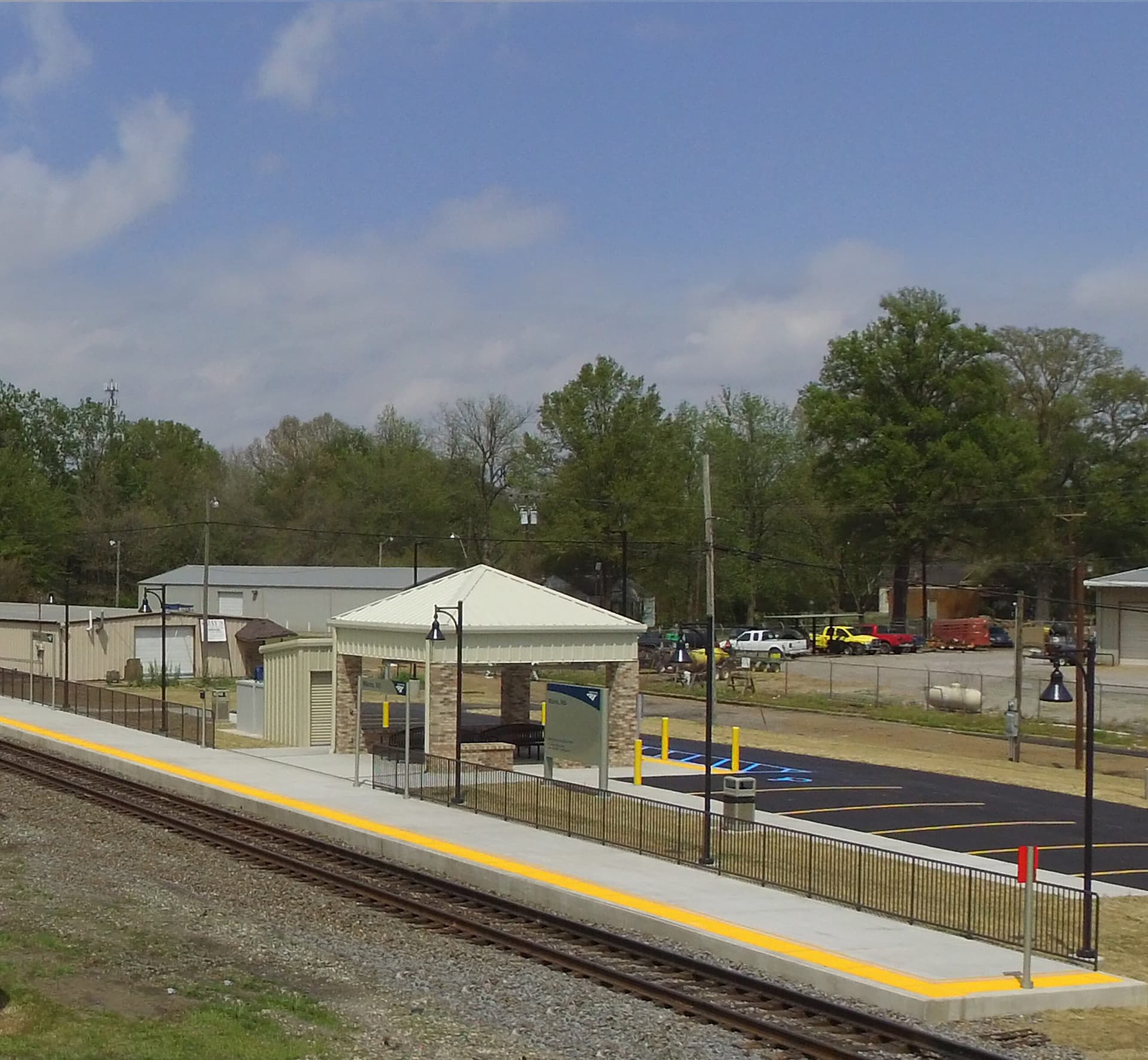
The finished station is a modest but carefully designed facility. A fully accessible concrete platform runs alongside the track, sheltered by an open-air structure with benches and heating elements for passengers waiting in colder months. The shelter's architectural details give it a sense of permanence: square piers of buff-colored brick support a hipped, seamed metal roof, and light standards lining the platform cast what Amtrak's station profile describes as "a bright, welcoming light."
The station sits in downtown Marks, within walking distance of the domed Quitman County Courthouse. That central location means arriving passengers step directly into the county seat rather than onto an industrial rail siding. The image Amtrak uses to represent the station on its profile page was provided courtesy of Quitman County, a small detail that reflects the local investment in the project's identity.
What Riders Should Know Before They Go
The Marks station operates as a flag stop with no on-site staff and a limited set of services. Travelers planning a trip through MKS should be aware of several practical realities:
- There is no ticket office at this location. Tickets must be purchased in advance through Amtrak's website, app, or phone line.
- There is no station waiting room. The open-air shelter provides the only covered waiting space on the platform.
- There is no passenger assistance service at this location. Travelers who require boarding assistance should contact Amtrak in advance to arrange support.
- Checked baggage service is not available at Marks. Passengers should plan to carry all luggage on board themselves.
- Parking details are listed as a category on Amtrak's station profile but specific hours and capacity have not been publicly detailed in available documentation.
Sources describe the station using both "flag stop" and "permanent stop" language, and the distinction matters operationally. Historically, a flag stop requires passengers to signal the train or notify Amtrak in advance that they intend to board. The 2018 construction established a permanent physical facility, but whether the stop now functions as a fully scheduled stop in every Amtrak timetable cycle is a detail worth confirming directly with Amtrak before booking.
Delta Heritage and Tourism
The station was never conceived purely as a commuter facility. According to Amtrak's own station profile, the project was "part of a local effort to improve travel options for residents of the Mississippi Delta and encourage tourism in the area." The language is pointed: Quitman County and the broader Delta region sit at the center of American cultural history in ways that draw visitors from well outside Mississippi.
The area's heritage tied to the Civil Rights Movement runs deep, and Marks itself has specific significance: the town is where Dr. Martin Luther King Jr. witnessed poverty that moved him to tears during the planning of the 1968 Poor People's Campaign, and where the campaign's mule train began its journey to Washington, D.C. That history, combined with the Delta's foundational role in the development of blues, country, and rock music, gives the region a cultural draw that rail access can help activate.
Beyond cultural tourism, northwest Mississippi's rivers, forests, and wetlands offer outdoor recreation that Amtrak's profile explicitly highlights: fishing, hunting, and wildlife observation. The station puts those resources within reach of passengers traveling the Chicago-to-New-Orleans corridor without a car.
An Open Question on Ridership
Amtrak publishes an annual fact sheet for the State of Mississippi, and the fiscal year 2025 edition is cited in public records related to the Marks station. However, station-level ridership figures for MKS are not available in current public documentation. Understanding how many passengers actually use the Marks stop would provide the clearest measure of whether the two decades of civic effort and the $1.2 million investment are generating the travel and tourism activity the project was designed to produce. That data is worth requesting directly from Amtrak.
What is already clear is the structure of what was built: a county with no passenger rail history assembled a coalition of federal, state, and regional funders, negotiated directly with a private freight railroad, and put a permanent station in the heart of downtown Marks. The City of New Orleans now stops there twice daily, connecting Quitman County to Chicago in one direction and New Orleans in the other.
This article was produced by Prism’s automated news system from verified source data, official records, and press releases, then run through automated quality and moderation checks before publishing. The system is built and supervised by the people who set the standards it runs under. Read our full AI policy.
Did this article answer your question?