Quitman County promotes heritage, blues and civil rights tourism
Marks is selling more than a stop on the map: Quitman County ties the Mule Train, blues and Delta history into one visitor story.
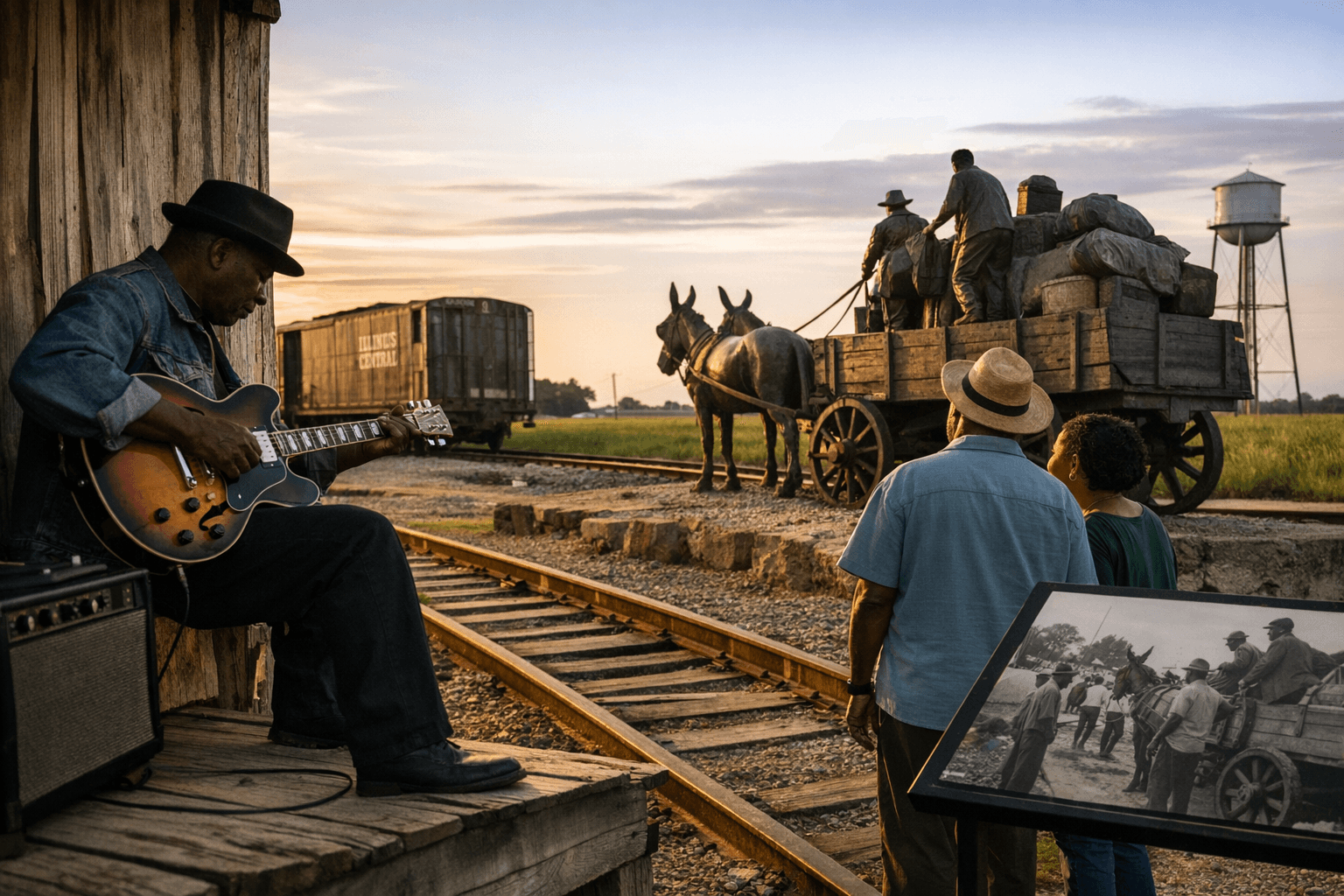
A county story built around memory and movement
Marks is at the center of Quitman County’s tourism pitch, and the county is using a surprising mix of history and culture to define itself. Its visitor pages place the county inside the Mississippi Delta National Heritage Area and describe a place where blues legends, country music greats, archaeological treasures, civil rights icons and Delta farmland all sit in the same frame.
That matters because the county is not just promoting places to see, it is telling residents what kind of place Quitman County says it is. In that self-portrait, the county is more than a seat of local government. It is a place where history is supposed to be visible, usable and part of the local economy.
The county’s own history page deepens that message. Quitman County was created in 1877 from parts of Tunica, Coahoma, Panola and Tallahatchie counties, and it was named for General John A. Quitman. Its original county seat at Hill’s Landing was later renamed Belen, a detail that gives the county’s past a wider geographic reach and a reminder that local place names often carry national history with them.
The Mule Train gives the county its strongest civil rights anchor
No part of Quitman County’s tourism identity is more powerful than the story of the Mule Train. The county says the first Mules & Blues Fest was held in 2015, tying a community event to one of the defining civil rights episodes connected to Marks. The festival links the Mule Train, Martin Luther King Jr.’s Poor People’s Campaign, the Mississippi Blues Trail and the Mississippi Freedom Trail, which makes it both a celebration and a public memory project.
The numbers make the story even more striking. In 1968, 115 Quitman County residents left Marks as part of the Mule Train, and the county says the train reached Washington, D.C., on June 19, 1968, where it joined the larger protest on the National Mall. That connection gives Marks a place in the national civil rights story that is far beyond county lines.
Quitman County has also worked to make that history visible on the ground. Marks was selected in 2011 by the Mississippi Freedom Trail Task Force from more than 200 sites as one of 30 Mississippi locations to receive a historical marker, and that marker was erected in Marks on October 2, 2015. For a county trying to shape how outsiders understand it, the marker turns memory into a fixed stop, not just a story told once a year.
Blues, Delta culture and the county’s wider visitor pitch
The county’s tourism pages do not rely only on civil rights history. They also frame Quitman County as a place of music, outdoor life and agricultural landscape, which gives the visitor story a broader Delta identity. That approach matters because it suggests the county wants travelers to see more than one layer of local life: not only marches and markers, but also the music, land and traditions that have shaped the place for generations.
The county describes itself as a sportsman’s haven, pointing to hunting, fishing and outdoor recreation as part of the local identity. Combined with the county’s references to the Mississippi Delta National Heritage Area, that positions Quitman County as a place where landscape and culture are inseparable. It is a deliberate blend of recreation and remembrance, one that tries to make the county attractive without flattening its history.

The county homepage’s list of attractions is broad enough to signal that Quitman County is trying to claim a larger place in Delta tourism. By putting blues legends, country music greats, archaeological treasures, civil rights icons and the Delta’s agricultural legacy in the same conversation, the county is inviting visitors to see the area as layered rather than single-purpose. That can help preserve pride in the county’s past, but it also raises a subtle question: whose version of the story gets centered when a place turns itself into a destination?
How visitors get there and what that could mean downtown
One practical advantage for Quitman County is that visitors do not have to rely only on cars. Amtrak says the Marks station has had City of New Orleans service since 2018, and the station is on Cherry Street. That gives the county a concrete transportation link that can help turn tourism from an idea into actual foot traffic.
For a small county, that matters. More visitors arriving for the Mule Train story, the Freedom Trail marker, the festival or the broader Delta landscape could mean more activity around Marks and more reason to keep historic sites presentable, interpreted and open. It can also strengthen the case for preserving places that might otherwise fade into the background, because heritage sites are easier to protect when they are part of an active visitor route.
Tourism can also be a form of civic recognition. When people come to Marks to learn about the Mule Train or to connect the county to blues and Delta history, they are not just spending a day in a rural county. They are acknowledging that Quitman County helped shape national conversations about justice, music and memory.
A small county telling a bigger version of itself
The county’s population figures give that effort even more context. The U.S. Census Bureau says Quitman County had 6,176 residents in the 2020 Census, and the estimate for July 1, 2025, is 5,364. The county is 73.1% Black alone and 24.4% White alone, numbers that help explain why civil rights memory is not an add-on here, but part of the lived identity of the place.
That shrinking population also underscores why tourism can matter beyond weekend visits. In a county of this size, a stronger heritage visitor economy can support local pride, help keep stories alive and create practical reasons to maintain landmarks tied to the Mule Train, the Freedom Trail and the county’s older settlement history. The larger test is whether longtime residents see the county’s tourism narrative as their own story, accurately told, or as a polished version meant mainly for outsiders.
Quitman County’s tourism pages suggest an answer they want visitors to hear clearly: the county’s identity is not divided between history and everyday life. It is built from both, and the task now is making sure that the story being sold to the outside world still reflects the people who have lived it.
This article was produced by Prism’s automated news system from verified source data, official records, and press releases, then run through automated quality and moderation checks before publishing. The system is built and supervised by the people who set the standards it runs under. Read our full AI policy.
Did this article answer your question?