How Maine’s ranked-choice runoff turned a long primary into final results
Maine’s ranked-choice count kept Sagadahoc County waiting for final answers, and House District 49 showed how a 6-vote margin can still require a full manual review.

Maine’s June 9 primary did not end when the polls closed. The final answer on several close races took more than five days to emerge from the Maine Department of Public Safety headquarters in Augusta, where ranked-choice tabulation kept resetting the count until one candidate crossed a majority. For Sagadahoc County voters, that delay was not abstract: the same system that settled the Democratic governor’s race also ended with Suzanne Andresen ahead of Nicolas Hamlin by 608 votes to 602 in House District 49.
Why election night was only the beginning
The reason the count stretched so long was simple: no candidate in the key statewide races cleared the threshold on the first tally. Once that happened, Maine’s ranked-choice system started doing what it is designed to do, eliminating the lowest finisher, re-sorting those ballots to the next available choice, and repeating the process until one candidate held a majority of the active ballots. That sequence played out in Augusta while campaigns, state officials, and newsrooms waited for the rounds to finish.
The broadest picture was not fully clear until around 1:40 a.m. Friday, after the counting delays had pushed final results well beyond election night. For voters who only saw early returns, the shift could look abrupt. In reality, the race was moving through a set of rules that are meant to reward second and third choices as much as first-place finishes.
How a ranked-choice ballot moves through the count
A ranked-choice ballot can change meaning as candidates drop out. That is why a first-choice lead on election night does not guarantee a win, and why a ballot can keep working long after the first count.
1. The first-choice votes are counted.
2. If no one reaches a majority, the candidate with the fewest votes is eliminated.
3. Each ballot for that eliminated candidate is sent to the voter’s next still-active choice.
4. The count repeats until one candidate has a majority.
In the Democratic governor’s race, that process is what allowed Hannah Pingree to overtake Nirav Shah after multiple rounds. A ballot that began with an eliminated candidate did not disappear; it moved to the next preference still in the running. That is the practical difference between a plurality count and ranked-choice tabulation, and it is why election-night returns can be only a first look.
Pingree’s win showed the system at work
The final tabulation gave Pingree 56.2 percent to Shah’s 43.8 percent in the Democratic gubernatorial runoff. That margin did not appear in the first wave of results, because the contest needed several rounds of redistribution before the winner was clear. Pingree later addressed supporters at her campaign headquarters in the 449 Forest Ave. shopping plaza in Portland after the result was announced.
That race became the clearest statewide example of how ranked-choice voting can change the shape of a contest after midnight. The leader at the first count is not always the nominee once lower-finish ballots are reassigned, and Pingree’s path to the nomination made that visible to anyone following the count hour by hour.
Why Sagadahoc County voters should care
House District 49 offered a local version of the same lesson. Suzanne Andresen was confirmed as the Republican nominee after a recount, defeating Nicolas Hamlin 608-602. A six-vote margin is the kind of result that keeps attention fixed on every ballot, especially in a county where small shifts can decide a nomination.
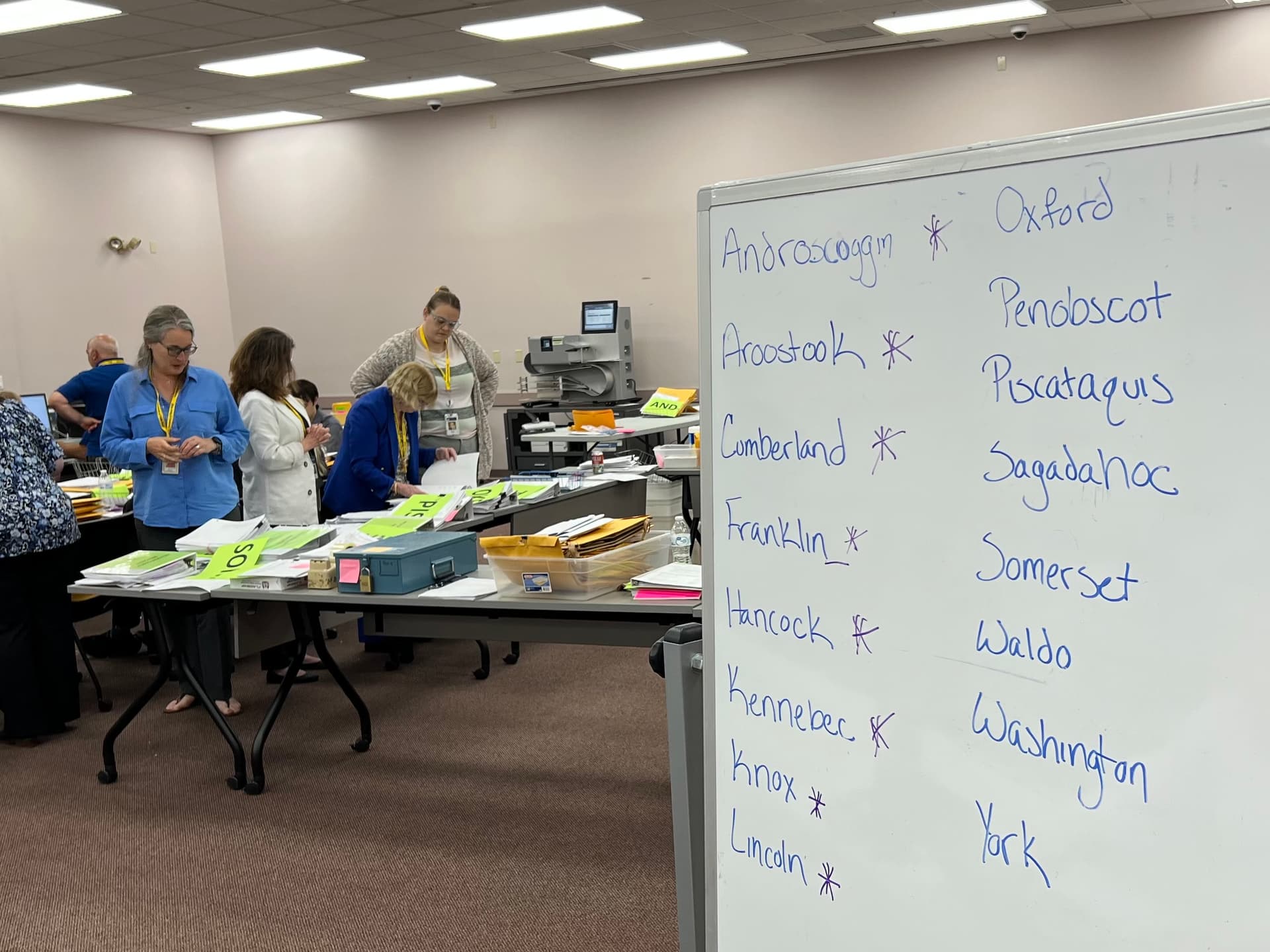
Maine law makes that process deliberate. Title 21-A, Section 737-A requires recounts to be a manual review of each paper ballot by representatives of the candidates and staff from the Secretary of State’s office. That is not a quick rerun of the night’s tally. It is a hands-on check of the paper record, which is why even a non-ranked-choice local race can take additional time before the result is locked in.
The same slow certainty mattered elsewhere too. Lisa Pratt was confirmed in House District 135, another example of how close primaries can remain unsettled until the paper ballots are reviewed and the final math is complete. In practice, the state’s election system asks voters to trust a process that values precision over speed.
What changed since Maine adopted ranked-choice voting
Maine voters approved ranked-choice voting in 2016, and the system was first used in the June 12, 2018 primary election. Later legislation clarified how the law works, giving the state a more defined framework for primaries that move into tabulation after the first count. The 2026 primary was the first time three statewide or congressional primary races moved on to ranked-choice tabulation in Maine, surpassing the previous record of two in 2018.
The official Secretary of State results page showed ranked-choice tabulation materials for the Democratic and Republican gubernatorial primaries, the Democratic U.S. House District 2 primary, and Republican House District 58 materials. That breadth matters because it shows the runoff system was not limited to one marquee contest. It was carrying multiple races at once, including the Democratic nomination in Maine’s 2nd Congressional District, where State Auditor Matt Dunlap overtook Sen. Joe Baldacci after ranked-choice tabulation.
For Sagadahoc County, the practical lesson is the one voters already saw in House District 49: early returns are not the final word when the margin is narrow. Ranked-choice voting, and the manual recounts that can follow it, are built to produce a winner that survives more than one count.
This article was produced by Prism’s automated news system from verified source data, official records, and press releases, then run through automated quality and moderation checks before publishing. The system is built and supervised by the people who set the standards it runs under. Read our full AI policy.
Did this article answer your question?