Woolwich exhibit by Josefina Auslender explores memory, reinvention, artistic truth
Josefina Auslender’s Woolwich show gives Sagadahoc readers a local way into a larger story about memory, migration and what art can make feel true.
Why this Woolwich stop belongs on your weekend list
At Sarah Bouchard Gallery in Woolwich, Josefina Auslender’s *La Chimera del Oro* gives Sagadahoc County a show that feels intimate on the wall and much larger in meaning. The exhibition runs April 11 through May 17, 2026, and it arrives as Auslender’s second solo presentation with the gallery, making it a repeat visit worth paying attention to rather than a one-off appearance. For anyone deciding where to spend an afternoon in Midcoast Maine, this is the kind of local stop that connects a small town gallery to questions about memory, migration and artistic truth.
A Woolwich show with a bigger Maine frame
The strongest reason to make the drive is that Woolwich is not hosting this work in isolation. Bowdoin College Museum of Art in Brunswick is showing *Josefina Auslender: Drawing Myself Free*, the first museum retrospective ever devoted to the artist, through May 31, 2026. That means the Woolwich exhibition functions as a companion piece, not just a separate display. You can see how the gallery setting sharpens the scale and intimacy of Auslender’s work while the museum survey gives the wider arc of her career.
That pairing matters because it turns a local gallery visit into part of a larger cultural moment in Maine. Auslender is Argentine-born, born in Buenos Aires in 1934, and secondary coverage says she moved to the United States in the 1980s before settling in Cape Elizabeth in 1991. The Bowdoin show centers migration, memory and personal experience, and the Woolwich show picks up those same concerns in a more concentrated setting. For readers who know the geography of Sagadahoc, Brunswick and Cape Elizabeth, that regional triangle gives the story a real Maine shape.
What Auslender is showing now
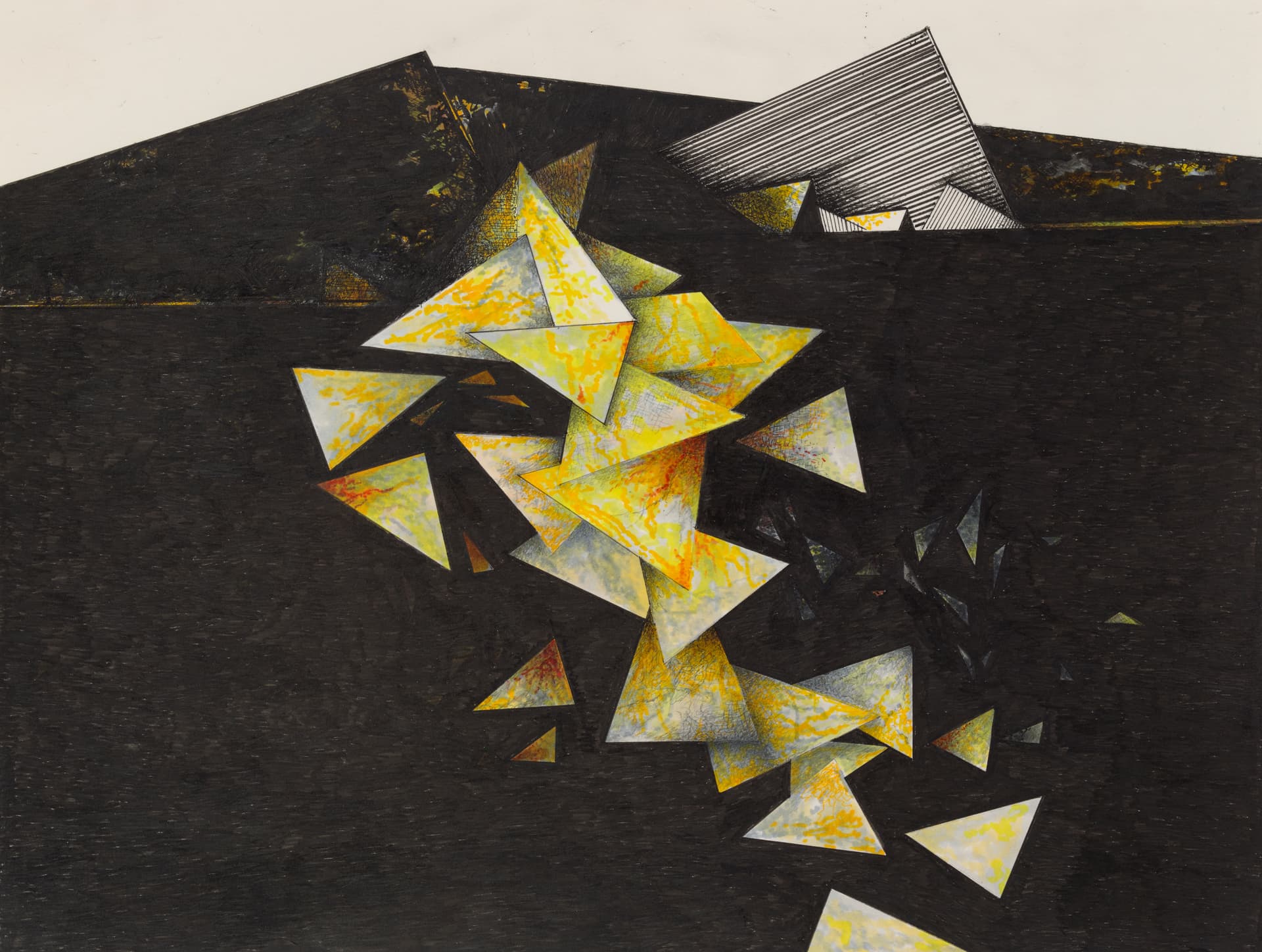
Sarah Bouchard Gallery says *La Chimera del Oro* includes new work in ink alongside a selection of graphite drawings from Auslender’s time in Argentina. The gallery also describes the series as one that introduces a distinctive realm of color and line, with gold, yellow, orange and white expanding her signature visual language. That makes the work look immediate, but not superficial: the gallery says the series questions the illusions of success and emphasizes fortitude and independence as an artist.
The review of the Woolwich show says Auslender revisits recurring motifs from earlier series and transforms them rather than repeating them. Those motifs include architectural forms, stripped-down human figures and gold-toned geometric elements that give the work its title and visual identity. That combination gives the exhibition its tension. It is rooted in recognizable shapes, yet it keeps pushing them toward something less fixed, as if the drawings are asking how much of identity is inherited and how much is made again over time.
For viewers, that is the key thing to watch for in the gallery. Auslender is not using ornament just to decorate a wall. She is building a visual language that asks what survives reinvention, what gets polished into success, and what remains stubbornly personal underneath.
Why the Bowdoin retrospective changes the Woolwich visit
The Bowdoin exhibition adds weight to the Woolwich show in a way that should matter to local visitors. Bowdoin says its retrospective is the first-ever museum survey of Auslender’s drawings and includes more than 80 works, while other coverage puts the total above 90 and even above 100. Either way, the number signals depth. This is not a quick look at a rising name. It is a major institutional recognition of an artist whose career has spanned decades and countries.
That scale changes how the Woolwich show reads. In the gallery, you are seeing an artist’s ideas in a more concentrated, almost conversational form. At Bowdoin, you see how those ideas stretch across time, migration and repeated experimentation. The museum opening also drew students and community members, a reminder that Auslender’s work is not only for specialists. It has enough reach to bring in people who simply want to understand why a drawing can hold history.
For Sagadahoc readers, that is the practical payoff. You can make one local art outing and come away with two different ways of seeing the same artist. In Woolwich, the work feels close and immediate. In Brunswick, it feels archival and expansive. Together, they show how a Maine artist can live in both a neighborhood-scale gallery and a museum-scale argument at the same time.
What viewers are likely to talk about after leaving
The most memorable part of this exhibition pair is not just that Auslender is being shown in two places at once. It is that both shows press the same central questions from different angles: What does an artist owe memory? How much does place shape the way a body or a building is remembered? When does repetition become reinvention instead of habit?
The Portland review places Auslender alongside another non-American artist, which helps explain why the Woolwich show feels connected to a broader conversation rather than isolated from it. Maine galleries are not simply filling walls. They are presenting international voices in a way that makes the local scene feel part of a wider cultural map. That is part of what gives *La Chimera del Oro* its charge in Woolwich: it is unmistakably rooted in one gallery, one county and one artist’s career, but it is speaking to questions that travel well beyond Sagadahoc.
If you go, expect to leave talking less about a single image than about the way Auslender uses line, shape and color to test what art can preserve. In a season when Bowdoin is giving her the first museum retrospective of her drawings and Sarah Bouchard Gallery is showing the companion chapter, Woolwich has become an unusually good place to think about how truth in art is made, revised and remembered.
This article was produced by Prism’s automated news system from verified source data, official records, and press releases, then run through automated quality and moderation checks before publishing. The system is built and supervised by the people who set the standards it runs under. Read our full AI policy.
Did this article answer your question?