18 Years Later, Teen Reunites With UCSF Doctor Who Saved Him Before Birth
A hole in his diaphragm nearly killed Mason Ellinger before he was born. At 18, he flew from Michigan to thank the UCSF surgeon who fixed it in the womb.
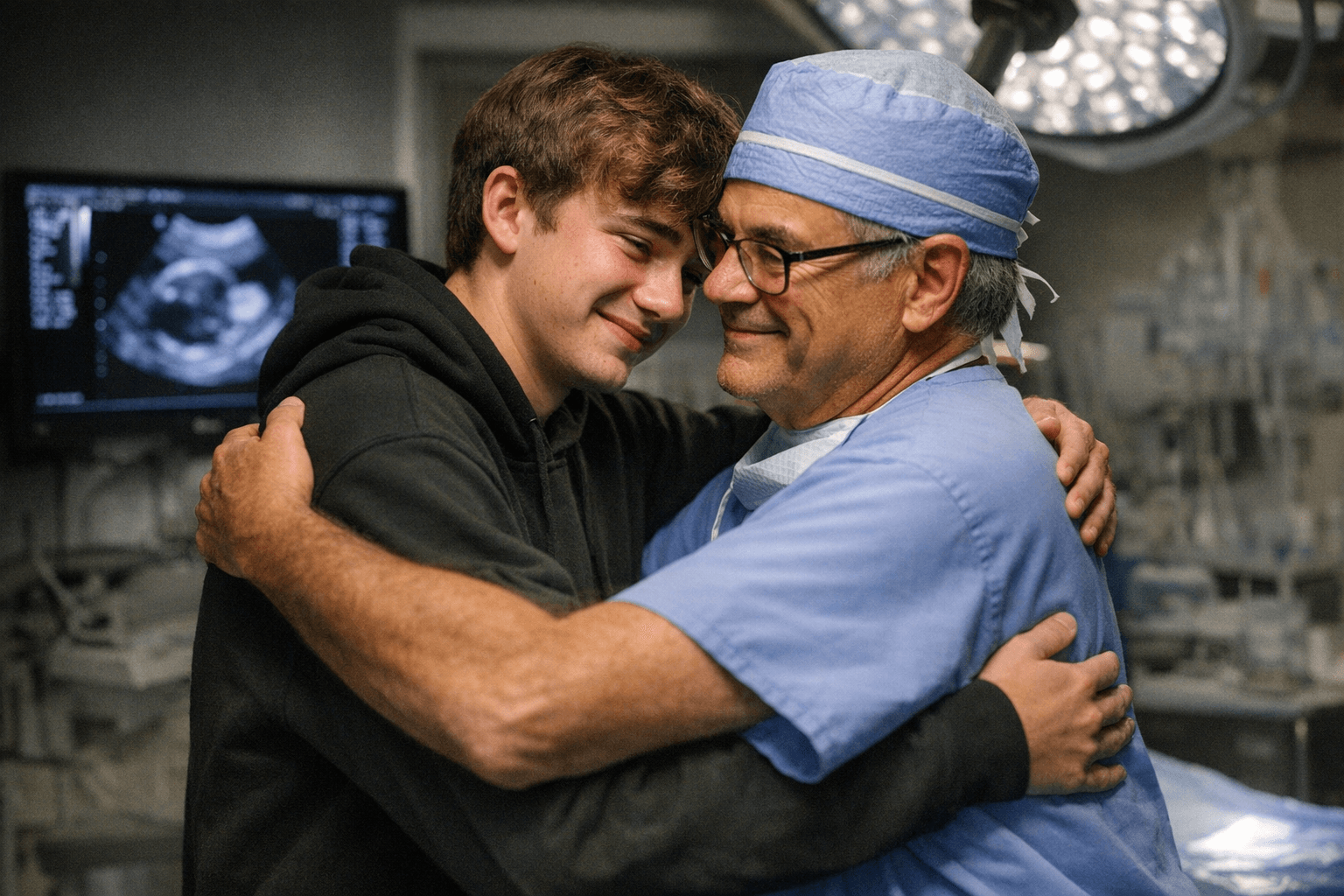
Inside UCSF Benioff Children's Hospital last Friday, Mason Ellinger stood across from a doctor who had last seen him through the walls of a uterus. The 18-year-old, who made the trip to San Francisco from Michigan for the occasion, told Dr. Hanmin Lee what he had spent his whole life working toward saying: "I'm actually glad I got to meet you after all these years."
The reunion, 18 years in the making, closed a loop that began before Mason drew his first breath. During his mother's pregnancy, doctors detected that Mason had congenital diaphragmatic hernia, or CDH, a birth defect in which an opening in the diaphragm allows abdominal organs to crowd into the chest and prevent the lungs from developing. The condition affects approximately 1 in 2,500 births, roughly 1,600 babies a year in the United States, and carries a mortality rate near 50 percent in the most severe cases. Mason's was severe.
To give his lungs a chance before delivery, Dr. Lee performed a balloon tracheal occlusion, a minimally invasive fetal procedure in which a tiny balloon is threaded into the airway of a fetus still in the womb. Blocking the trachea forces fluid to accumulate inside the lungs, expanding them and pushing displaced abdominal organs back down toward the abdomen. UCSF's Fetal Treatment Center is among a small number of programs in the country performing advanced fetal interventions of this kind, and has spent more than 25 years refining them.
Mason was born and survived. At 18, he came back.
"It is shocking," he told Lee at the reunion. "All this happened when I was born. I couldn't remember anything. Now, I'm grateful that I'm here standing."
His mother described the original diagnosis as one of the hardest moments of her life. "I'm going to get emotional," she said. "It was just a difficult situation. He was our first pregnancy. A difficult situation to be told that your baby has an issue." The family's trip from Michigan reflects how the Fetal Treatment Center draws patients from across the country, many of whom have no comparable program within reach of home.
For Mason's sister Isabel, watching his journey reshaped her own future. "Seeing the struggles that he had and my parents had just kind of inspired me to go into another field that I can help a lot of more kids like him," she said.
Dr. Lee directs the Fetal Treatment Center and serves as surgeon-in-chief of UCSF Benioff Children's Hospital. He has published more than 150 papers on fetal and pediatric surgery and led multiple National Institutes of Health-funded trials on advanced prenatal procedures. Cases like Mason's are part of what that research ultimately tracks: whether children who receive fetal interventions go on to live full lives, and what the decades of follow-up reveal about the techniques used to save them.
For Mason, that answer arrived in person at UCSF on Friday, standing in the same hospital system where his life began.
This article was produced by Prism’s automated news system from verified source data, official records, and press releases, then run through automated quality and moderation checks before publishing. The system is built and supervised by the people who set the standards it runs under. Read our full AI policy.
Did this article answer your question?