Bolinas Shuts Off Water Supply After Substantial Leak Hits Coastal Town
Bolinas lost its entire water supply Saturday night after a substantial leak, a warning for San Francisco where much of its own pipe network dates back a century.
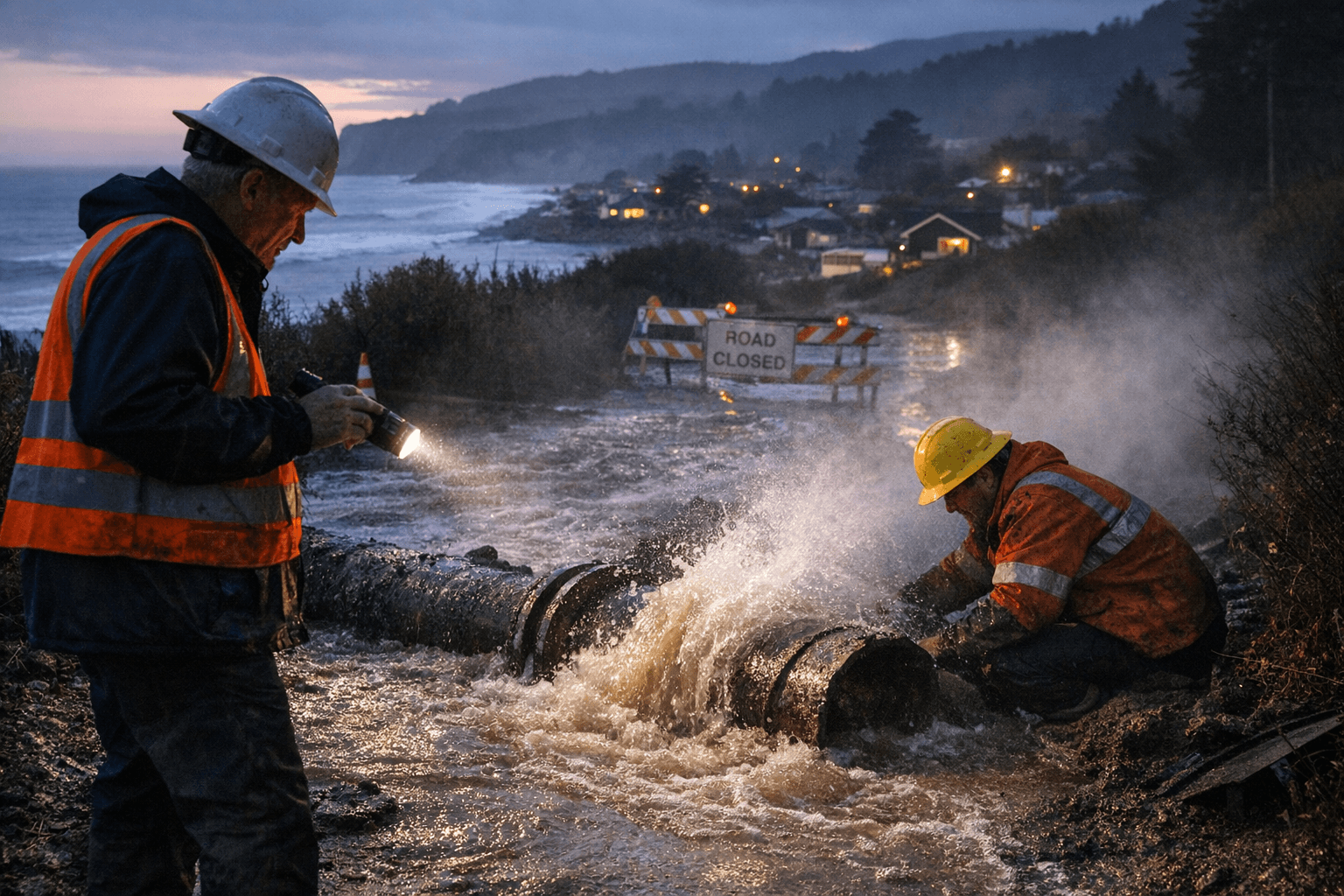
Every tap in Bolinas ran dry Saturday night.
The Bolinas Community Public Utility District shut off water service to the entire coastal town after crews discovered a substantial leak in the system, urging residents to fill every available container before pressure fell away completely. Repair work was still underway as of Sunday with no firm restoration timeline announced.
The suddenness of the outage is the detail that should travel far beyond western Marin County. In Bolinas, there was no managed drawdown, no 48-hour notice, no option to plan: a single infrastructure failure severed supply to a whole community at once. The BCPUD, which has served the district's roughly 2.6 square miles since its formation in 1967, has navigated drought emergencies before, including mandatory conservation measures in 2021. But a leak-driven shutoff of the entire system is a different kind of reckoning. It gives residents minutes, not days.
That reckoning is relevant in San Francisco in a way the SFPUC has implicitly acknowledged in its own capital planning documents. Many parts of the city's water system are approximately 100 years old. The oldest sections of the sewer network date to the Gold Rush era. Across its 16 dams, 25 reservoirs, 8 water tanks, 3 water treatment plants, and more than 150 miles of pipelines, the SFPUC supplies 2.6 million customers with infrastructure that, in places, was already aging before the Bay Bridge was built. The agency says it is replacing aging water and sewer mains to prevent breaks and improve seismic safety, but the scale of that work remains vast and the oldest segments most vulnerable to precisely the kind of unannounced failure Bolinas experienced Saturday.
The question the SFPUC has not yet answered publicly: which specific segments of that network carry the greatest risk of a system-wide shutoff, and what are the protocols if one fails on a Saturday night?
Until those answers come, the Bolinas incident offers a practical template for what to do before the emergency arrives, not during it. Emergency managers recommend storing at least one gallon of water per person per day, with a minimum three-day supply, in clean sealed containers kept somewhere accessible. Filling a bathtub the moment an alert goes out, as Bolinas residents were told to do Saturday, is a last resort, not a plan. In San Francisco, AlertSF, accessible at alertsf.org, sends real-time notifications for water service disruptions and other emergencies; signing up takes under two minutes. The SFPUC also maintains a 24-hour emergency line for outage reports and service failures. Bolinas residents can reach the BCPUD's own 24-hour emergency number at (415) 868-1224.
Bolinas draws its water from a dam constructed in the 1920s on Arroyo Hondo Creek, north of the town center. That water travels to a treatment plant on Mesa Road, passing through microfiltration and chlorination before reaching homes and businesses. A century-old origin story for a water supply is not unusual in California. It is, however, a reminder that the pipe under the street and the creek behind the dam do not age on a maintenance schedule. They fail on their own timeline, on a Saturday night, when nobody is watching.
This article was produced by Prism’s automated news system from verified source data, official records, and press releases, then run through automated quality and moderation checks before publishing. The system is built and supervised by the people who set the standards it runs under. Read our full AI policy.
Did this article answer your question?