Ending Federal Housing Vouchers Forces 920 San Francisco Families to Move
920 San Francisco families who relied on Emergency Housing Vouchers face new moves as funding meant to last 10 years is expected to dry up after five.

When Lily Wu moved her family of five out of a residential hotel in 2022, the Emergency Housing Voucher program finally gave her stable space; now she fears having nowhere to go as the subsidy expires. The phrase “I’m Going to Lose Everything” has been used to describe the anxiety among affected tenants as federal support winds down.
The Emergency Housing Voucher program, designed as pandemic-era rental assistance, was intended to provide 10 years of support but is now expected to dry up this year after just five years, leaving 920 San Francisco voucher recipients facing another move or renewed housing instability. Many families accepted the voucher believing it would provide long-term rental support, and city housing administrators are scrambling to manage the change.
San Francisco Housing Authority Executive Director Dan Adams raised the program’s fallout at the Housing Authority Board of Commissioners meeting on Feb. 5, describing the early termination as an additional administrative burden for staff. Adams said, “The uncertainty has actually really been challenging for us to figure out.” He also asked publicly, “Is this the time to reach out to residents when we don’t know everything?”, highlighting the difficulty the agency faces in communicating timelines and a possible process for shifting subsidies.

The human consequences are immediate. Junchang Tan, who after nearly a decade in an around-100-square-foot single-room-occupancy hotel room used pandemic-era funds to move his family of four into an apartment, now finds himself “back at square one” after three years of stability and a prior national news profile about that move. Tenants across the city who were at high risk of homelessness before receiving vouchers must now reassess leases, school arrangements and care responsibilities without confirmed replacement assistance.
Compounding the housing shock are contemporaneous federal cuts to public-health grants. The San Francisco Community Health Center reported that over $300,000 in CDC-funded programs were terminated effective Feb. 11, 2026, and warned that these cuts are part of a larger $600 million reduction to HIV and STD prevention and surveillance grants targeting California, Minnesota, Colorado, and Illinois. SFCHC said TransHOPE, a program training young community leaders to provide peer-based outreach and direct linkage to HIV, STI and other services for young transgender women, is among services threatened, and added, “These are critical health care services that keep our most marginalized communities healthy and safe.” The center also warned, “We expect to receive notice of additional terminations.”
The San Francisco Department of Public Health reported receiving federal notice on Feb. 12 that four Centers for Disease Control and Prevention grants, representing more than $8 million of planned funding, had been terminated. The department warned that the federal government’s action “will not only impact direct core services and patient care, but it will significantly harm San Francisco’s efforts keep our community healthy, reduce health disparities, reduce HIV and STI transmission, and build a healthier and more resilient City.”
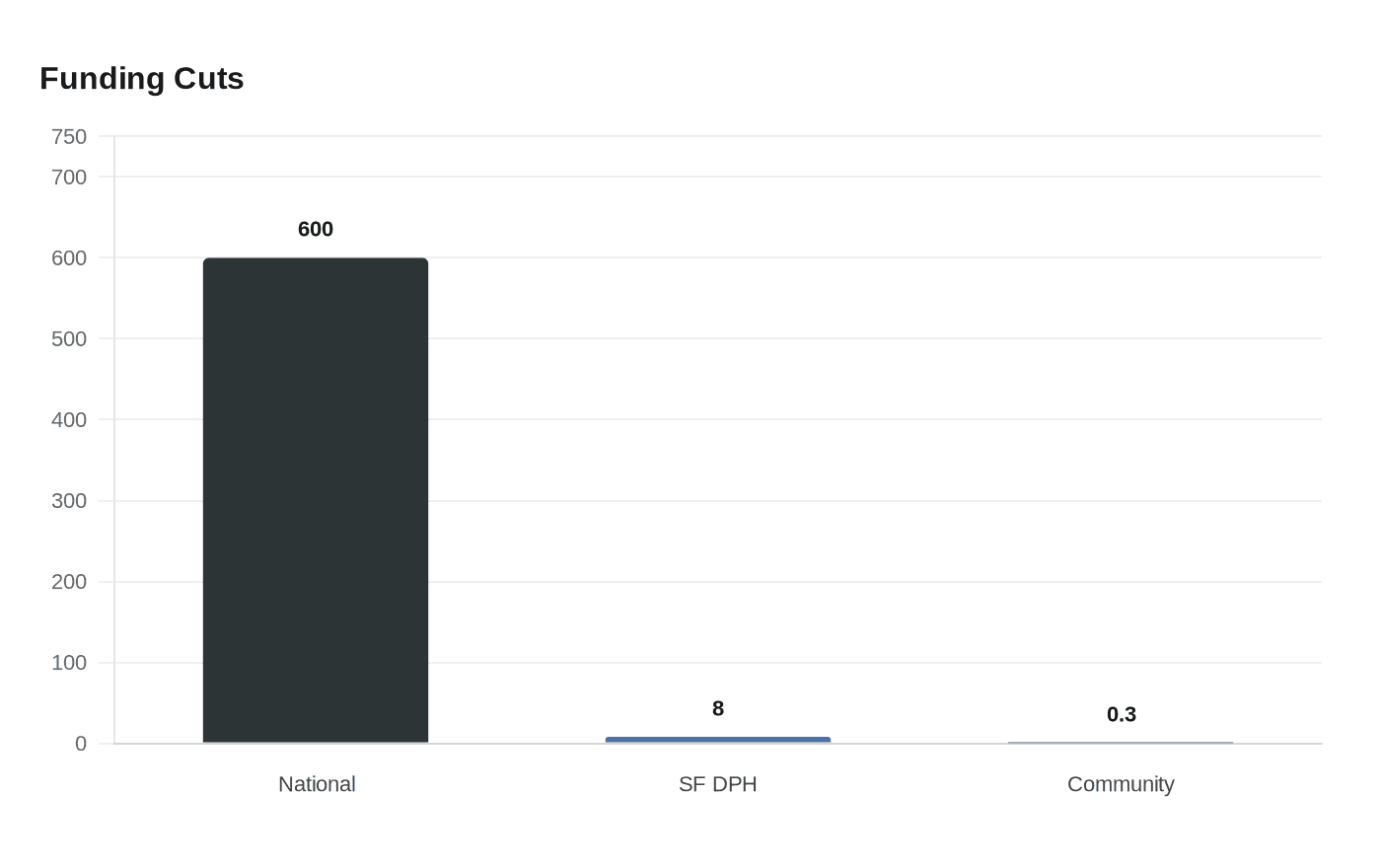
City officials have not identified the specific federal office that issued the early termination of EHV funding, nor have they released a deadline schedule or dollar figures tied to San Francisco’s EHV allocation. For now, housing administrators and public-health providers in San Francisco are left to manage the fallout: 920 voucher recipients facing potential displacement, more than $8 million in cancelled public-health funding at the Department of Public Health, and over $300,000 cut from community-based prevention work that organizers say underpinned a nearly 20% reduction in new HIV infections nationally between 2010 and 2022.
Local housing and health leaders warn the twin federal cuts could reverse years of progress in preventing homelessness and controlling infectious disease spread, and, as SFCHC put it, result in “an irreparable loss to the backbone of our HIV and public health infrastructure here in San Francisco and across the country.”
This article was produced by Prism’s automated news system from verified source data, official records, and press releases, then run through automated quality and moderation checks before publishing. The system is built and supervised by the people who set the standards it runs under. Read our full AI policy.
Did this article answer your question?