Golden Gate Park’s origins reveal San Francisco’s bold civic experiment
Golden Gate Park began as 1,013 acres of dunes and became San Francisco’s great civic build, still shaped by public use, upkeep, and decision-making.
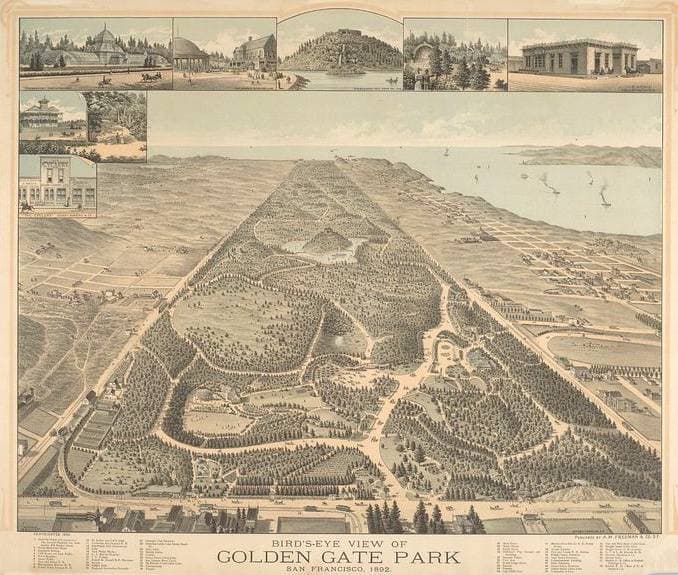
Golden Gate Park did not begin as a preserved green refuge. San Francisco built it from 1,013 acres of windswept sand in the Outside Lands, turning unstable ground into one of the city’s most valuable public assets. That origin still explains the park’s force: it is a landscape engineered for everyday use, not a relic that happened to survive.
Built from dunes, not found as nature
The park’s first great act was political as much as practical. In 1866, Frederick Law Olmsted proposed a public park for San Francisco to improve the health and morality of the citizenry and attract capital and investment. Four years later, William Hammond Hall submitted a plan to Mayor Frank McCoppin to tame the sand dunes and “fit a graceful curvature” to the natural topography. Hall’s original plan was later published in the First Biennial Report to the Park Commissioners in 1872, giving the city a blueprint for a park that would be shaped, planted, and managed rather than left to chance.
That design problem was severe. The site was shifting sand, so the city had to stabilize the land before it could become a usable park. Park designers used horse manure to transform the dunes into arable soil, an early example of San Francisco treating infrastructure, ecology, and public life as one project. The result was not just open space. It was a working civic machine built to hold everything from leisure to crisis.
A park that absorbed spectacle and disaster
Golden Gate Park quickly became a stage for mass events. The California Midwinter International Exposition of 1894 was the first world’s fair held in the United States west of the Mississippi, and it brought 2 million visitors to the park. The fair occupied 180 structures on 160 acres, and its footprint became today’s Music Concourse, where the city still concentrates major cultural and visitor traffic. That legacy matters because the area remains one of the park’s clearest examples of how San Francisco turned raw land into a public destination with lasting civic value.
The park also became a refuge in catastrophe. After the 1906 earthquake and fire, about 200,000 displaced residents camped in Golden Gate Park. People first lived in crude shelters and later in temporary wooden barracks, making the park part emergency zone and part temporary city. Conservatory Valley and other parts of the park held survivors at a moment when much of San Francisco was in ruins, underscoring that this landscape has always served functions far beyond recreation.
The Conservatory of Flowers is one of the most visible reminders of that layered history. Several prominent San Francisco businessmen bought the kit in 1878 and donated it to the city, and the Conservatory opened in 1879 as the park’s first formal structure. It was an immediate success, and it survived the 1906 earthquake without serious damage. In a park built from sand, the Conservatory became a symbol of what the city could construct, preserve, and hand over to the public.
What the park holds now
Golden Gate Park today is described by San Francisco Recreation and Parks as 1,017 acres, with 680 forested acres, 130 acres of meadows, 15 miles of drives, and 33 acres of lakes. Those numbers matter because they show the park as a managed system, not a blank expanse. Every acre has to be maintained, planted, and moved through by walkers, drivers, cyclists, concertgoers, and tourists.
The San Francisco Botanical Garden at Strybing Arboretum adds another layer. The garden spans 55 acres and contains about 9,000 kinds of plants, giving the park a living collection that reaches far beyond the city’s native ecology. Around the Music Concourse, the de Young Museum and the California Academy of Sciences anchor the park’s visitor economy and its everyday civic life, pulling together art, science, school trips, and weekend crowds in one district.
The park also houses one of the city’s most unusual living attractions: its bison herd. San Francisco’s bison have lived in Golden Gate Park since 1892. Their first home was near the present Music Concourse, and they were moved to the Bison Paddock in 1899. Today, San Francisco Zoo staff care for the herd while Recreation and Parks gardeners maintain the enclosure, a small but telling example of how the park depends on shared institutional responsibility.
The park as a family commons
Golden Gate Park has also shaped how San Francisco thinks about children’s space. The Sharon Quarters for Children opened in 1888 and is thought to have been the nation’s first public playground. That site is now the Koret Children’s Quarter, which includes a 1914 Herschell-Spillman Carousel and the concrete slides that generations of families still recognize immediately. The space was renovated in 2007 with support from the Koret Foundation, showing how the park’s oldest civic ideas continue to be refreshed through private and public investment.
That evolution matters because it shows the park is not frozen in one era. It keeps getting reworked for new users, while still carrying the imprint of its earlier civic ambitions. A playground built in 1888, a carousel from 1914, and a renovation in 2007 all sit inside the same park that began as dune country.
Why this landscape still defines San Francisco
Golden Gate Park is best understood as San Francisco’s original mega-infrastructure project. The city did not merely protect a natural asset. It engineered a public realm from hostile terrain, then kept adding institutions, attractions, and emergency uses on top of it. The Midwinter Fair, the 1906 refugee camps, the Conservatory of Flowers, the bison paddock, the botanical garden, and the Koret Children’s Quarter all show the same pattern: the park has been asked to serve the city’s celebrations, its crises, and its everyday need for common ground.
That is why Golden Gate Park remains locally legible in the strongest sense. It is where San Francisco shows its values in land use, maintenance, and access. The city’s most famous open space still asks the same question it did in the 1870s: who gets to shape public ground, and what kind of city does that make?
This article was produced by Prism’s automated news system from verified source data, official records, and press releases, then run through automated quality and moderation checks before publishing. The system is built and supervised by the people who set the standards it runs under. Read our full AI policy.
Did this article answer your question?