How San Francisco ranked-choice voting works for local elections
San Francisco’s ranked-choice ballot is simpler than it looks: mark up to three candidates, one per column, and your backup choices can still decide a close local race.
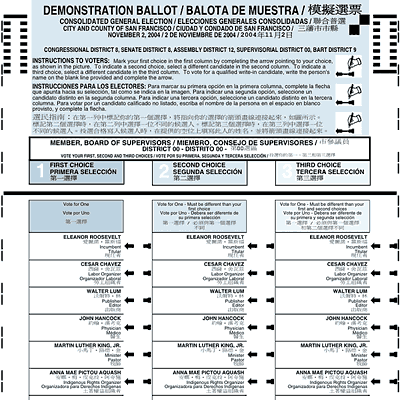
San Francisco adopted ranked-choice voting in March 2002 and first used it in the November 2, 2004 municipal election. In a crowded mayoral or supervisor contest, you are not forced to gamble on a single name and hope for a runoff later. You can rank candidates by preference, keep your ballot alive if your first choice falls short, and use city-run tools and multilingual materials to get the markings right before you vote.
How to mark a ranked-choice ballot
On the city’s ranked-choice ballot, candidates are listed in three columns, and voters can select up to three candidates in ranked-choice contests: first choice, second choice, and third choice.
1. Pick your first choice and mark only that candidate in the first column.
2. If you want a backup, mark a different candidate in the second column.
3. If you want a third backup, mark a different candidate again in the third column.
4. Before you seal or submit the ballot, review the instructions printed on the ballot itself, the insert enclosed with your mail ballot, and the ranked-choice information in your voter pamphlet.
The key rule is to select only one candidate in each column. That means the ballot is built for one clear preference per rank, not for stacking support on the same person in multiple columns.
Mistakes that do not spoil your vote
A lot of voter confusion starts with the fear of “wasting” a ranking. In San Francisco, that fear often goes farther than it should. If you rank only one candidate, that vote still counts for that candidate. If you rank two or three candidates, your lower choices are there to keep the ballot working later if your top choice is eliminated.
Some mistakes do matter, but many common worries do not. Ranking the same candidate more than once does not help that candidate, because each rank is supposed to reflect a different preference. Leaving the second or third column blank does not cancel the rankings you already made. A voter should choose a different candidate if any, which means you are not required to fill every rank.
The most avoidable error is overmarking a single rank. If you mark more than one candidate in the same column, that rank cannot be read as a clear preference. The cleanest San Francisco ballot is simple: one candidate per column, up to three choices total, and no duplicate names.
How the count works when no one leads outright
Ranked-choice voting changes the finish line as much as it changes the ballot. A round-by-round count eliminates the candidates with the least support and keeps moving until one candidate has majority support. San Francisco adopted the system to let voters elect a majority winner without separate runoff elections for most local offices.
That matters in a city where crowded fields are common. A candidate can lead the first count in a race for City Hall or the Board of Supervisors and still fail to win outright if the rest of the field is split. In that case, the city keeps counting, eliminating the lowest candidate, then transferring those ballots to the next available choice on each ballot until someone crosses the majority threshold.
Your ballot can keep working even after your first choice is out of contention, so a second- or third-choice ranking can decide the race if the first count does not produce a winner.
Where San Francisco voters learn the system
The Department of Elections offers a practice tool at sfelections.org/rcv, where you can rehearse ranking choices before Election Day. That is especially useful across neighborhoods with different voting habits and language needs.
San Francisco election materials are available in English, Chinese, Spanish, Filipino, and Ting Vit. Large-print and audio formats are also available upon request, including audio on CD or USB in the 2026 voter information pamphlet. The Department of Elections is at 1 Dr. Carlton B. Goodlett Place, City Hall, Room 48, and the office is open Monday through Friday from 8 a.m. to 5 p.m. Voters can also reach it at SFVote@sfgov.org or by phone at (415) 554-4375.
In 2024, the Department of Elections issued a ranked-choice voting education partnership request for the November 5, 2024 Consolidated General Election, with applications due June 17, 2024 and a grant term running from August 26 to November 15, 2024.
Why San Francisco’s version carries weight beyond the city
A California implementation report on San Francisco’s first use found that the system produced a majority winner without a separate runoff. San Francisco was the first place in California to use ranked-choice voting, and a FairVote report published May 21, 2026 found that the system first appeared in California in San Francisco in 2004 before expanding to seven California cities.
The broader debate over ranked-choice voting is still unsettled nationally. A 2025 American Bar Association task force report found the method is prohibited in 19 states, explicitly permitted or required in 8 states, and legally unclear in 23 others. It is used in Alaska and Maine for statewide elections and in municipalities across the United States.
In California cities, a 2026 FairVote report found candidates of color won 64% of ranked-choice races compared with 36% in the same cities before ranked-choice voting, and women won 44% compared with 34% before it. The same report found California cities saved $5 million per election cycle by avoiding runoff elections. A 2024 University of California eScholarship paper examined ranked-choice voting and candidate diversity in San Francisco supervisor elections.
Oakland Mayor Libby Schaaf captured the logic when she said: “When you’re walking through a neighborhood and you see a sign for an opponent, you don’t pass by. You run up the stairs… This is a politically engaged person and you want their second-choice vote.”
This article was produced by Prism’s automated news system from verified source data, official records, and press releases, then run through automated quality and moderation checks before publishing. The system is built and supervised by the people who set the standards it runs under. Read our full AI policy.
Did this article answer your question?