How San Francisco's water system brings Sierra snowmelt to the city
San Francisco's tap water starts as Sierra snowmelt in Hetch Hetchy, then travels by gravity, treatment and transmission to city sinks. That distance drives both reliability and drought risk.
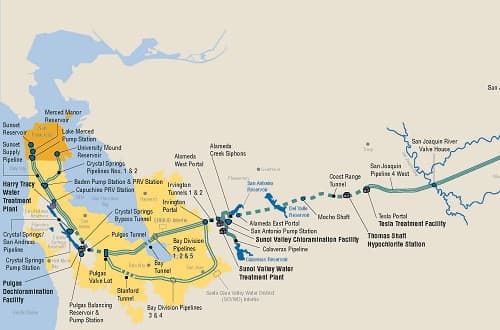
A glass of water in San Francisco starts high in the Sierra Nevada, where snowmelt feeds Hetch Hetchy Reservoir in a granite basin. From there, the water moves through a regional system of reservoirs, transmission lines and treatment facilities before reaching homes, businesses, schools, hospitals and city facilities in San Francisco and three other Bay Area counties. The San Francisco Public Utilities Commission builds the whole network around three goals: seismic reliability, delivery reliability and water quality reliability.
From mountain snow to the sink
The majority of the supply comes from snowmelt stored in Hetch Hetchy Reservoir, and the regional system stretches from the Sierra Nevada to San Francisco. The network includes reservoirs, transmission systems and treatment facilities, including East Bay and Peninsula water filter plants that serve parts of the system. Stanford’s domestic water in its own Hetch Hetchy-connected supply comes from the Tuolumne River watershed in Yosemite National Park and is conveyed by the Hetch Hetchy Regional Water System.
Why gravity is part of the story
The system is almost entirely gravity fed. The Hetch Hetchy water delivery system requires almost no fossil fuel consumption to move water from the mountains to the tap. That design makes the route from the Sierra to the Bay Area unusually efficient compared with many urban systems that rely heavily on pumps.
Gravity does not remove the need for infrastructure. It simply changes how the system works, which is why reservoirs, transmission lines and treatment plants still have to operate together. The payoff is that water can travel long distances while keeping energy use low.
Reliability, drought and earthquakes
SFPUC puts seismic reliability first. San Francisco and the broader Bay Area live with earthquake risk, and a water system that spans mountains, reservoirs and treatment plants has to keep working when the ground does not. Delivery reliability and water quality reliability are the other two goals because a long-distance network has to do more than simply carry water, it has to deliver it safely and consistently.
The regional system provides a reliable supply during all seasons and through periods of water surplus and drought. That is the practical value of storing Sierra snowmelt: it gives the Bay Area a buffer when weather shifts, the dry season stretches on, or reservoir conditions tighten.
The same system also supports fire protection. That makes reliability more than a household concern, because water pressure and supply matter in apartment buildings, commercial districts and dense urban blocks across San Francisco.
A regional system, not just San Francisco’s
The Hetch Hetchy Regional Water System serves 2.7 million customers in San Francisco, San Mateo, Santa Clara and Alameda counties. The broader count is 2.6 million residents and businesses, while the Bay Area Water Supply and Conservation Agency says its member agencies rely on the system to protect the health, safety and economic well-being of 1.8 million people, businesses and community organizations. Those different figures reflect different ways of measuring the same network.
BAWSCA’s member cities, water districts and private utilities account for two-thirds of the system’s water consumption and pay for two-thirds of its upkeep. The water reaching a San Francisco faucet is managed through a regional compact, not a city-only arrangement. Decisions made across the Bay Area shape what reaches San Francisco homes, and the city in turn depends on those same decisions to keep the system funded and maintained.
The policy stakes behind the pipes
BAWSCA was created to plan for and acquire supplemental supplies, encourage conservation and recycled water use, and finance essential repairs and seismic strengthening. Those tasks link drought planning, earthquake readiness and everyday conservation.
Local water rules often focus on conservation even when the taps are flowing normally. The region is not only trying to move water from the Sierra to the city. It is also trying to protect that supply against dry years, protect the people who depend on it, and keep expensive repairs from becoming emergencies.
A century-old dam still shaping daily life
Bay Area officials marked the centennial of O’Shaughnessy Dam, the infrastructure tied to Hetch Hetchy’s century-long role in the region. The dam and reservoir were built to bring Sierra water to the Bay Area, and they remain central to how San Francisco gets its drinking water today.
The regional water system provides hydroelectric and solar power alongside drinking water service. Combined with the gravity-fed design, that gives the system a footprint that is different from many large urban water networks, where moving water can consume far more energy.
This article was produced by Prism’s automated news system from verified source data, official records, and press releases, then run through automated quality and moderation checks before publishing. The system is built and supervised by the people who set the standards it runs under. Read our full AI policy.
Did this article answer your question?