IRS Data Reveals Bay Area Lost 50,000 More Residents Than It Gained Since 2020
The Bay Area shed 50,000 more residents than it gained since 2020, IRS filings show, emptying SF classrooms and darkening storefronts from the Sunset to the Excelsior.

Along Irving Street in the Outer Sunset, the arithmetic of departure has been playing out for years: one school's enrollment roll trimmed, another storefront's lease sign swapped for a "For Lease" placard, one more family's address changed to Sacramento. Federal tax records now confirm the scale of what the neighborhood felt anecdotally. IRS migration data shows that the Bay Area lost more than 50,000 more residents than it gained since 2020, a net drain concentrated disproportionately in San Francisco County and funneled toward Southern and Central U.S. metros, as well as parts of the Mountain West.
The IRS records capture changes in tax-filing addresses and thus reflect households with the greatest economic footprint: employed adults, dual-income families, and the professionals whose spending animates retail corridors. The net figure of 50,000 represents a sustained, five-year gap between arrivals and departures, not a single pandemic-year shock.
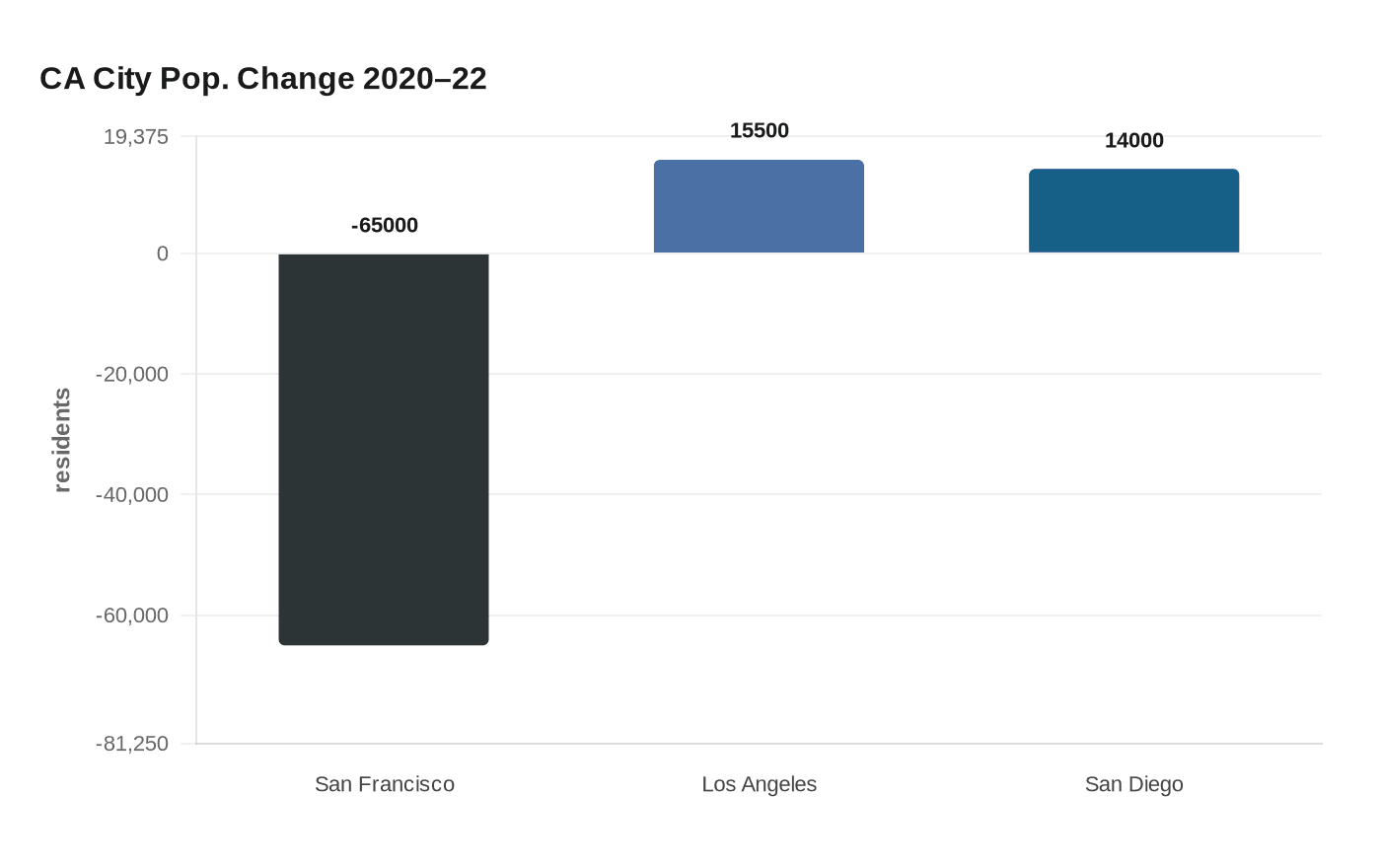
San Francisco County absorbed the most acute losses in the region. Census estimates showed the city shed roughly 65,000 residents between 2020 and 2022 alone, a 7.5 percent population drop that put it in a category of its own among major California cities. While Los Angeles added more than 15,500 residents and San Diego gained more than 14,000 during the same stretch, San Francisco kept shrinking. Sacramento, the Central Valley, and the Inland Empire registered some of the clearest gains, with researchers at UC Berkeley's Terner Center for Housing Innovation noting that less expensive land in those regions makes housing structurally more affordable, a pull factor for families priced out of the Bay Area's median home values now exceeding $1.4 million.

The classroom is where the demographic shift lands hardest. San Francisco Unified School District has lost more than 4,000 students since the 2017-18 school year, and district projections anticipate shedding an additional 4,600 by 2032. That trajectory has already forced school mergers, co-locations, and closures, and produced a $102 million budget shortfall SFUSD must close over the next three years. Newcomer student enrollment, a sensitive indicator of family migration patterns, fell 29 percent between the 2022-23 and 2025-26 school years, dropping from 1,856 students to 1,326.
The IRS data disaggregates movers by income level, which helps explain neighborhood-level variation. Family-oriented ZIP codes across the Excelsior, the Richmond, and Noe Valley have lost a disproportionate share of middle-income households, the very residents whose presence sustains the dry cleaners, the weekend brunch spots, and the hardware stores that define walkable neighborhood life. Foot traffic collapses do not reverse quickly. Once anchor businesses close, the retail corridor often cannot reconstitute itself even when population stabilizes.
For San Francisco's municipal budget, the population math compounds: fewer households generate less property transfer tax revenue, less sales tax, and lower transit ridership, all of which feed budget line items that are already under pressure. City leaders have increasingly relied on granular migration data to justify targeted economic development incentives and housing affordability programs, though the IRS records make clear that the policy response has not yet reversed the directional trend.
The IRS data carries a methodological caveat: it tracks only tax-filing households and likely undercounts non-filing populations, including some low-income residents and recent immigrants. The net loss of 50,000 is therefore a floor, not a ceiling, on the Bay Area's actual population shift.
What the records capture without ambiguity is where the math leads: a region that once grew by attracting talent from everywhere has spent five years sending more people outward than it draws in, and the schools, storefronts, and tax rolls of San Francisco are carrying the balance.
This article was produced by Prism’s automated news system from verified source data, official records, and press releases, then run through automated quality and moderation checks before publishing. The system is built and supervised by the people who set the standards it runs under. Read our full AI policy.
Did this article answer your question?

