San Francisco Diesel Prices Top $8 Per Gallon, a U.S. First
SF diesel broke $8/gallon Saturday, a U.S. first, as Stanford researchers warn prices could hit $10 if the Strait of Hormuz stays shut for two more months.
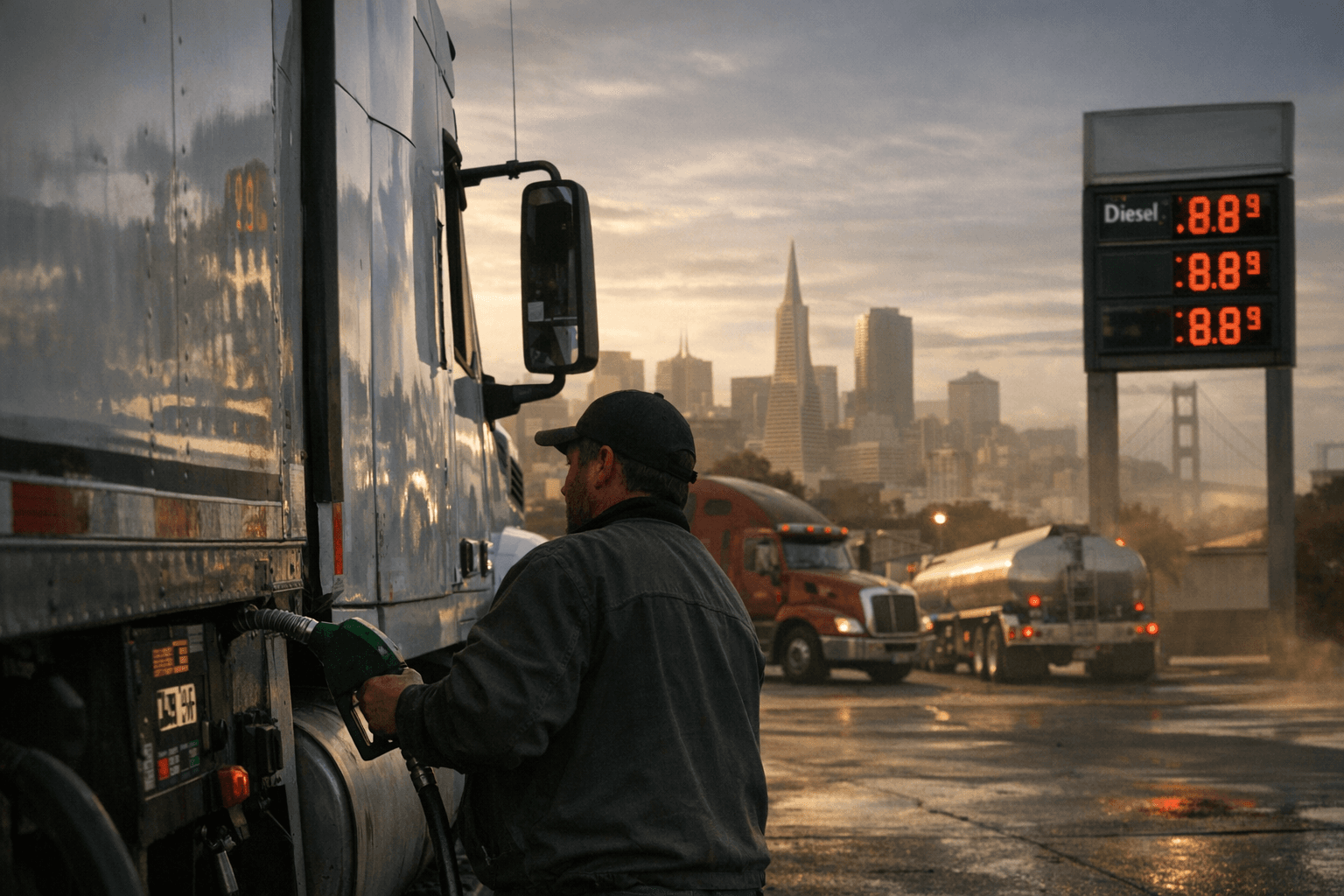
Every garbage truck Recology runs through the city's residential streets, every restaurant supply rig making pre-dawn deliveries to the Mission and SoMa, every construction flatbed hauling material to a Hayes Valley job site: all of them drew diesel in San Francisco this weekend at a price no American city has ever seen, $8 per gallon.
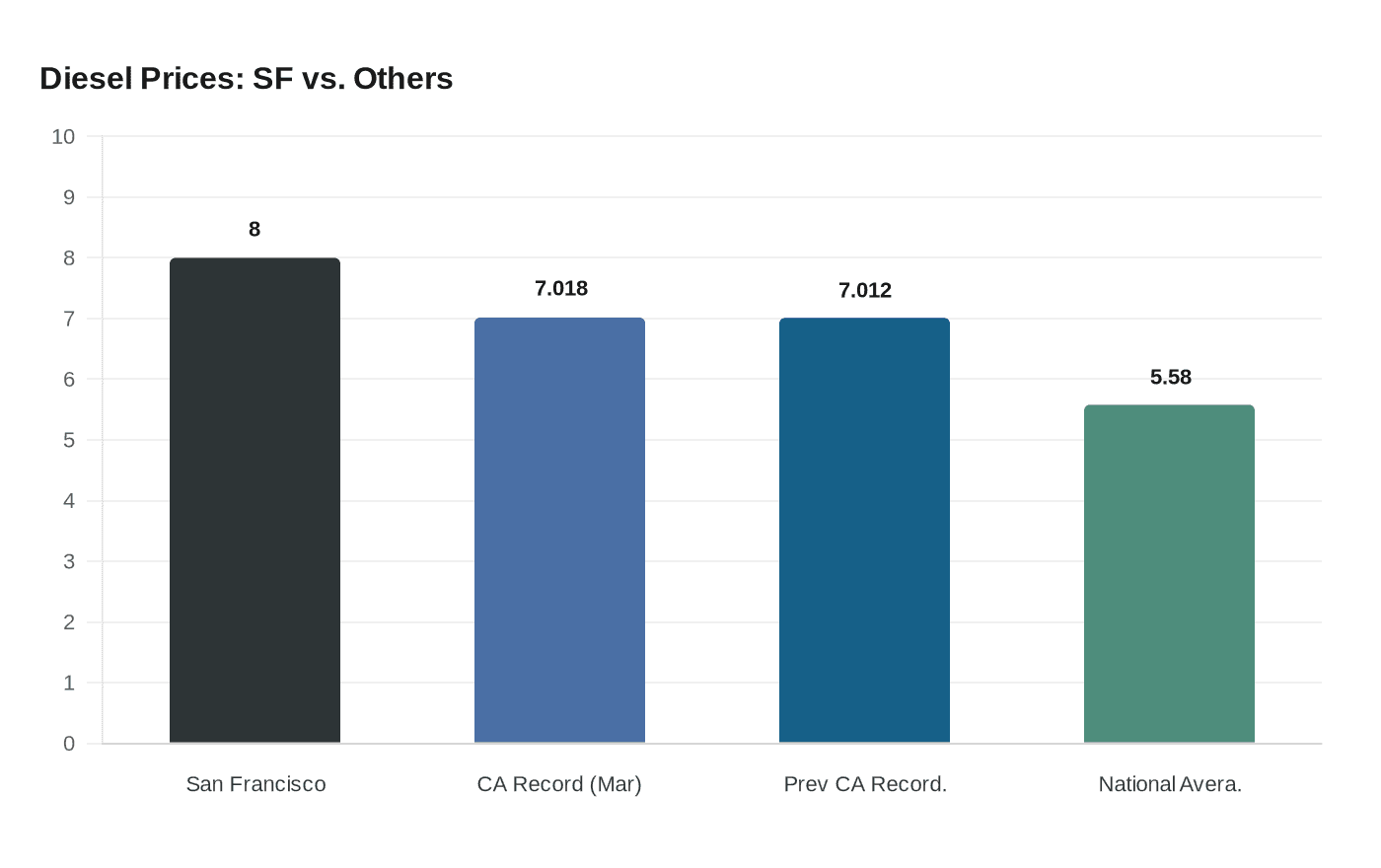
GasBuddy, the nation's largest fuel-price tracking service, confirmed Saturday that San Francisco crossed the $8 threshold, becoming the first U.S. city in the agency's recorded history to do so. "For the first time ever, GasBuddy data show average diesel prices have risen above $8 per gallon in San Francisco, CA, the first U.S. city ever to reach the $8 mark," Patrick De Haan, GasBuddy's head of petroleum analysis, announced on X. The national diesel average that same morning stood at $5.58 per gallon, placing San Francisco more than $2.40 above what truckers pay to fill up in the rest of the country.
That gap is staggering even by California standards. Statewide diesel had only just set its own all-time record of $7.018 per gallon in late March, barely edging past the previous high of $7.012 from June 2022, set during Russia's first months in Ukraine. San Francisco's price now runs nearly a dollar above that fresh statewide record. Filling a standard 150-gallon long-haul diesel tank in the city costs roughly $1,200 today, against about $840 at the national average, and about $1,050 even at California's record-breaking statewide mark from two weeks ago.
Diesel is not an abstract commodity for San Francisco. It moves the city. Recology's fleet hauls residential and commercial waste from every neighborhood under a city franchise agreement that links rate adjustments to operating costs, including fuel. Restaurant supply distributors covering the Tenderloin, Chinatown, and the Outer Sunset run diesel rigs to businesses that have thin enough margins already. Construction contractors, who have kept San Francisco's residential pipeline moving despite years of cost pressure, build fuel surcharges into bids that then roll into project budgets, carrying costs forward through the entire development chain. De Haan warned last month that rising diesel would "quickly ignite additional inflation," with consumers likely to see higher supermarket prices and costlier online deliveries by April. That window has closed. California truckers, including owner-operators such as Trey Dyar, were already rationing fuel stops and taking only higher-paying loads when diesel hit $6.75 per gallon in mid-March. At $8, the arithmetic is worse.
The immediate cause is the U.S.-Iran war, which began February 28 and has closed the Strait of Hormuz, the narrow maritime passage through which roughly 20 percent of the world's oil supply flows. Crude has surpassed $100 per barrel since the closure. On Saturday, President Donald Trump issued a 48-hour ultimatum on Truth Social, warning Iran to reopen the strait or "hell will reign down on them." De Haan said "more escalations like this likely mean oil prices" will rise further.
California's exposure runs deeper than the geopolitics. Phillips 66 shut down its Los Angeles-area refinery at the end of December 2025. Valero's Benicia refinery, which anchors Northern California's fuel supply from Solano County roughly 30 miles northeast of the city, is in the process of closing in 2026. Together, the two shutdowns erase 17.5 to 21 percent of the state's in-state refining capacity. California already produces less than 24 percent of its own crude. Ryan Cummings, chief of staff at Stanford's Institute of Economic Policy Research, said the state "relies heavily on gasoline imports from Asian refineries, many of which depend on crude oil moving through the recently closed Strait of Hormuz." In Northern California specifically, Cummings warned, there is now "a thinner safety net and fewer backup options when supply tightens." State fuel taxes and regulations add more than $1 per gallon on top of market prices before a driver even approaches the pump; the excise tax alone rose to $0.612 per gallon last July.
Chevron's head of oil refining, Andy Walz, last month declared California was "careening toward an energy crisis" and warned the company may reduce in-state refining unless Sacramento rolls back regulations and taxes. New California Air Resources Board rules alone could cost Chevron $500 million within five years, Walz said. He also flagged the national security dimension: Chevron supplies Travis Air Force Base, one of the country's largest military installations, from its Richmond refinery. "I think the US government should be concerned," Walz said.
Cummings called the combined picture "cataclysmic." If the Strait of Hormuz remains closed for another two months, he said, San Francisco diesel could reach $10 per gallon. A USC Marshall School study by Professor Michael Mische had already projected California gasoline could hit $8.43 per gallon by the end of 2026, a forecast built before the Iran conflict began. Diesel has already passed that number, ahead of schedule, with the Strait still closed and no state intervention announced.
This article was produced by Prism’s automated news system from verified source data, official records, and press releases, then run through automated quality and moderation checks before publishing. The system is built and supervised by the people who set the standards it runs under. Read our full AI policy.
Did this article answer your question?

