Multiple Dead Gray Whales Found in San Francisco Bay, Triggering Investigation
Four gray whales were found dead in San Francisco Bay in less than two weeks, with one confirmed ship strike and no mandatory vessel speed limits anywhere in the Bay.
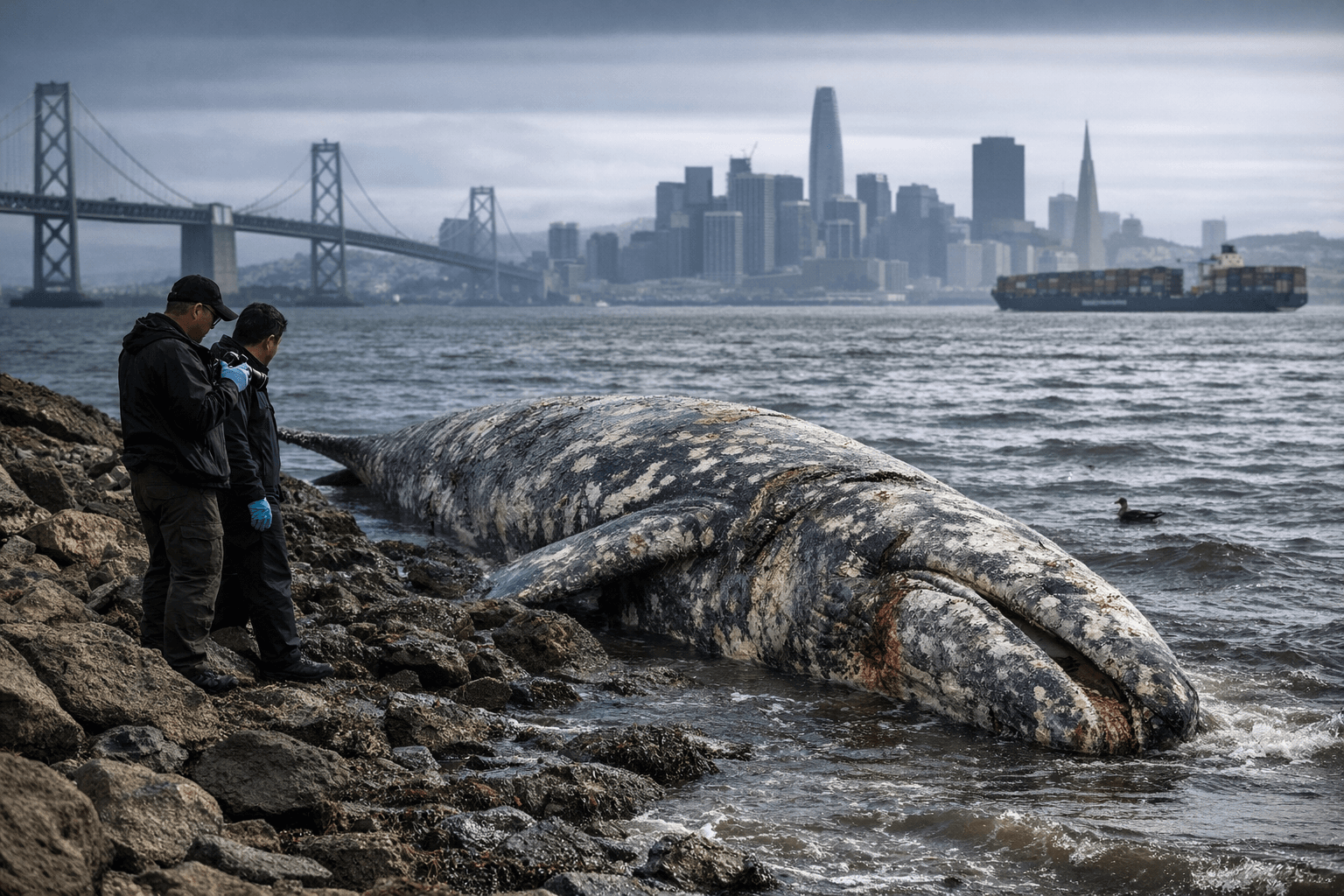
The waters between the Golden Gate Bridge and Angel Island that cargo ships, Bay ferries, and weekend kayakers share every day have become the center of a federal marine mortality investigation. Four gray whales turned up dead in San Francisco Bay over roughly two weeks in late March and early April 2026, and scientists are racing to determine whether the cluster reflects a preventable pattern of human-caused killing.
The series of deaths began March 17, when the U.S. Coast Guard and U.S. Army Corps of Engineers found a 42-foot adult female gray whale floating just east of the Golden Gate Bridge and towed the carcass to Angel Island State Park. A necropsy performed there by a joint team from the Marine Mammal Center and the California Academy of Sciences confirmed injuries consistent with a vessel strike. The whale was in fair to normal body condition and had been feeding recently: she was not starving. She was struck.
Three more gray whales followed in rapid succession. A male was found dead at the Phillips 66 Refinery in Rodeo on March 25, but its inaccessible position made a full necropsy impossible. On March 28, researchers collected tissue samples from a fourth whale found floating in the Bay, with lab results still pending at the time of this report. The U.S. Coast Guard separately reported a whale drifting near Point San Pablo Yacht Harbor, though responders were unable to relocate the animal for further examination.
"It's alarming to respond to four dead gray whales in just over a week because it really puts into perspective the current challenges faced by this species," the Marine Mammal Center said. The center, based at Fort Cronkhite in the Marin Headlands, has partnered with the California Academy of Sciences on every Bay Area cetacean stranding response this year.
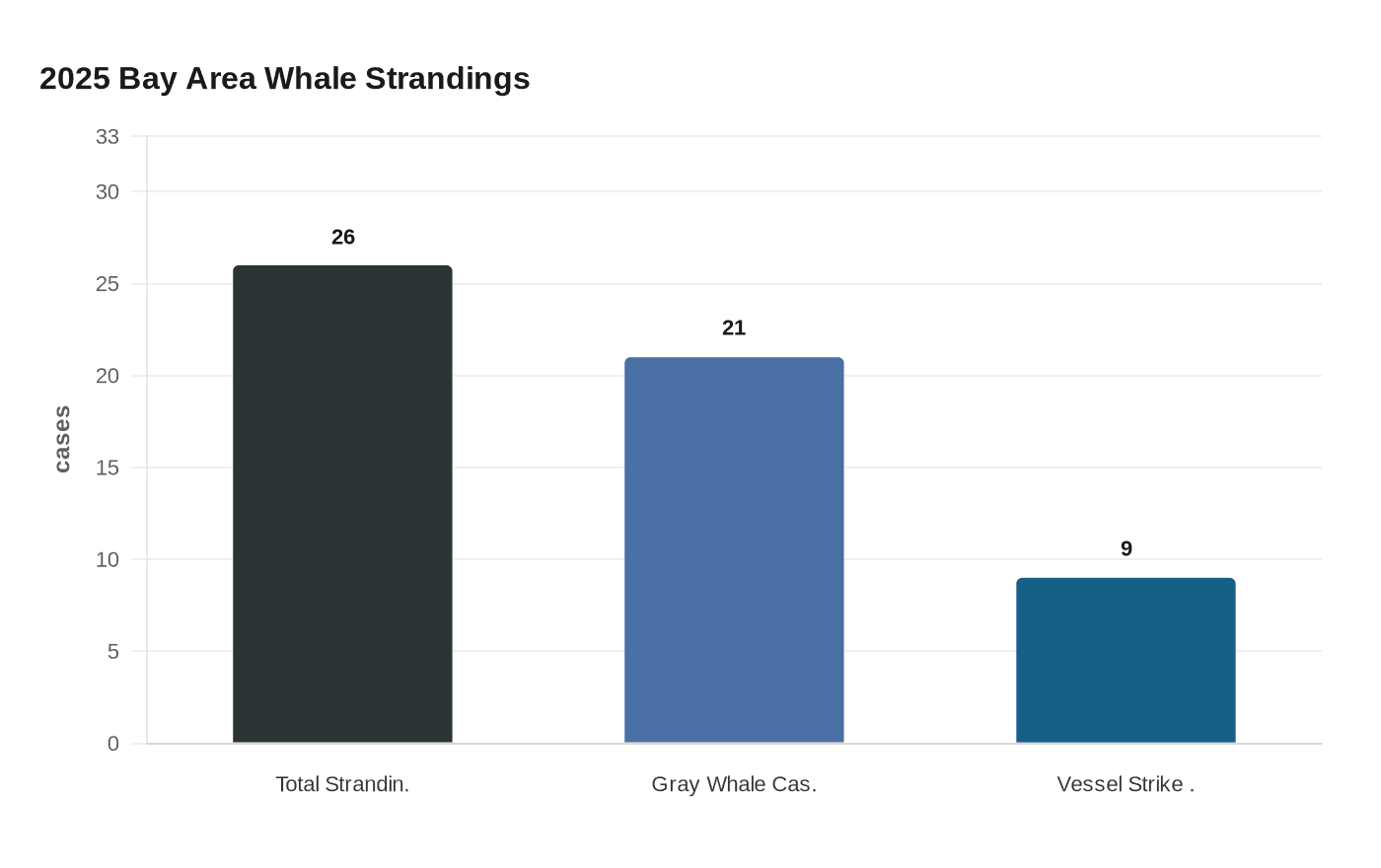
The scale of this spring's gray whale presence in the Bay makes these collisions more likely, not less. In 2025, 26 whale strandings were reported or responded to in the Bay Area, with 21 involving gray whales and nine classified as suspect or probable vessel strikes. That year was a banner one for sightings, with 36 individual whales entering the Bay and as many as 10 present at the same time. Meanwhile, NOAA Fisheries documented calf production reaching a very low estimate of roughly 85 calves in 2025, with investigators pointing to changes in Arctic feeding grounds as a likely driver of malnutrition and population decline.
Despite growing concern, there are no mandatory vessel slowdown requirements anywhere in San Francisco Bay, something experts say could be a critical gap in protecting marine life. Conservation groups are pressing the San Francisco Harbor Safety Committee to adopt temporary speed advisories or exclusion zones during peak migration. The Marine Mammal Center is developing "Whale Smart," a vessel-operator training program working with ferry crews and commercial captains to improve real-time whale reporting and collision avoidance. The California Academy of Sciences has pointed to a direct policy precedent: shipping lane adjustments near San Francisco were previously informed by whale-strike data, including changes made in 2013.
Barbie Halaska, Necropsy Manager at the Marine Mammal Center, framed the deaths in the context of a species already under pressure. "We're concerned to discover this year's first gray whale death here in the San Francisco Bay Area because this species already faces many environmental challenges," she said after the March 17 necropsy.
If you are on the water and spot a gray whale, federal guidance is clear: slow down immediately, maintain at least 100 yards of distance, and do not approach an animal that is surfacing, blowing, or appearing disoriented. To report a dead, injured, or stranded marine mammal along the West Coast, call the NOAA West Coast Stranding Hotline at 1-866-767-6114. The Marine Mammal Center also operates a 24-hour rescue line at (415) 289-7325, and boaters can hail the Coast Guard directly on VHF Channel 16. Shoreline residents who see a carcass wash ashore, or a live whale behaving abnormally in nearshore waters, should call rather than approach: handling a protected marine mammal, alive or dead, is a federal offense under the Marine Mammal Protection Act.
A distressed whale in the water may exhibit slow or labored breathing, a tendency to swim in circles, an inability to dive, or highly visible ribs or a sunken area behind the head indicating severe emaciation. A whale that surfaces next to or directly in front of a vessel is in danger regardless of its apparent health.
The tissue samples collected from the March 28 animal, along with materials gathered throughout the multi-week response, are expected to take weeks to process. Scientists at the Marine Mammal Center said the results will determine whether the four deaths share a common cause and whether a formal unusual mortality event designation, which can unlock emergency federal resources and compel regulatory review of shipping lane speeds and configurations, is warranted. The Golden Gate corridor, one of the busiest commercial waterways on the West Coast, may be tested by that answer.
This article was produced by Prism’s automated news system from verified source data, official records, and press releases, then run through automated quality and moderation checks before publishing. The system is built and supervised by the people who set the standards it runs under. Read our full AI policy.
Did this article answer your question?