Police Pursuit Ends in Fiery Fatal Crash Near Travis AFB
A Bay Area man died in a burning, propane-filled van at Travis AFB's gate after a Napa County pursuit; the FBI has found no terrorism link.
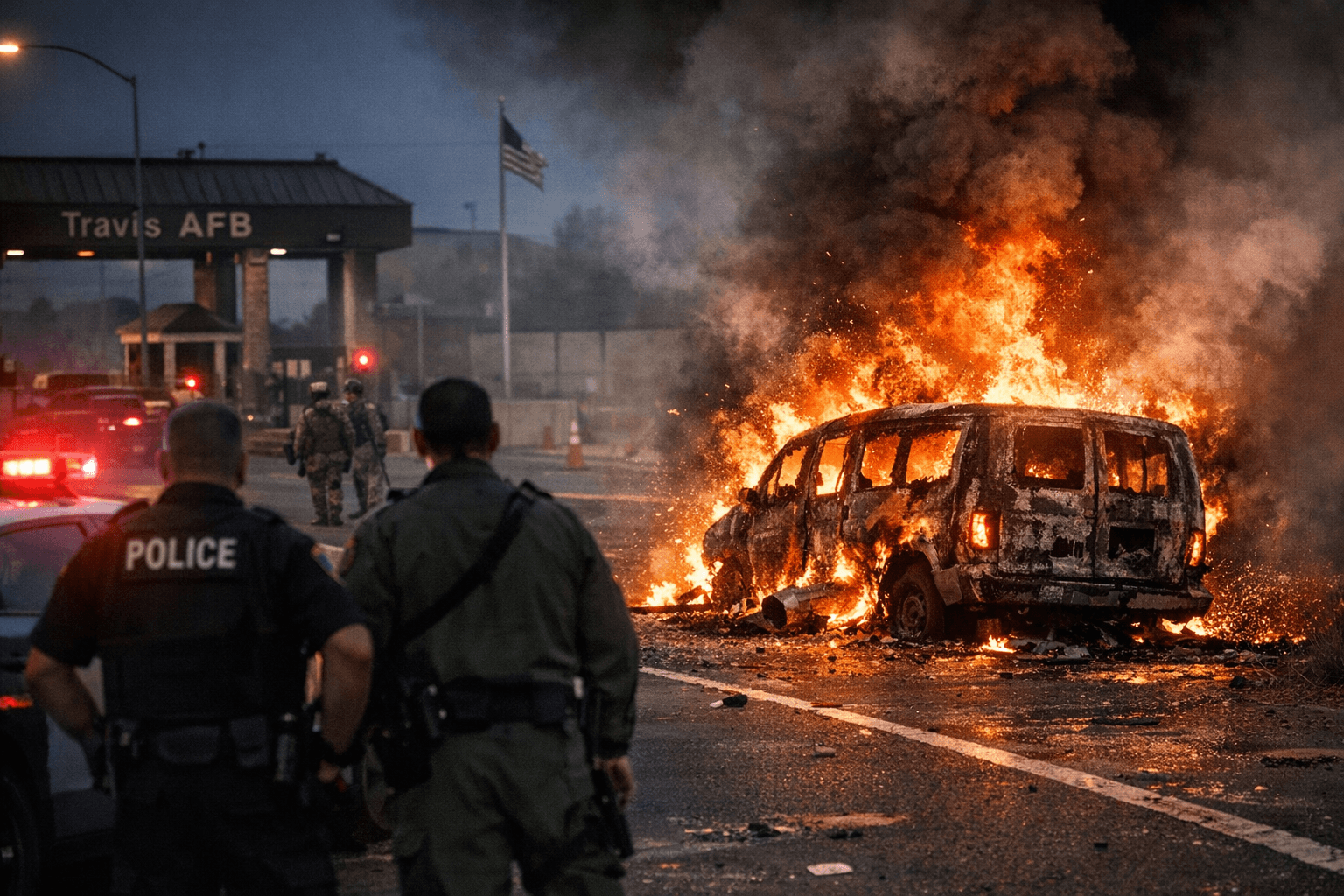
Hafiz Kazi, a Bay Area man whose life investigators are only beginning to reconstruct, died at the entrance of Travis Air Force Base in Fairfield after a Napa County sheriff's pursuit ended at 12:17 a.m. in a burning van in the base's visitor parking lot. The passenger riding with him also died at the scene. The FBI has found no connection to terrorism and says Kazi's motive remains entirely unknown.
The pursuit began just after midnight when Napa County sheriff's deputies made a traffic stop along Highway 12, east of State Route 29. The vehicle fled with two occupants inside, drawing deputies into a cross-county chase that carried into Solano County. Authorities have not said what prompted the original stop, leaving unresolved the threshold question of whether the chase met the policy standards required to sustain a high-speed pursuit on a busy regional corridor.
When the van crashed and caught fire in the visitor parking lot, deputies tried to extinguish the blaze but were unable to do so. Officers from the Fairfield Police Department and the Air Force Office of Special Investigations arrived and spotted propane tanks inside the van. The discovery triggered a federal response: the FBI was called in alongside Air Force explosive ordnance disposal technicians. The main gate at Travis Air Force Base was closed the following morning.
Kazi was so severely burned that investigators could not identify him immediately. Fingerprinting eventually confirmed his identity. At a Friday news conference, FBI Special Agent in Charge Sean Ragan of the Sacramento field office said Kazi is believed to have spent most of his time in the United States living in the San Francisco Bay Area, though investigators are still working to determine where he had lived most recently. He had previously worked as a cab driver; whether he still held that job at the time of his death is unknown.
"Now the question is, why?" Ragan said. "Why did this individual end up at the front gate of Travis Air Base, on fire, and now deceased? And we don't have the answers to that."
Agents are reviewing Kazi's social media accounts, emails, and the phones recovered from the van. They have identified some of his associates and are interviewing them. The passenger who died alongside him has not been publicly identified.
The corridor where the pursuit began carries particular weight for Bay Area drivers. Highway 12 runs east from the Napa Valley toward Fairfield before intersecting with Interstate 80, the artery that connects San Francisco to Sacramento and funnels commuters, weekend travelers, and freight traffic through Solano County every day. A high-speed chase along those lanes past midnight, with no public explanation for what triggered the traffic stop, puts the risk calculus of pursuit policy into sharp relief.
That calculus is being actively contested in San Francisco. The city's pursuit rules were significantly broadened when voters approved Proposition E in 2024, expanding the circumstances under which SFPD officers can initiate a car chase. Before Prop E, the department's policy permitted pursuits only in a narrow range of cases: violent felonies, suspected drug sales, burglaries of businesses, and sexual assaults. The revised rules extend that authority to officers who believe a crime is about to be committed and add "violent misdemeanors" as an authorized pursuit category, a term that California's penal code does not formally define. California's Peace Officer Standards and Training guidelines, which set the minimum threshold every law enforcement agency must meet to claim statutory immunity for pursuit-related harm, require departments to weigh the severity of a suspected offense against the risk to the public before and during any chase.
The Napa County Sheriff's Department, which initiated this pursuit, operates under its own policy and has not disclosed what offense prompted the traffic stop on Highway 12. That silence carries consequences when a fleeing vehicle crosses a county line at highway speed and ends up breaching the gate of a military installation in Solano County. The supervisory decision to continue rather than terminate a pursuit, once the chase enters another jurisdiction at that hour, is precisely the kind of reassessment California's pursuit framework is designed to compel.
Whether the Travis AFB crash prompts any review of Napa County's protocols, or sharpens Sacramento's attention to cross-county pursuit accountability, remains an open question. The FBI's investigation is still in early stages, and the identity of the second person who died in that van has not been released. What is certain is that Highway 12 and Interstate 80, the same routes that carry Bay Area commuters past Travis AFB's gates each morning, are where these policy choices play out at speed.
This article was produced by Prism’s automated news system from verified source data, official records, and press releases, then run through automated quality and moderation checks before publishing. The system is built and supervised by the people who set the standards it runs under. Read our full AI policy.
Did this article answer your question?