San Francisco Launches Curbside EV Charging Program for Residents Without Private Parking
Ashkan Javaherian nearly sold his EV before a pilot charger in Duboce Triangle saved him. Now SF wants 100 more by 2030.

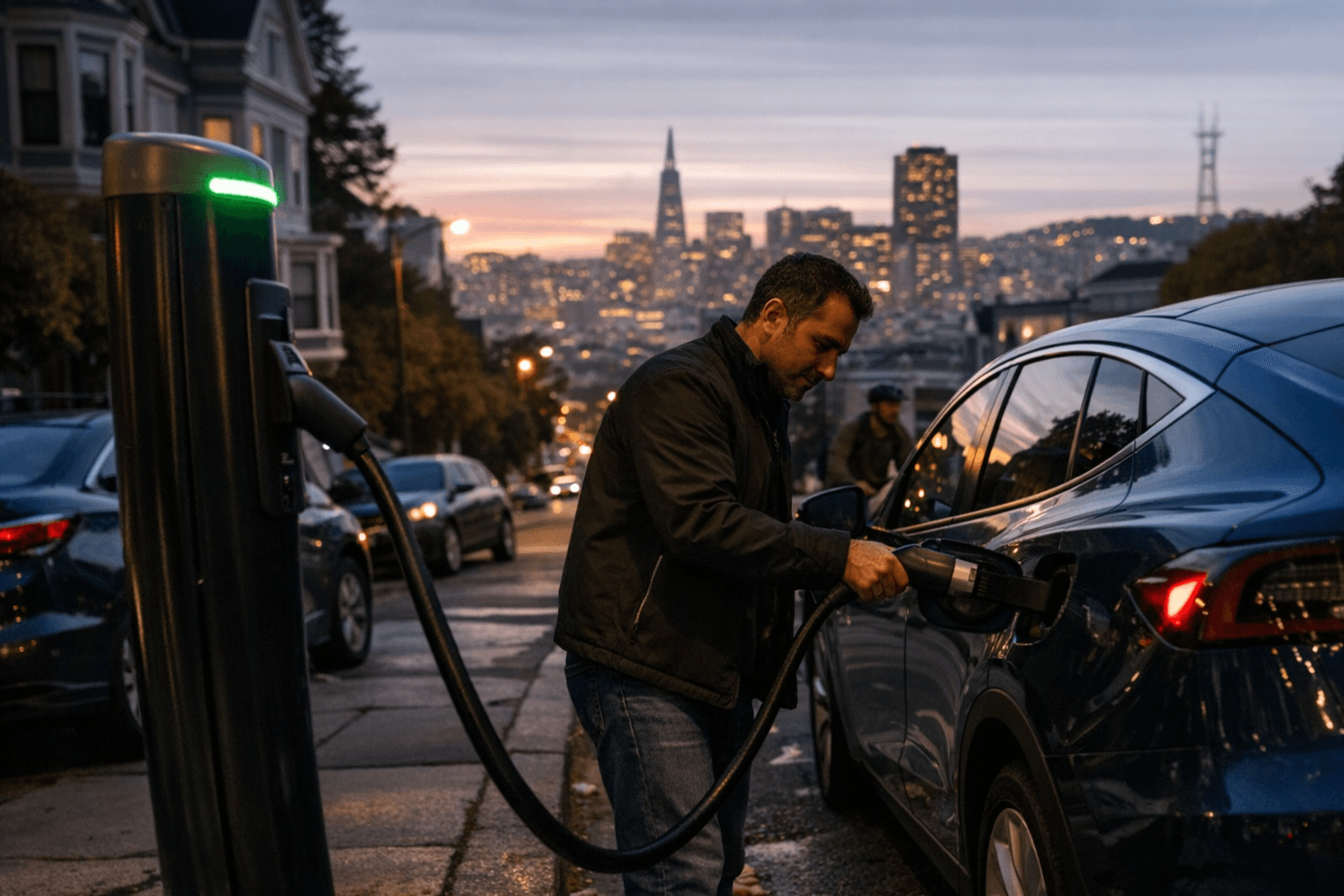
Ashkan Javaherian came close to selling his electric vehicle because he had nowhere to charge it near his home. Then he found one of two curbside chargers installed last April in front of the International Brotherhood of Electrical Workers Meeting Hall in the Duboce Triangle neighborhood, and kept the car. That two-charger pilot is now the foundation for a citywide program Mayor Daniel Lurie introduced on March 10 alongside Board of Supervisors President Rafael Mandelman, with a goal of reaching 100 curbside chargers across San Francisco by 2030.
The legislation establishes a permitting pathway through the San Francisco Municipal Transportation Authority, which will begin accepting applications from private charging companies this summer. The process unfolds in two stages: companies first apply to become approved vendors under the SFMTA program, and once qualified, they can seek site-specific permits at individual curbside locations. SFMTA Director of Transportation Julie Kirschbaum said the two-step structure is designed to let approved vendors move faster across multiple sites. The chargers will be privately funded.
"The permit will enable us to solicit proposals from EV charging companies," Kirschbaum said. "Based on the pilot, we believe there is a lot of interest in this area and that this is a viable investment for companies to make."
The program is explicitly aimed at renters and apartment residents, a population that defines San Francisco's housing landscape. Without access to private parking or a garage outlet, most people in multifamily buildings have no practical way to charge at home. "This legislation will expand access to reliable charging, especially for renters and people who live in apartment buildings," Lurie said at the press conference, which he held beside the Duboce Triangle pilot chargers.
San Francisco Public Works Director Carla Short, whose department is one of several agencies involved alongside San Francisco Environment and the San Francisco Public Utilities Commission, described the pilot as essential groundwork. "The pilot program provided us with a road map to make EV charging available for more people in San Francisco and to support the city's commitment to environmental sustainability," Short said. "Advancing curbside charging in San Francisco moves us closer to reaching our climate action goals and addressing a barrier for San Franciscans as they consider buying an electric vehicle."
SFMTA's Taxis, Access and Mobility Services division will oversee the permit program, with site selection guided by demand and community feedback. Kirschbaum framed the program's intent plainly: "Our priority is simple. We're trying to create a feasible, equitable, and responsive pathway to meet this important community need."
The curbside program is part of a broader charging expansion across the city. SFMTA currently operates 55 public chargers in its off-street parking garages and expects that number to reach approximately 305 by fiscal year 2027. Separately, the agency recently secured a $5 million California Energy Commission grant to install 140 charging stations for its non-revenue vehicle fleet, a distinct initiative from the privately funded curbside installations.
Supporters of the legislation tie it directly to the city's Climate Action Plan and its net-zero emissions target for 2040. San Francisco already ranks among the highest in U.S. cities for EV adoption rates, but that adoption has been concentrated among residents who have private parking. The curbside program is the city's most direct attempt yet to extend that access to everyone else.
This article was produced by Prism’s automated news system from verified source data, official records, and press releases, then run through automated quality and moderation checks before publishing. The system is built and supervised by the people who set the standards it runs under. Read our full AI policy.
Did this article answer your question?