SF Data Center Boom Reshapes Real Estate, Sparks Economic Debate
SF's housing market flipped from "doom loop" to "feeding frenzy" in early 2026, but more than a third of renters are already rent-burdened as evictions climb.

A four-story data center called SJC37 sits finished but hollow on the edge of the Bay Area: tan exterior complete, no equipment inside, and possibly years away from receiving the power it needs to operate. Owned by Digital Realty, one of the world's largest data center landlords, the building is an apt symbol of the tension at the heart of San Francisco's AI-driven economic moment — capital rushing in, reality pushing back.
The AI boom has reshaped the city's real estate landscape faster than almost anyone predicted. Patrick Carlisle, chief market analyst at Compass, put it plainly: "San Francisco has become the center in the country, and probably the world, of AI startups." Newcomers flooding into the city are employees of Databricks, Anthropic, and OpenAI, and their arrival has been credited with flipping the housing market from what some analysts called a "doom loop" into a full-blown "feeding frenzy" by early 2026. According to a Colliers market report, the AI industry has been the key driver of leasing across the San Francisco Bay Area since 2024, with several major tenants absorbing large blocks of previously vacant office space.
But the rebound is not landing equally. More than a third of San Francisco renter-occupied households are "rent burdened," spending more than 30 percent of their income on rent, according to U.S. Census Bureau data. Twenty percent are "severely rent burdened," spending more than half their income on housing. Real estate agent Ken De Leon acknowledged the contradiction directly: "The increase in evictions is a negative impact of a positive trend." Landlords who offered concessions during the pandemic are now "less flexible and forgiving of tenants not paying their rent," De Leon said, because the calculus has shifted. Rahman Popal, founder of the Law Firm for Tenants Rights, said landlords are now more inclined to push tenants out "because they now know that they can get more money from the new market rate."
City Hall has taken a different view. Ted Egan, the city's chief economist, wrote in a city controller's report that post-pandemic rising rents are a "bright spot" for San Francisco's economy. "It's a sign of economic vitality. It's clearly demand growing again — more people wanting to live in San Francisco," Egan wrote. He pointed to Mission Bay as a neighborhood seeing noticeably stronger economic activity than the rest of the city, driven by the concentration of office-using AI workers nearby.
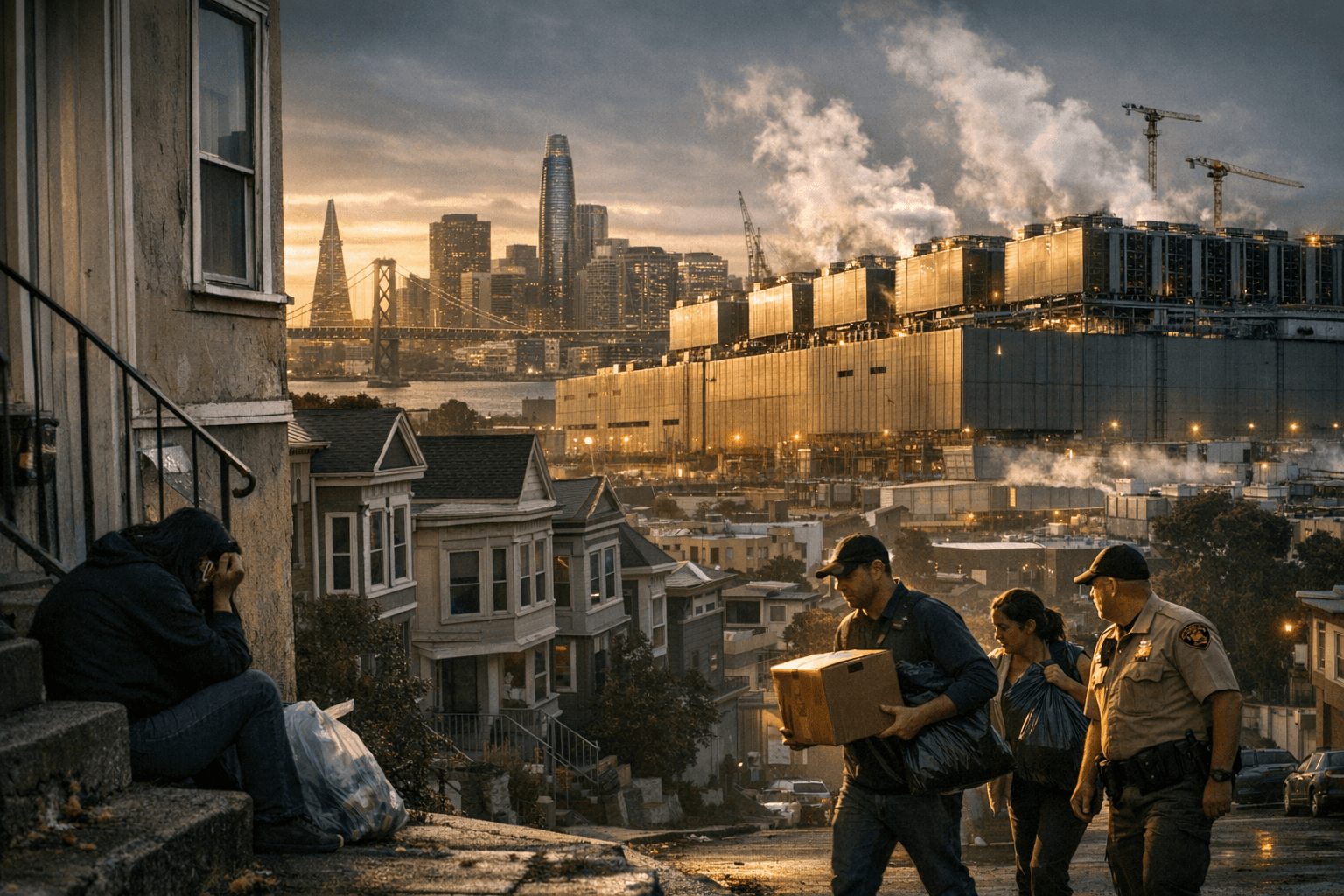
Egan is notably cooler on data centers themselves as an economic engine. "They need some electricity, but they don't need a lot of people," he said, arguing there is "far more economic upside to having highly paid AI engineers working in offices." That skepticism is backed by the structural realities facing Bay Area data center development: California's energy costs rank among the highest in the country, the state offers no tax breaks for data centers, and land near urban areas is expensive and constrained. Colliers' report notes that "exceptional growth in data centers fueled by AI and cloud computing is spurring mounting challenges in power, water, and zoning availability creating new pressures." Community opposition is intensifying; a few projects have already been abandoned, and more are expected to be shelved in 2026.
Not everyone agrees the housing surge is as AI-driven as the headlines suggest. Courtney Jung, an agent with City Real Estate, said as of late 2025 that it remains "too speculative to say that AI is 'fueling our market' in San Francisco," adding that a clearer picture will emerge only as IPOs materialize and it becomes evident which AI companies have genuine staying power.
The national picture complicates things further. While Bay Area leasing has been robust, Colliers warns that as AI capabilities begin to fulfill entry-level job functions, companies nationally may eventually need less office space, not more. Whether San Francisco's current momentum represents a durable structural shift or a cycle-peak surge is a question the city's real estate market, and its most stretched renters, cannot afford to get wrong.
This article was produced by Prism’s automated news system from verified source data, official records, and press releases, then run through automated quality and moderation checks before publishing. The system is built and supervised by the people who set the standards it runs under. Read our full AI policy.
Did this article answer your question?

