SF Laundromat Owners Learn Passive Income Dream Is Anything But
When a shoe insole wedged into a pipe flooded all of 5090 Mission Street's machines, two 36-year-old Bay Area entrepreneurs got a $100,000 lesson in what TikTok never shows.
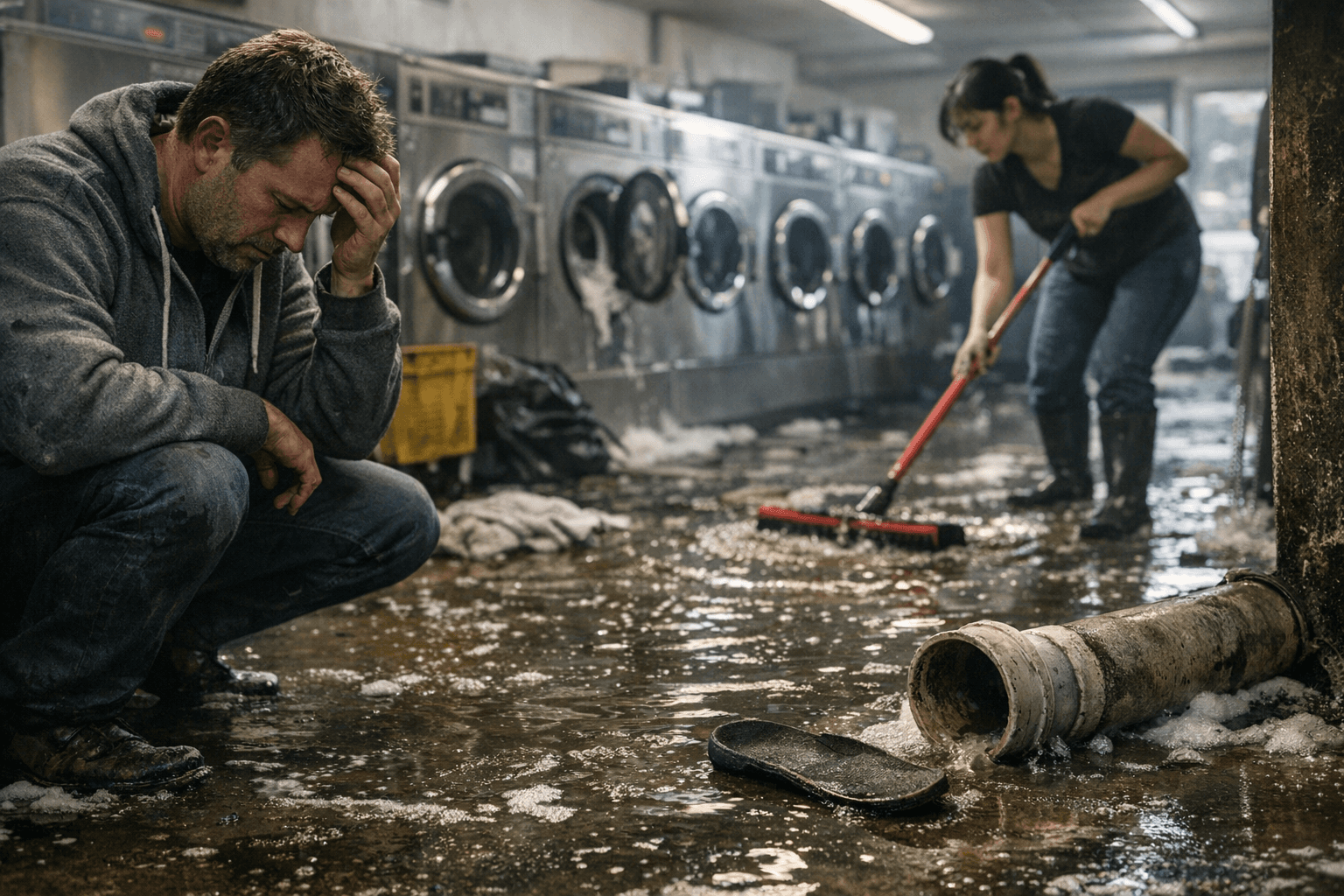
A shoe insole, packed into a drain alongside rags and loose coins, flooded the entire floor of the Laundry Hub SF at 5090 Mission Street near Geneva Avenue in the Outer Mission. For Jonathan Canites and Brian Lagman, the two 36-year-olds who bought the laundromat less than two years ago as a passive income investment, the water spreading across those tiles was the bluntest possible rebuttal to the viral content that had inspired them in the first place. Brian Lagman doesn't need to check a calendar to remember the date. "I remember this because it was my daughter's birthday that day," he said.
That single pipe blockage crystallized what had been building since the pair closed on the business in November 2024: owning a neighborhood laundromat in San Francisco is not a passive endeavor. It is a second job, a maintenance operation, a customer-service role, and on the worst days, an emergency flood remediation project, all running simultaneously on top of two already full-time careers.
The TikTok Pipeline to WealthCon
Canites and Lagman didn't stumble into laundromats. They pursued them methodically, drawn in by a specific current of internet culture that has made coin laundry one of the defining "lifestyle entrepreneur" trends of the mid-2020s. On TikTok, laundromat ownership has a recognizable visual formula: someone unlocks a metal cash box, pours what looks like hundreds of quarters into a bucket, and the clip cuts before any broken machine, clogged drain, or disgruntled customer appears on screen. Cami Wengert, known online as "Laundromat Girl," is among the genre's biggest names; she bought a laundromat in 2020 and quit her nursing job in 2023 to pursue it full-time, becoming a reference point for anyone weighing the idea.
The two men met in Las Vegas at WealthCon, a conference for investors looking to scale their portfolios. Canites runs a handyman business; Lagman is an engineer. Both were already active in real estate and hunting for a different kind of side hustle when laundromats entered the conversation. They approached it the way real estate investors do: with research. They cold-called laundromat owners up and down the Bay Area. "I would say about 70, 60% of the people that we spoke with, they were older folks getting ready to retire," Lagman said. The listing that eventually became the Laundry Hub SF appeared not on a commercial brokerage platform but on OfferUp, the app better known for secondhand furniture and gaming consoles.
The Purchase, the P&L Gap, and the Camera Footage
Because laundromats operate largely in cash, conventional bank financing is difficult to secure. Canites and Lagman drew on their real estate experience to negotiate a seller financing arrangement, effectively cutting out the bank and dealing directly with the outgoing owner. They closed on the space in November 2024.
Almost immediately, the numbers began to diverge from what they'd been shown. The profit and loss figures presented during due diligence did not match actual performance once the business was theirs. The camera system Canites and Lagman installed, with live feeds accessible on their phones, added a visual dimension to the problem. They could watch in real time as customers arrived carrying oversized garbage bags of laundry, saw out-of-service signs on multiple machines, and turned around and walked out. Every one of those departures represented revenue the laundromat could not recover and a neighbor who might not return.
Both owners posted their personal contact information on the laundromat walls so customers could reach them directly with issues, an approach that reflects both their responsiveness and the unavoidable truth that this business requires someone available to answer a call at any hour.
The Flood, the Gut Punch, and the $100,000 Pivot
The pipe blockage that flooded the Laundry Hub forced the kind of crisis management that passive income content never covers: damage assessment, contractor coordination, customer communication, and a sudden unbudgeted repair bill, all on a day Lagman will always associate with his daughter's birthday. The flooding exposed every structural vulnerability at once: aging infrastructure, the financial fragility of a small brick-and-mortar business operating under San Francisco's commercial rent pressures, and the compounding cost of equipment that was already underperforming.
Rather than treating the flood as an exit signal, Canites and Lagman made a counterintuitive call. They decided to reinvest. "It was a risk," Lagman said. Heavy-duty commercial washing machines run $18,000 per unit. The total cost of the overhaul exceeded $100,000, which they financed. The gamble appears to be working: customer traffic increased after the new machines went in, and the owners have since moved to modernize further, including installing card readers across the floor. The Laundry Hub SF now looks less like the struggling operation the previous owner sold and more like what Canites and Lagman originally imagined, though the path there bore no resemblance to anything they watched on TikTok.
What to Check Before Buying a Neighborhood Essential
The Laundry Hub SF episode is a compressed case study in what gets overlooked when social-media-fueled business strategies meet San Francisco's urban realities. For anyone considering a similar purchase in a high-cost city, several steps are non-negotiable:
- Verify the P&L independently. Seller-provided figures are a starting point. Cross-reference against utility bills, maintenance logs, and raw transaction records before signing.
- Inspect the drainage and plumbing infrastructure thoroughly. In aging commercial buildings across the city, deferred maintenance on pipes is common. A single blockage can shut down operations entirely. Require documented inspection reports as a condition of sale.
- Understand your financing structure. Seller financing can work, but it demands experienced negotiators and explicit contractual terms covering equipment condition and disclosure obligations.
- Build machine replacement costs into your budget from day one. At $18,000 per heavy-duty unit, a laundromat with aging equipment is carrying a large deferred capital liability. The Laundry Hub's owners absorbed over $100,000 in upgrades within their first year of ownership.
- Clarify insurance coverage for flood damage and equipment failure before closing. Small businesses in San Francisco face a constrained insurance market, and most standard policies contain exclusions that leave owners exposed to exactly the kind of sudden-onset flood damage that hit Mission Street.
The Infrastructure Gap the City Has Yet to Close
Beyond individual due diligence, the Laundry Hub SF story points to a structural gap in how San Francisco supports small-business owners who take on neighborhood essential services. Laundromats serve a vital function in communities like the Outer Mission, where a large share of residents live in multi-family housing without in-unit machines. When a flood closes a laundromat for days, those residents absorb the disruption too, carrying bags to competitors or going without.
City economic-development programs and disaster-relief structures have historically centered on restaurants and retail during crises. Service businesses like laundromats rarely fit neatly into those support frameworks. Access to affordable commercial insurance, vetted maintenance contractor networks, and pre-sale disclosure requirements for infrastructure condition would reduce the odds that the next buyer of a neighborhood essential inherits a pipe problem they never knew existed.
Canites and Lagman are still at 5090 Mission Street. They fix the machines, check the cameras, and answer the phones. They are, by any definition, doing the daily labor of keeping a neighborhood running. The $100,000 upgrade and the flood remediation were the price of an education the internet had no interest in selling them.
This article was produced by Prism’s automated news system from verified source data, official records, and press releases, then run through automated quality and moderation checks before publishing. The system is built and supervised by the people who set the standards it runs under. Read our full AI policy.
Did this article answer your question?

