SF Supervisor Wong Pushes Angled Parking Plan to Ease Sunset District Congestion
Eight years after 81% of Sunset voters rejected angled parking, Supervisor Alan Wong is pushing it again as daylighting laws and L-Taraval construction steadily drain the district's curb space.

On Santiago Street between 27th and 28th Avenues, a single block of 90-degree parking stands as both proof of concept and cautionary tale. In 2017, it was the only block out of 25 surveyed near Taraval Street where Sunset residents voted to swap parallel spaces for angled ones. Across the other 24 blocks, 81 percent of voters said no, killing a conversion that could have added up to 140 spaces to the neighborhood. Now, District 4 Supervisor Alan Wong is pressing the San Francisco Municipal Transportation Agency to revisit the idea across the broader Sunset, and he is doing it in a neighborhood that has already made its feelings plain.
Wong, appointed to the District 4 seat on December 1, 2025 by Mayor Daniel Lurie, announced a plan to evaluate converting parallel curbside parking to angled or 90-degree configurations on eligible streets throughout the district. His office had already requested SFMTA complete an initial parking review by January 15, 2026, weeks after taking office. SFMTA confirmed it responded to that request and identified streets where conversion may be feasible, saying it had "provided guidance on developing a neighbor petition and identified streets where adding parking may be possible" and would continue working with Wong's office to explore options.
The parking math is straightforward: angled configurations fit more cars per linear foot of curb than parallel spaces, so converting even a handful of blocks could meaningfully expand supply without widening a single street. What Wong has not yet detailed publicly is which specific streets are under active consideration, how many spaces each targeted block could gain, what the conversion process would cost, or how SFMTA would measure whether the changes actually reduced the circling and multi-block walks that constituents describe.
Those complaints are real and intensifying. Two forces have been draining the Sunset's curbside inventory simultaneously. California's daylighting law, which prohibits parking within 20 feet of a crosswalk, has triggered a rolling red-paint campaign across the district, eliminating spaces intersection by intersection. Separately, SFMTA's modifications to the L-Taraval Muni light-rail line, including new boarding islands and pedestrian crossings on Taraval Street, have removed additional spaces along a corridor that residents and small-business owners depend on daily. The cumulative effect: residents report walking multiple blocks from wherever they managed to park just to reach their own front doors.
"One of the most frequent issues that I hear from residents and also small businesses in the neighborhood is that there is not enough parking," Wong said. "In the Sunset, we don't have as strong public transit as other locations." He called angled conversion "a win-win solution," arguing it "allows us to increase parking in a way that's a win-win situation."
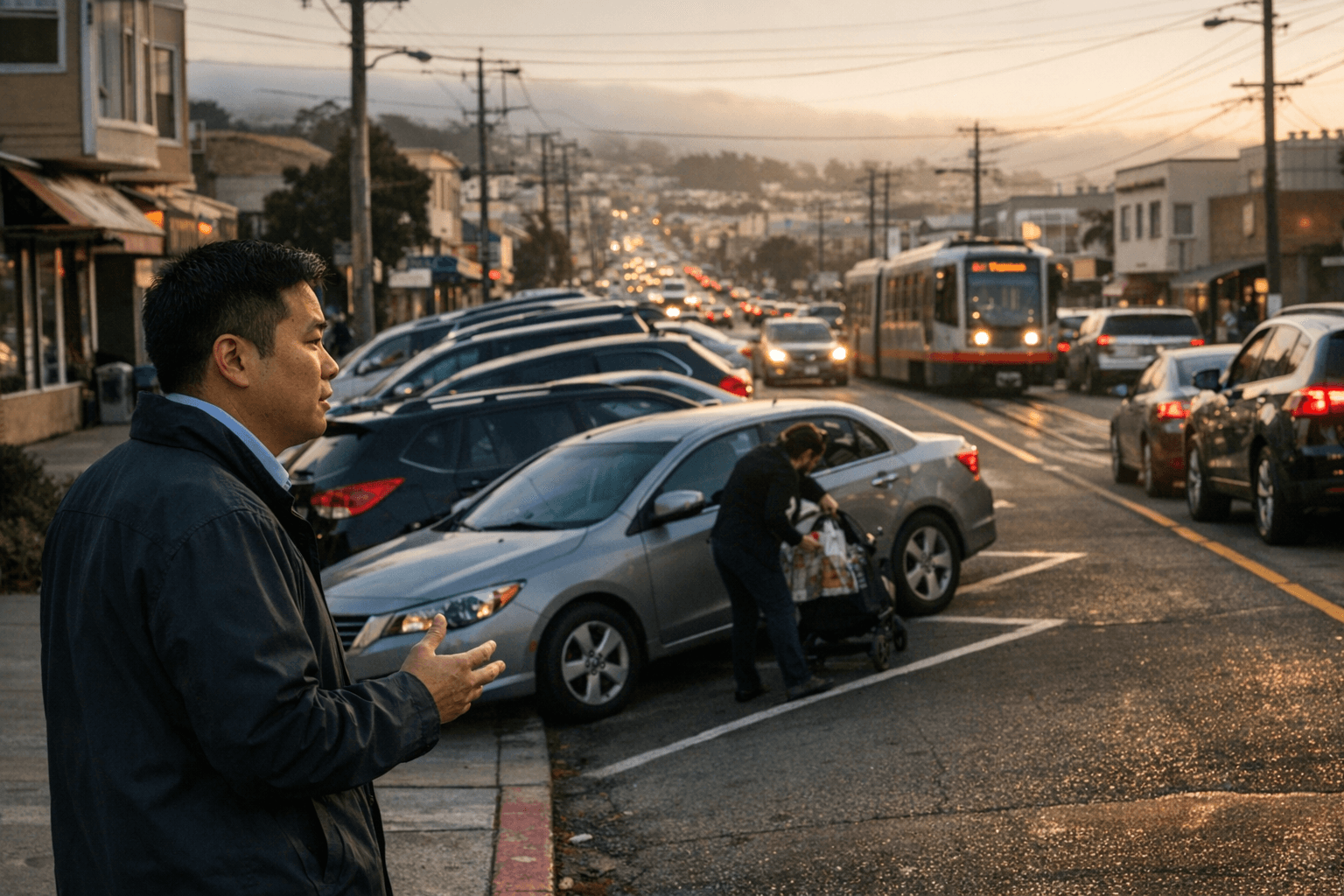
Liam Reidy, board president of the United Irish Cultural Center at 2700 45th Avenue, backed the proposal and pointed to Sloat Boulevard's existing angled parking as evidence the configuration works for institutions hosting large events. The Irish Center, celebrating its 50th anniversary this year, already has city approval for a new six-story building with two underground parking levels holding 54 cars. Margaret Graf, founder of Senior Power, a Sunset-based advocacy organization for older residents, has also raised concerns about parking scarcity, representing a constituency that has little flexibility to absorb longer walks from car to destination.
The 2017 vote, however, remains the central obstacle. Only 38 percent of eligible residents on those 25 blocks participated, yet the margin was overwhelming. The tradeoffs that drove that defeat have not changed. Angled parking narrows effective lane width, complicating delivery truck access, emergency vehicle movement, and drivers reversing into traffic. Cyclists face a fundamentally different hazard: rather than being doored, they contend with cars backing toward them from wide angled stalls. Wide-stall geometry can also compress pedestrian sight lines at corners. SFMTA has said it evaluates safety criteria including sight lines before approving any conversion, but block-by-block safety analysis for Wong's new targets has not been made public.
Wong, a lifelong Sunset resident who served five years on the City College Board of Trustees and works at the Children's Council of San Francisco, is running in the June 2026 special election for the District 4 seat, the same seat that changed hands twice in quick succession after the recall of Joel Engardio and the resignation of interim appointee Beya Alcaraz. His focus on an issue as viscerally felt as parking scarcity carries obvious political weight heading into that vote. Whether he can reverse the neighborhood's eight-year verdict on angled parking, and whether he can do it with more block-by-block specifics than he has offered so far, will determine if this proposal carves out more rows of angled cars on Sunset streets or becomes the second conversion plan to die at the curb.
This article was produced by Prism’s automated news system from verified source data, official records, and press releases, then run through automated quality and moderation checks before publishing. The system is built and supervised by the people who set the standards it runs under. Read our full AI policy.
Did this article answer your question?