SF Tech Jobs Keep Falling Even as AI Investment Surges
SF and San Mateo counties lost 4,400 jobs in 2025 even as OpenAI and Anthropic posted a record 410 AI job listings per month.
Lunchtime lines snake around the block outside SoMa restaurants, apartment hunters are trading bids over asking price in the Mission, and OpenAI has signed leases totaling roughly a million square feet. But behind the surface signals of a boom, San Francisco is still shedding tech jobs at a pace that no amount of AI investment has yet reversed.
San Francisco and San Mateo counties lost a combined 4,400 jobs, a 0.4% decline, in 2025, according to California Employment Development Department data. The information sector took the deepest hit, losing 4,500 jobs, roughly a 4% drop. Professional and business services shed a net 3,600 more, with the sharpest cuts concentrated in professional, scientific, and technical services and in corporate management roles. Modest gains in administrative and support services provided only partial relief, and healthcare emerged as the clearest bright spot in an otherwise contracting market.
The raw employment headcount in the two-county area tells the same story: 194,500 tech jobs in November 2024, falling to 190,000 by March 2025 and barely recovering to 190,800 by November 2025. Meanwhile, monthly tech job listings averaged just 2,295 in 2025, a figure that has not come close to the pre-2023 range. Between 2019 and 2022, average monthly listings never dipped below 3,875 and reached 4,798 in 2019, according to Lightcast data compiled by Ted Egan, the city and county of San Francisco's chief economist.
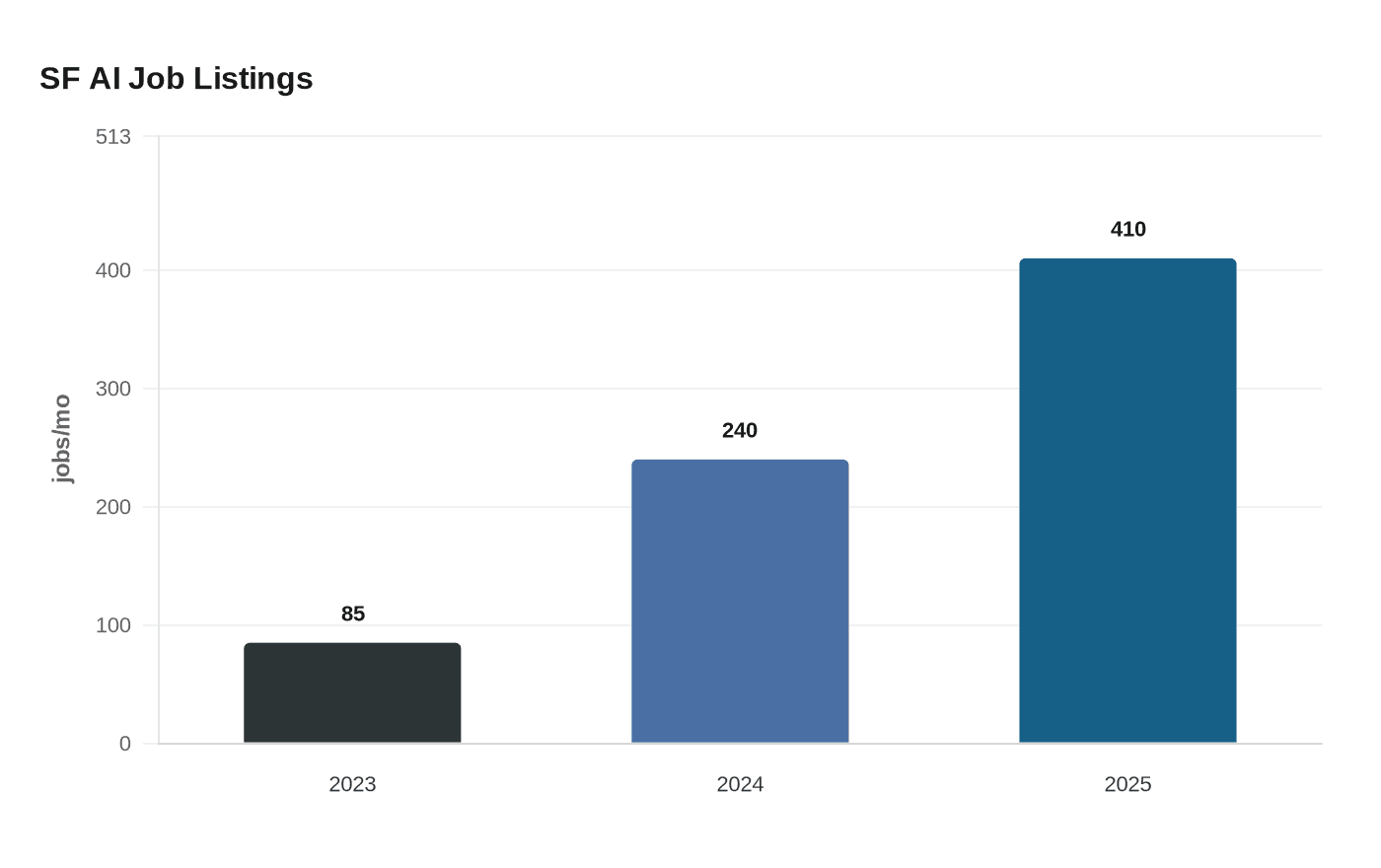
Generative-AI companies are hiring, but not nearly enough to fill the gap. OpenAI and Anthropic and their peers listed an average of 410 San Francisco jobs per month in 2025, up from 240 per month in 2024 and 85 per month in 2023. AI roles now account for 18% of all monthly tech job listings in the city, compared with just 4% in 2023. Yet that growth has not translated into a broad recovery.

"The rate of job losses is slowing in tech," Egan said. "There isn't yet sign of a durable jobs recovery, and the jobs we're seeing in AI are not enough."
The reason, Egan and other analysts argue, is structural. This AI cycle is directing capital into infrastructure rather than payroll. Data centers, specialized chips, and computing power are absorbing billions in investment that in earlier tech booms would have flowed into office leases and salaries. "When tech is hiring, you have money flowing out of both the companies and their employees," Egan noted, underscoring what the city loses when that multiplier effect is absent.
Mass layoff figures show the worst of the cutting may be easing. In the last six months of 2025, employers let go 1,131 people in San Francisco through mass layoffs, defined as job-cutting events involving 50 or more workers at companies with at least 75 employees. Of those, 793 worked for tech companies or in tech jobs. That figure was less than half the total from the same period in 2024 and the lowest comparable six-month tally since 2021. But the slowdown in layoffs has not produced the hiring surge that typically follows.
Ahmed Banafa, a tech expert at San Jose State University, said the pattern reflects a deliberate restructuring by major firms. "Salesforce is not the only one. I mean, Microsoft did this before. Meta did it and most of the basic programming is done by AI. The same thing with Google, Alphabet," Banafa said. Companies are cutting roles and replacing a share of them with positions requiring AI skills. "They find that is going to replace a certain number of workers and staff, and this is reflected as cost cutting," he added.
Commercial real estate offers a similar mixed picture. Downtown San Francisco office vacancies remain near all-time highs even as AI companies sign the kind of leases not seen in years. Mark Ritchie, a Bay Area commercial real estate specialist, pointed to OpenAI's roughly million-square-foot commitment and Databricks' 300,000-square-foot lease in Sunnyvale. "These numbers don't exist anywhere else in the world," Ritchie said. But he cautioned against reading too much into them: "Even with the large-scale employment and leases we see with AI compared to the previous tech booms and the scale of that hiring and those leases, this is not that large."
For a city whose fiscal health has long depended on tech workers spending their salaries at local businesses, paying city taxes, and filling commercial space, AI infrastructure investment is a structurally different kind of boom, one that moves capital through server farms and semiconductor supply chains rather than through the neighborhoods of SoMa and the Financial District.
This article was produced by Prism’s automated news system from verified source data, official records, and press releases, then run through automated quality and moderation checks before publishing. The system is built and supervised by the people who set the standards it runs under. Read our full AI policy.
Did this article answer your question?

