SF Woman Says City Housing Deepened Her Addiction, Sparking Reform Calls
A San Francisco woman says city-funded housing deepened her addiction, spotlighting 875 overdose deaths recorded inside SF's own permanent supportive housing buildings since 2020.

At the Elm Hotel in the Tenderloin, and across dozens of single-room-occupancy buildings the city contracts to house formerly homeless San Franciscans, the Housing First promise of stability without precondition has come with a dangerous side effect for some residents: addiction not interrupted, but accelerated.
A formerly homeless woman's account of how city-provided permanent supportive housing deepened rather than disrupted her drug use has reignited the sharpest policy debate in San Francisco's homelessness response, raising a question that city officials have struggled to answer: do the Department of Homelessness and Supportive Housing's contracts with its 30-plus nonprofit providers contain any enforceable treatment access requirements, resident safety standards, or staffing ratios tied to measurable outcomes?
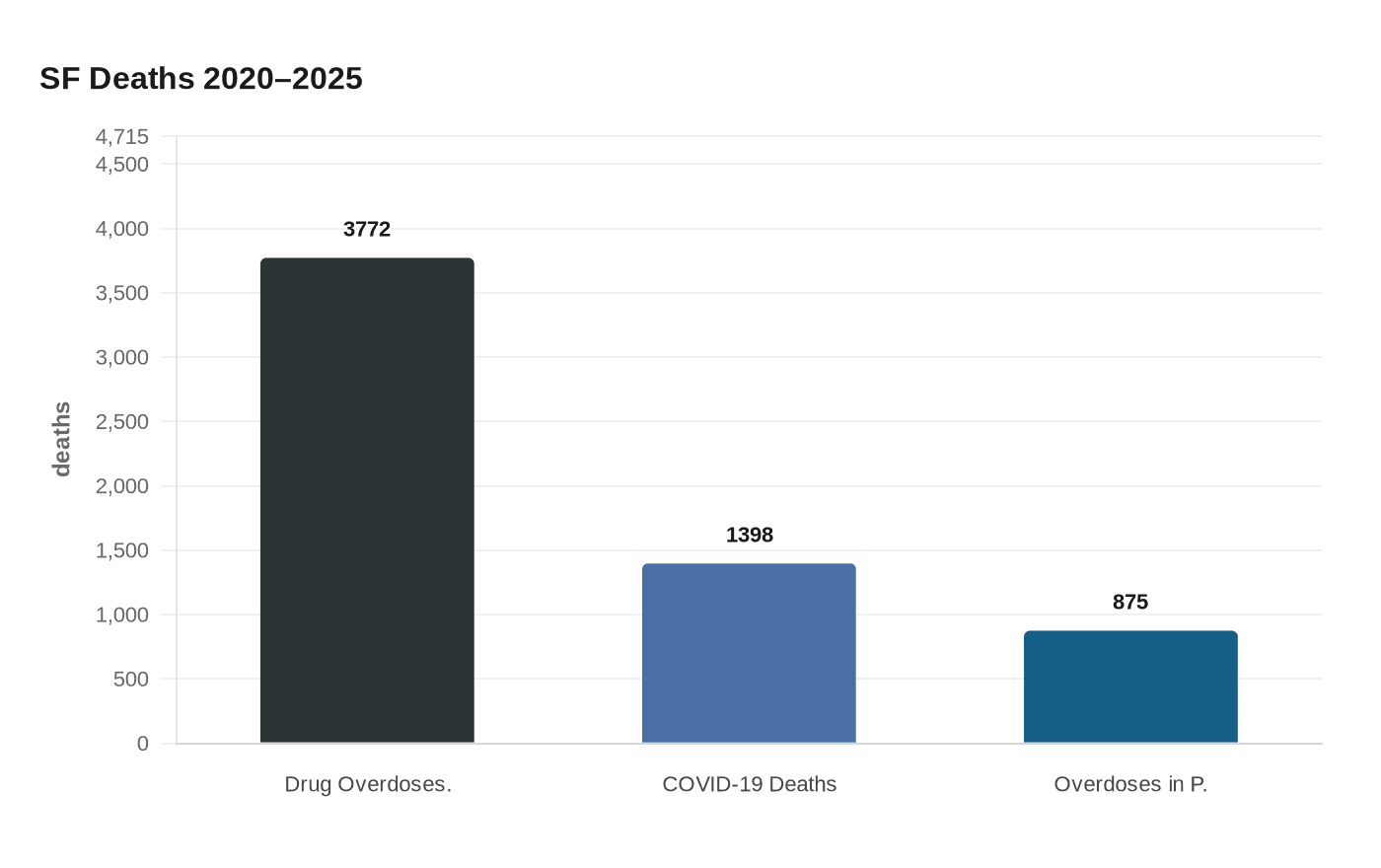
The numbers framing her story are severe. Between 2020 and 2025, 3,772 San Franciscans died of accidental drug overdoses, surpassing the city's 1,398 COVID-19 deaths over the same period by more than 2.7 times. Of those overdose deaths, 875 occurred inside San Francisco's 122 permanent supportive housing locations, roughly one in four fatalities. Six providers accounted for nearly 70 percent of those in-building deaths.
Episcopal Community Services led the group with 162 overdose deaths at its properties over five years. The city paid ECS $265,964,288 during that same period. On June 3, 2025, the Board of Supervisors unanimously approved a 24-month contract extension for ECS covering five Tenderloin hotels, the Alder, Crosby, Elm, Hillsdale, and Mentone, bringing the provider's cumulative grant ceiling to $72,297,684. Mayor Daniel Lurie signed the extension.
That contract renewal became a flash point for supervisors who argue the city has been paying for failure without demanding accountability. District 6 Supervisor Matt Dorsey, whose district encompasses much of the Tenderloin, co-authored the "Recovery First" legislation with Board President Rafael Mandelman, backed by Supervisors Stephen Sherrill and Danny Sauter. Lurie signed the law in May 2025. It enshrines long-term remission through recovery as the city's primary substance use disorder policy goal, a direct challenge to a decade-old state framework that Dorsey has described as one that "defied urging from the Obama Administration's HUD for recovery-inclusive supportive housing options, adopting instead a 100 percent drug-tolerant model, even as the deadliest drug crisis in human history was beginning to take hold."
Under Lurie's "Breaking the Cycle" plan, the Department of Public Health and HSH are now required to develop sober living options for people exiting homelessness. A sober living transitional housing site opened at James Baldwin Place in May 2025. The Board passed Lurie's Fentanyl State of Emergency Ordinance 10 to 1 in February, giving both departments formal authority to accelerate that shift.
But the underlying contract accountability question that the woman's story makes unavoidable has not been fully resolved. HSH has not publicly detailed whether its supportive housing agreements contain penalty clauses for high-mortality buildings or require minimum staff-to-resident ratios tied to overdose reduction benchmarks. With 14,000 households still registered and waiting under the city's Coordinated Entry System, and federal homelessness funding increasingly uncertain, how the city answers that question will shape the lives of the next cohort of residents placed into those Tenderloin hotels.
This article was produced by Prism’s automated news system from verified source data, official records, and press releases, then run through automated quality and moderation checks before publishing. The system is built and supervised by the people who set the standards it runs under. Read our full AI policy.
Did this article answer your question?