SFPD Swears In Three New Horses to Mounted Patrol Unit at Golden Gate Park
Three new horses joined SFPD's 152-year-old Mounted Patrol Unit last Thursday — and the unit's budget remains as opaque as its history is celebrated.
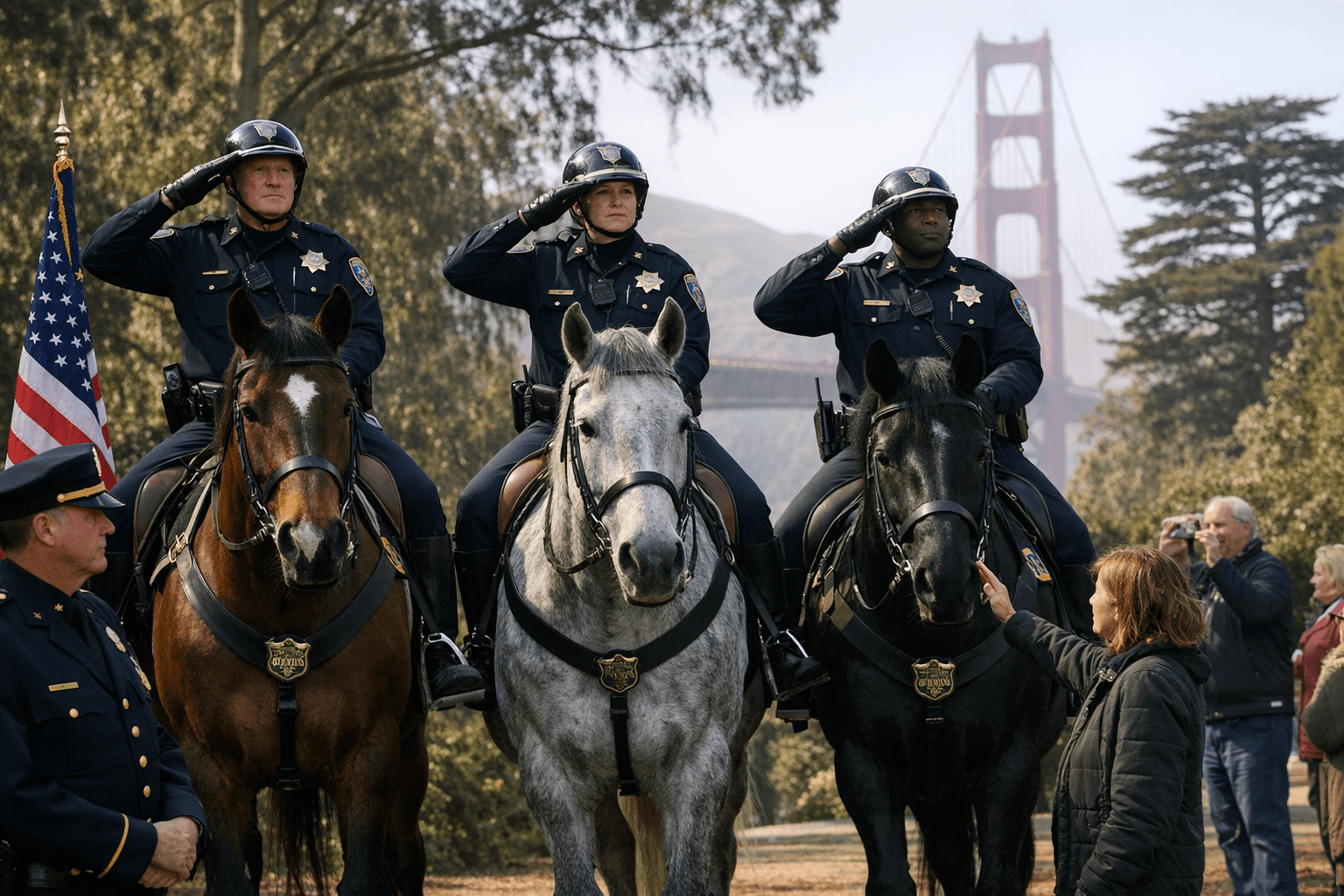
At the Fred C. Egan Police Stables inside Golden Gate Park, a horse named Sutro received a police badge affixed to his breast collar last Thursday, the latest recruit in a unit that has patrolled San Francisco continuously since 1874.
Sutro, along with Ozzie and Cinco, were formally sworn into the SFPD Mounted Patrol Unit during a Year of the Horse celebration that drew police command staff and residents to the park stables on March 26. The three horses join an existing stable of four — Rusty, Bubba, Duke and Gus — bringing the unit's working herd to seven and its operational reach across some of the city's highest-traffic corridors.
Deputy Chief of Special Operations Jason Sawyer, reading remarks on behalf of Chief Derrick Lew, who was unable to attend, framed the additions as part of an unbroken institutional continuum. "As we're stepping into the 152nd year of the Mounted unit, the people and the horses remain strong and committed to continuing an important role to protect public safety and build a relationship within the community," Sawyer said. He also pointed to the tactical advantage a horse gives over a patrol car in dense settings: "Their height offers a clearer view in the crowded areas."
That advantage is put to use across a wide swath of the city. The unit patrols Union Square's retail blocks, Fisherman's Wharf, Golden Gate Park, McLaren Park, China Basin, the Castro, Japantown, the Embarcadero, and Marina Green, as well as every major civic event on the calendar, from the St. Patrick's Day Parade to the Cherry Blossom Festival. Unlike patrol cars, horses can enter any space in the city, classified as service animals, and can thread traffic in ways that cut response time. The unit no longer deploys for active crowd dispersal, however; after incidents in which horses injured civilians in crowded situations, that role was phased out.
Getting a horse ready for that kind of environment is its own intensive process. Officer Tim Yee, handler of one of the newly sworn-in horses, described the gap between a working ranch animal and a city horse. "For a city horse, it's very different because in the country, they're out in the pasture and working on a ranch," Yee said. "You have to think about stuff like the Muni buses, school buses, electrical lines, railroad tracks, grates. They have to be acclimated to having a bunch of people come up to them." SFPD says the selection process eliminates more than 99 percent of candidate horses and typically takes more than a year from start to sworn-in.
What all of this costs is harder to determine than the ceremony suggests. SFPD does not publish a line-item breakdown for the Mounted Unit, and the department did not provide staffing counts or annual expenditure figures ahead of last week's event. The Fred C. Egan stables are staffed around the clock, seven days a week, by a dedicated civilian team of stable attendants, a commitment that adds overhead well beyond officer salaries. Among the department's roughly 80 specialty units, the Mounted Unit carries the longest officer wait list; one veteran rider reported waiting 24 years before his assignment came through.
That institutional loyalty has helped the unit outlast every budget fight directed at it. When Mayor Art Agnos moved to trim the unit's funding in 1988, supporters pushed a ballot measure that wrote the Mounted Unit directly into San Francisco's City Charter. Cutting it now requires a voter referendum, not just a line-item veto, a legal status no other police specialty unit in the city holds.
Seven horses, a 152-year history, and the protection of the city's foundational legal document: the Mounted Unit goes into this year harder to eliminate than it has ever been, and with three new badges to show for it.
This article was produced by Prism’s automated news system from verified source data, official records, and press releases, then run through automated quality and moderation checks before publishing. The system is built and supervised by the people who set the standards it runs under. Read our full AI policy.
Did this article answer your question?