Aztec mural preserves 1926 buffalo drive through historic district
A Main Avenue mural turns a July 1926 buffalo drive into a public landmark, linking Aztec’s streets, families and museum history in plain view.
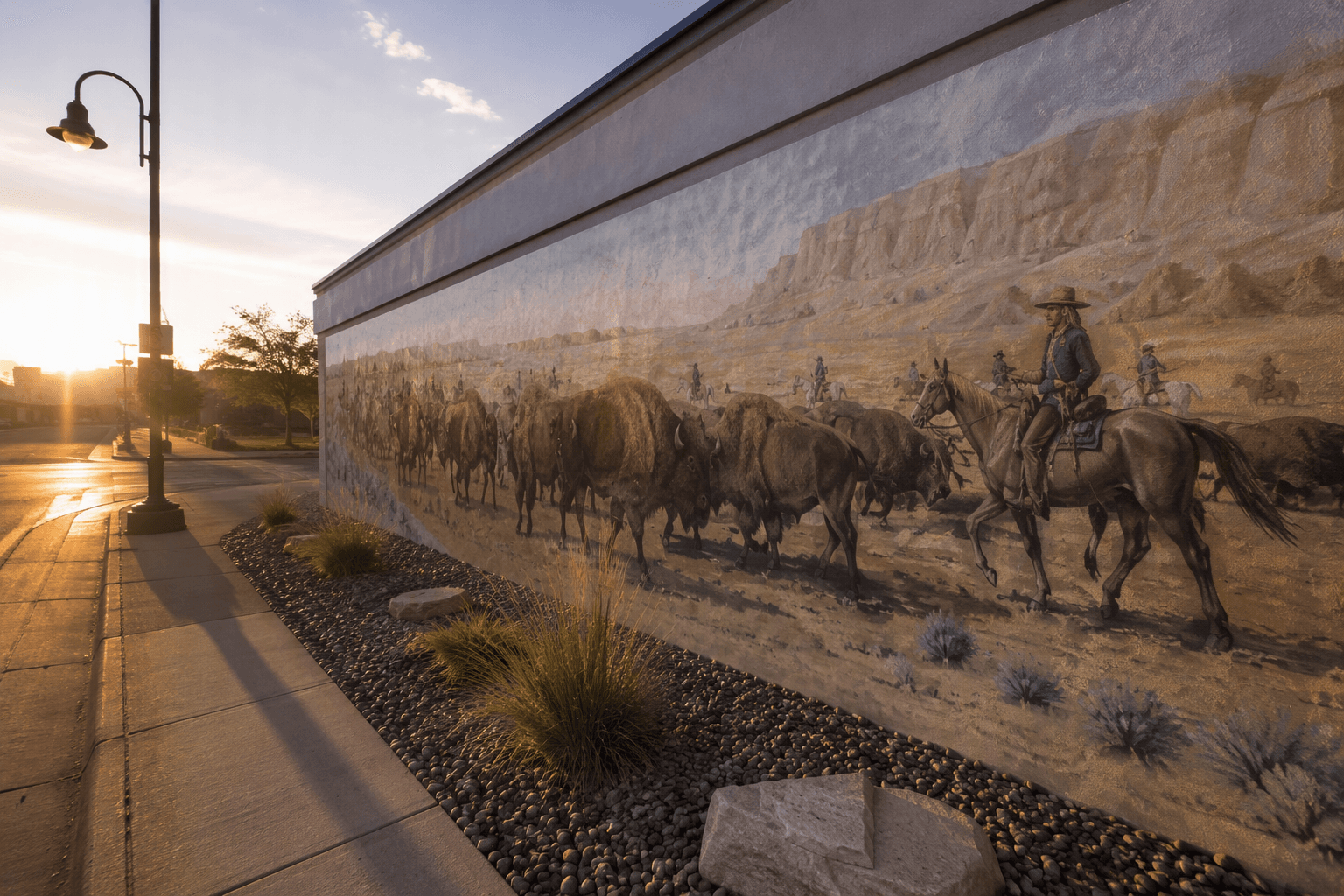
On Main Avenue in Aztec, a mural marks a July 1926 buffalo drive through the National Historical District and turns a brief local scene into a permanent civic landmark. Painted just south of Aztec Museum & Pioneer Village, it preserves a moment tied to real streets, real families and a place residents still walk past today.
A photograph became a wall-sized record
The Buffalo Mural on Main did not begin as a generic piece of public art. Aztec Museum & Pioneer Village says it was inspired by a 1926 photograph published by The Aztec Independent Review, giving the mural a direct line to a specific local image and the newspaper record behind it. Southwestern artist John Cogan completed the mural in 2010, and the project was funded by a donation from Dr. Craig and Dorrie Edgerton.
Those details matter because they show how the town chose to preserve its history. The mural was not added as decoration alone; it was created with names, dates and a documented scene in mind. That is what makes it such a strong civic marker for Aztec, where memory is tied closely to streets, institutions and the built landscape.
Why the 1926 buffalo drive still resonates
The event at the center of the mural was a July 1926 buffalo drive through Aztec’s National Historical District. The museum’s walking-tour materials place the scene in a specific town setting, not in a vague frontier myth. The public-art page invites viewers to imagine Aztec in that month, when cotton from the giant cottonwood trees drifted across Main Street and settled on the dark dirt below.
That visual detail gives the mural its power. It connects agriculture, transportation and daily life in one scene, with black cars, mostly from the Model T era, sharing the road with a buffalo drive in the middle of town. For residents, the mural turns an old photograph into something much more immediate: a reminder that Aztec’s streets once carried livestock, vehicles and the rhythms of a community built around the river corridor.
The event matters locally because it is part of Aztec’s own memory, not imported history. A mural like this preserves the kind of story that can disappear when it lives only in newspaper archives or family recollections. Put on Main Avenue, it becomes part of the town’s public language, visible to anyone passing by the museum or moving through the district.
How the museum frames Aztec’s past
Aztec Museum & Pioneer Village describes itself as a historical museum of northwest New Mexico, and the buffalo mural fits squarely inside that mission. Its Pioneer Village interpretation focuses on settlement along the Animas River and on the practical needs that shaped community life: food, trade, transportation, entertainment and spiritual observances. That approach makes the mural more than a single image. It becomes one thread in a broader story about how people built and sustained Aztec.
The museum’s exhibits deepen that picture. The Pioneer Room includes information on Aztec’s early families and photographs of 78 buildings in the area, linking people to the structures they lived in and used. The broader Pioneer Village features 14 original and replicated structures dating from the 1880s, reinforcing that the museum treats history as something grounded in place, architecture and family memory.
Seen alongside those exhibits, the mural functions like an outdoor extension of the museum’s work. It connects the public street to the indoor collection, making local history visible before a visitor ever steps through the door. That is especially important in a town where so much of civic identity is tied to what remains standing, what gets preserved and what stories are made visible in public.
What to see in person
The mural is easiest to understand in person because its meaning depends on its location. It sits on Main Avenue, south of Aztec Museum & Pioneer Village, so the street itself becomes part of the interpretation. A quick stop lets you compare the mural’s historic scene with the present-day district around it, where the museum anchors one end of the experience.
- Buffalo Mural on Main Avenue, south of Aztec Museum & Pioneer Village
- Aztec Museum & Pioneer Village, 125 N. Main, Aztec, New Mexico
- Open Tuesday through Saturday, 10 a.m. to 4 p.m.
A simple visit can include both the mural and the museum:
The museum setting helps explain why the mural has staying power. It is not an isolated artwork hanging on a wall for art’s sake. It is a public marker chosen to sit beside an institution that already collects early family history, documents buildings and interprets the town’s development along the Animas River.
What residents can learn from seeing it is straightforward but lasting: Aztec has long chosen to remember itself in public. The buffalo drive of July 1926 lives on because the town made room for it on Main Avenue, where history is still part of the everyday streetscape.
This article was produced by Prism’s automated news system from verified source data, official records, and press releases, then run through automated quality and moderation checks before publishing. The system is built and supervised by the people who set the standards it runs under. Read our full AI policy.
Did this article answer your question?