Aztec Ruins offers a close-up look at Chacoan history in Aztec
A half-mile walk at Aztec Ruins opens a compact Chacoan world: over 500 rooms, a restored Great Kiva, and living ties to Indigenous communities.
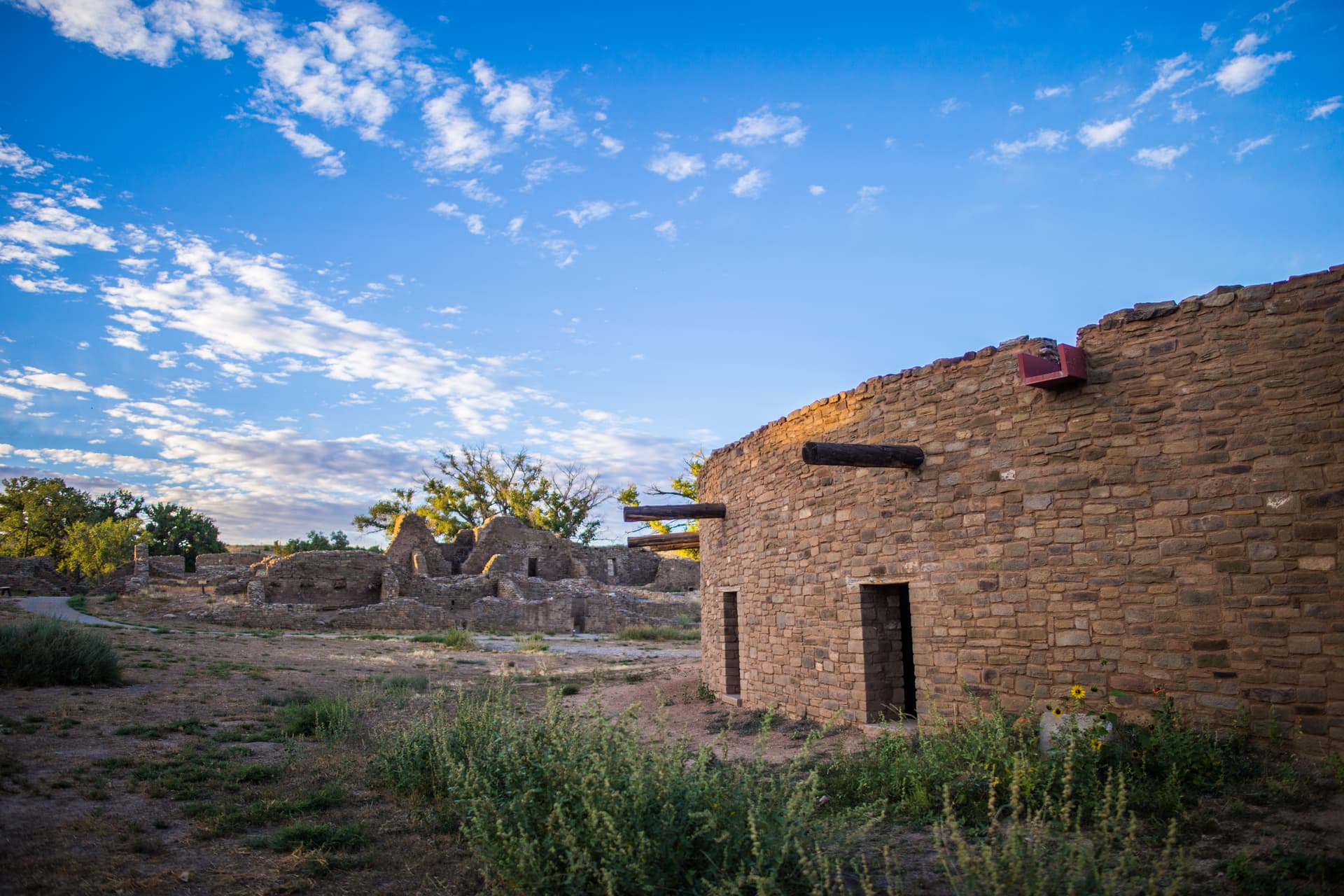
Original masonry, wooden beams, and a rebuilt Great Kiva make Aztec Ruins National Monument one of the largest and most monumental Chacoan settlements outside Chaco Canyon. The monument is small enough for a short stop, but dense enough to reward a closer look.
Start at the visitor center
The best way in is the visitor center, which sits in the former home of pioneering archaeologist Earl Morris. It is the place to get an orientation, pick up a trail guide, browse the museum, and watch the 15-minute film *Aztec Ruins: Footprints of the Past*, which brings together Pueblo voices, Navajo tribal members, and archaeologists.
Aztec Ruins is one of the best-preserved Chacoan structures of its kind and is deeply sacred to many Indigenous peoples of the American Southwest. The visitor center is open daily from 9 a.m. to 5 p.m., except Thanksgiving, Christmas, and New Year’s Day, while the public areas of the monument are open daily from 7 a.m. to 5 p.m.
Walk the West Ruin trail
The main draw is the self-guided Aztec West trail, a half-mile route that leads into the West Ruin itself. Tree-ring dates place occupation at the site from about A.D. 1110 to the late 1200s, and the settlement grew into a regional center after Chaco declined farther south. At its height, the West Ruin had more than 500 rooms, along with multiple kivas, making it a serious political, social, and economic center rather than a small outpost.
What you notice on foot is the precision. The walls still show skilled stone masonry, original mortar in some places, and original wooden beams in others, details that are easy to miss if you only glance from a distance. The rebuilt Great Kiva is the centerpiece, a major ceremonial structure and one of the largest reconstructed buildings of its kind.

The comparison that helps most is Chaco Canyon itself, about 55 miles to the south. Aztec Ruins belongs to the same architectural and cultural world, but because it sits near downtown Aztec and within the City of Aztec’s surrounding footprint, it is far easier to reach on a short San Juan County outing than many larger archaeological sites.
A site shaped by excavation and preservation
In 1916, the American Museum of Natural History began sponsoring excavations, and Earl H. Morris, then 25, headed the first dig. He spent seven seasons excavating and stabilizing the West Ruin, the Great Kiva, and parts of the East Ruin, and he later supervised restoration work in the early 1930s at Aztec and other Southwest sites.
The Great Kiva reconstruction came in 1933 to 1934, with National Park Service involvement and Morris returning in 1934 to oversee the work. The reconstruction cost $12,451. The visitor center itself began as the Earl Morris house.
President Warren G. Harding established Aztec Ruins National Monument by proclamation on January 24, 1923, preserving it “for the enlightenment and culture of the nation.” Most of the land was donated to the federal government by the American Museum of Natural History in 1921, 1928, and 1930, and in 1931 the government purchased another 6.8 acres from the heirs of H. D. Abrams.
Why it matters to living Indigenous communities
Aztec Ruins is part of UNESCO’s Chaco Culture World Heritage property, which includes Aztec Ruins National Monument, Chaco Culture National Historical Park, and several smaller Chaco sites.
The park’s history-and-culture materials acknowledge many traditionally associated tribes, including the Hopi Tribe of Arizona, Navajo Nation, Jicarilla Apache Nation, Kewa Pueblo, Mescalero Apache Tribe, and Ohkay Owingeh, among others. Federal repatriation notices show the monument working with tribes under law.
Make time for the broader setting
The monument includes a nearby Animas River walk and picnic area, where a half-mile path connects visitors to the river. The monument sits inside the modern town of Aztec, just a short drive from Farmington.
The park covers 129 hectares, or 318 acres, and a 2023 landscape restoration project aimed to protect unexcavated cultural resources from wind erosion and climate change.
This article was produced by Prism’s automated news system from verified source data, official records, and press releases, then run through automated quality and moderation checks before publishing. The system is built and supervised by the people who set the standards it runs under. Read our full AI policy.
Did this article answer your question?