Farmington prayer walk honors slain Navajo men, protests injustice
Dozens walked downtown Farmington to honor three Navajo men killed in 1974 and press for public recognition of a massacre that still shapes San Juan County politics.
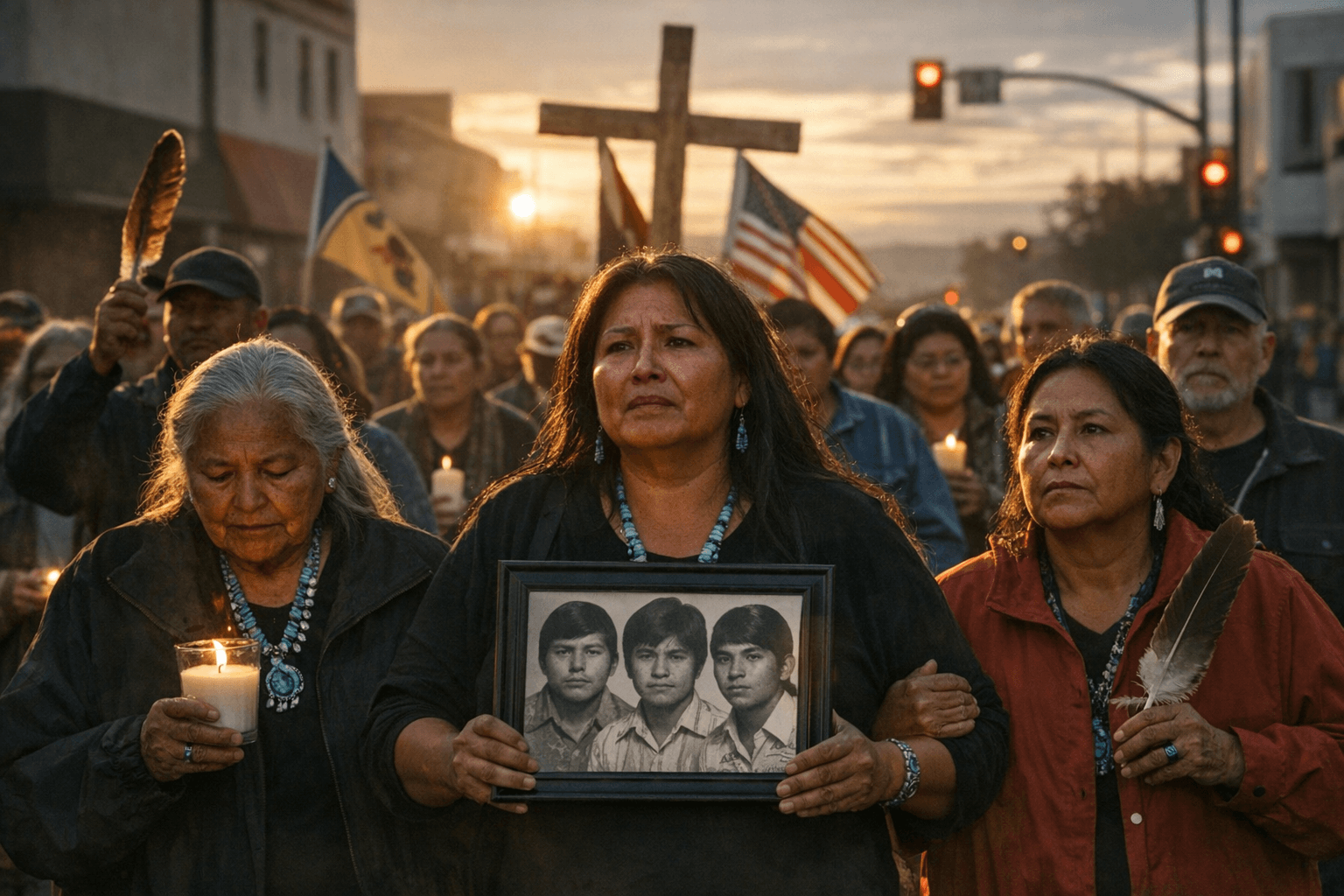
Downtown Farmington became a place of remembrance and protest as dozens of Indigenous people walked past the Totah Theater area on April 11 for the annual Chokecherry Canyon Massacre Memorial Prayer Walk, honoring Herman Dodge Benally, John Earl Harvey and David Ignacio and demanding that the city face what happened to them.
The march tied a public ceremony to a hard civic question that has not gone away in San Juan County: how the city remembers the killing of three Navajo men by three white Farmington high school students in 1974, and whether local institutions are willing to treat that violence as part of the county’s shared history. Participants carried flags, raised fists and used the walk to call for public recognition, education and reconciliation, not just mourning.
The punishment handed down after the killings still hangs over the story. The attackers were sent to reform school and served less than two years, a result many Native residents have long viewed as a sign of unequal treatment under the law. That public anger helped trigger a civil-rights investigation by the New Mexico Advisory Committee to the U.S. Commission on Civil Rights, which held a three-day open meeting in Farmington in 1974 and concluded that Native Americans in almost every area suffered from injustice and maltreatment.
The committee’s July 1975 report, The Farmington Report: A Conflict of Cultures, examined community attitudes, the administration of justice, health and medical services, alcohol abuse and alcoholism, employment and economic development. A later U.S. Commission on Civil Rights press release said the committee’s Farmington hearings followed the mutilation murders of the three Navajo men and drew testimony from more than 60 people.
The question of what Farmington remembers has continued to surface. A 2005 follow-up report found race relations had improved in some ways but still cited concerns including Native underrepresentation on the Farmington City Council and disproportionately high arrest rates. A 2011 briefing said the commission had previously studied discrimination against Native Americans in border towns and noted that Farmington again hosted a forum in 2004.
The walk’s endurance shows why the massacre remains present in civic life here, not just in history books. In 2024, more than 250 people marched in Farmington for the 50th-anniversary remembrance, and local reporting identified the victims as John Earl Harvey, 39, of Fruitland, Herman Benally, 34, of Kirtland, and David Ignacio, 52, of Blanco Trading Post. The annual prayer walk keeps that grief visible, while asking San Juan County to confront the past as part of its future.
This article was produced by Prism’s automated news system from verified source data, official records, and press releases, then run through automated quality and moderation checks before publishing. The system is built and supervised by the people who set the standards it runs under. Read our full AI policy.
Did this article answer your question?