San Juan College student welds a path for women in trades
Tia Harrison’s welding path shows how family legacy, college training and local job demand can turn a trade into a stable career for San Juan County women.
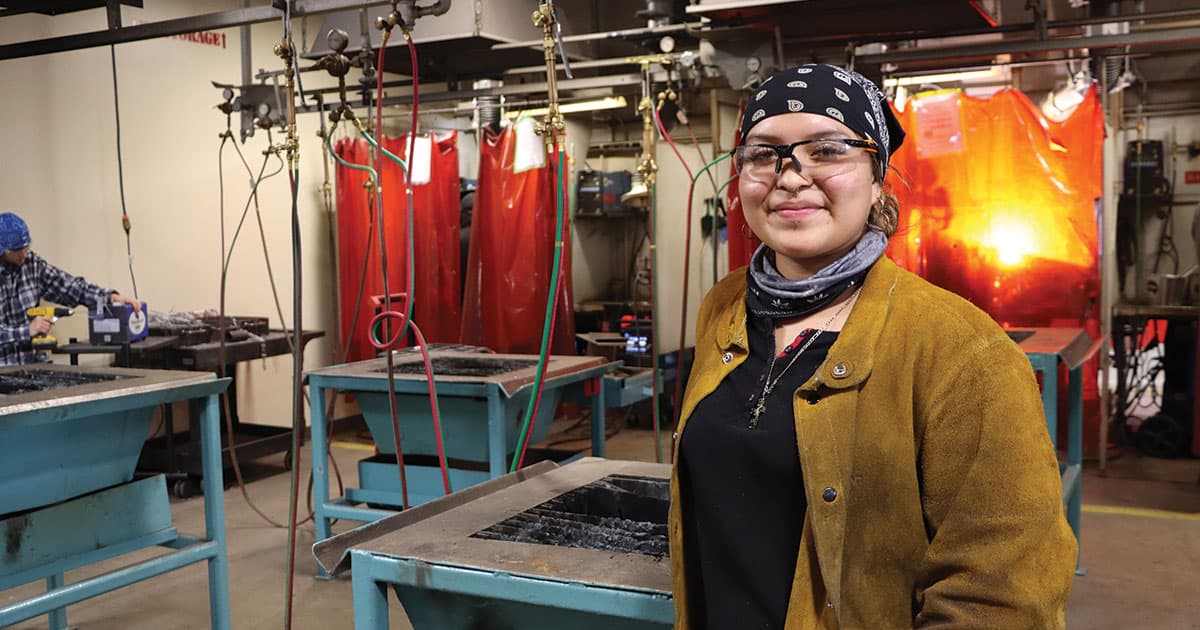
The tools Tia Harrison’s grandmother passed down did more than connect a family. They helped set Harrison on a welding path that now runs from a free training program in Gallup to San Juan College’s shop floor in Farmington, with a trade that paid a national median wage of $51,000 in May 2024 and is projected to need about 45,600 openings a year through 2034.
A family legacy in steel
Harrison’s interest in welding began with her grandmother, a former heavy equipment operator and boilermaker who introduced her to the trades and showed her what skill and persistence could make possible. When Harrison chose to pursue welding professionally, her grandmother gave her a leather jacket, gloves and welding equipment, a practical handoff that doubled as a vote of confidence. Harrison is now the first person in her family to attend college, which gives her training path a second weight: it is not only a career step, but also a family milestone.
That family story matters in San Juan County because the region’s workforce conversations are really about who gets access to good wages without having to leave home. Harrison’s experience shows how a trade can become both an entry point into the labor market and a way to build something durable for the next generation. In a county where rent, fuel and household expenses can quickly outrun entry-level pay, a credential that leads to a skilled occupation has immediate economic value.
A fast track from Gallup to Farmington
After high school, Harrison enrolled in the Industrial Workforce Program in Gallup, a free 12-week construction training program that includes welding and heavy equipment and offers job placement assistance. The program gave her an early look at construction work, heavy equipment operation and welding techniques, and the experience was enough for an instructor to push her toward more advanced training. That recommendation led her to San Juan College, where she moved away from home and lived on campus while she worked toward her welding degree.
That pathway is important because it compresses the time between interest and income. San Juan College’s School of Trades and Technology says students can earn a degree or certificate in two years or less, and the college’s welding certificates are designed as one-year and two-year options for people aiming to move quickly into the field. For students balancing family obligations, transportation limits or the need to stay in northwest New Mexico, that shorter timeline can make the difference between trying a trade and actually starting a career in it.
What San Juan College teaches in the shop
San Juan College’s Welding AAS is built around plate and pipe welding, using oxy-acetylene, shielded metal arc welding, gas metal arc welding, flux core arc welding and gas tungsten arc welding. The catalog also builds in mathematics, blueprint reading, drafting and metallurgy, which means the program is aimed at more than torch time alone. SJC describes its welding facilities as state-of-the-art and says the program meets national weld standards, so students are training in an environment that mirrors the expectations of employers who care about precision, safety and code compliance.

That hands-on design is central to Harrison’s progress. In the shop, she learned by doing, not by sitting through a long stretch of theory before touching equipment, and that approach helped her build confidence while sharpening the practical skills employers want. The college’s certificate options reinforce the same model: introductory work in the general certificate and more advanced shop work, blueprints and fabrication techniques in the advanced certificate.
Where the pay and jobs are
The broader labor market explains why welding remains such a strong local pathway. The U.S. Bureau of Labor Statistics says welders, cutters, solderers and brazers had a median annual wage of $51,000 in May 2024, and even though employment growth is expected to be slow, the occupation is projected to generate about 45,600 openings each year on average from 2024 to 2034. Those openings matter in a region like San Juan County, where career training is closely tied to keeping more workers in the local economy instead of sending them out of the area for work.
Local hiring shows that demand in practical terms, too. Current Farmington listings include a code welder opening at Bailey’s Welding Service Inc. paying $20 to $23 an hour, a structural welder role at Hitachi Global Air Power US with pay listed at $19 to $25 an hour, and weld-related openings at C&J Equipment Manufacturing in Bloomfield. Those are the kinds of jobs that turn training into a paycheck, especially for students who want to stay in the Four Corners region after graduation.
San Juan College’s place in New Mexico’s workforce system underlines that demand at a bigger scale. The New Mexico Higher Education Department said SJC had 643 students enrolled in the state’s $60 million high-demand workforce-training effort, second only to Central New Mexico Community College’s 2,121. Higher Education Secretary Stephanie M. Rodriguez said, “These results make it clear that New Mexicans are eager for flexible, accessible pathways to high-demand careers and these efforts are meeting their needs.”
Why Harrison’s path matters for women in trades
Harrison’s story is also about who gets seen as belonging in welding shops. San Juan College says she is carving out her own place in the trade and proving that women belong in technical careers that have long been male dominated. That matters not only as a symbol, but as a practical example for younger students who need to see someone from their own community succeeding in a field that can lead to stable wages, code-level credentials and work close to home.
For San Juan County, the larger lesson is straightforward: a welding credential can move from family encouragement to classroom training to local employment in a matter of months, not years. Harrison’s path shows how a grandmother’s tools, a free training program in Gallup and San Juan College’s shop-based instruction can combine into a direct route to economic mobility, while also widening the door for women who want a place in the trades.
This article was produced by Prism’s automated news system from verified source data, official records, and press releases, then run through automated quality and moderation checks before publishing. The system is built and supervised by the people who set the standards it runs under. Read our full AI policy.
Did this article answer your question?