Small-Town Business Defies Rural Decline, Becomes Community Living Room
A former lumberyard in Madison, Minn. is now a 15,000-sq-ft community living room — and the data says it's not a fluke but a signal of rural Minnesota's real comeback.
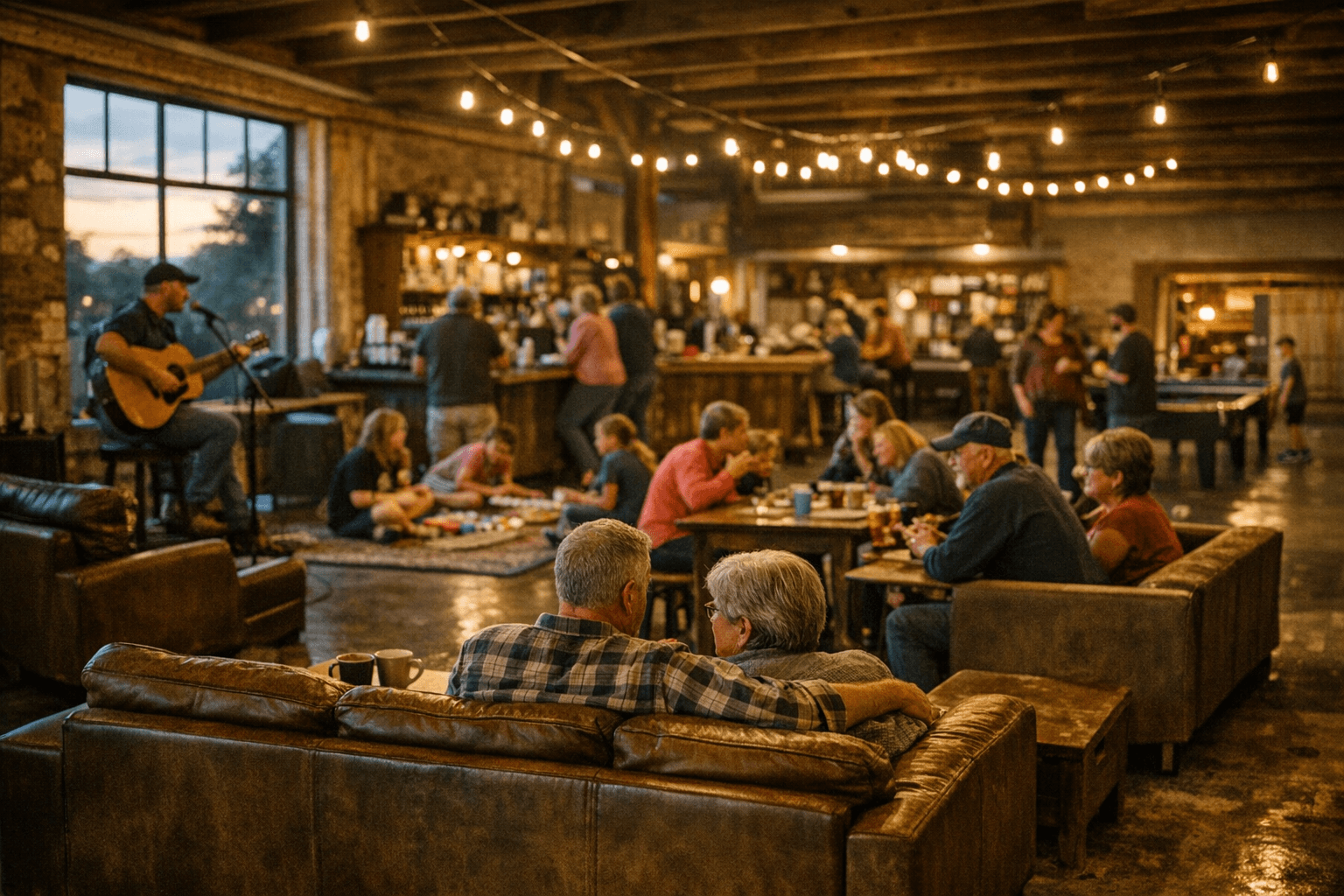
On a Tuesday afternoon in downtown Madison, Minnesota, a group of women calling themselves the "Bored Tuesday Ladies" are slapping down playing cards for nickel stakes. An espresso machine whirs. A guitar waits on a nearby stage. This is not a scene from a town in decline. It is, according to a growing body of data and more than a few converts, a preview of what Greater Minnesota can look like when someone decides to stop waiting for revival and start building it.
The woman who built this particular version is Kris Shelstad, owner of the Madison Mercantile. Her business card lists it as a coffee house, art gallery, and innovation center, but that is, as she would be the first to admit, only the short list.
A 'Swiss Army Knife' for Small-Town Life
Shelstad acquired a former lumberyard, hardware store, and auto shop on the south end of downtown Madison and remodeled the cavernous 15,000-square-foot space into something the county's newspaper publisher once called a "Swiss Army knife" solution to the city's needs. The Mercantile opened in February 2022, and Shelstad recalls workers fielding curious visitors while the renovation was still underway. "We'd literally be here working and people would wander in, wondering 'what are you doing?' Most of them thought I was crazy, including the city council, I think," she said with a laugh.
The space now hosts a stage for live performances (the "Stad Stage"), a gallery for rotating art exhibits, a woodworking area stocked with donated tools, a classroom for a visiting guitar instructor, and an in-development audio room for podcasting. Regular programming includes a quilting group, a men's Bible study, an intergenerational music series, a Welcoming Committee promoting diversity and inclusion, and Prairie Eco-links, a group convening conversations on climate change and soil health. The Bored Tuesday Ladies showed up on their own.
Carmen Fernholz, a local farmer and community leader, put it plainly from a table near the card game: "This has been a real game changer. It's a gathering spot. It's something a lot of rural communities need, and this place fulfills it. It's just how you bring a rural community together."
Speed Friending and the New Arrivals
The Mercantile's most talked-about recent programming is speed friending, a structured social event borrowed from the logic of speed dating and designed specifically to help newcomers build community ties quickly. Shelstad and her Mercantile are an example of a phenomenon that is reshaping Greater Minnesota: an increasing number of young and middle-aged people are choosing to move in, especially since 2020, bringing fresh energy to the state's rural areas and defying the outdated stereotype that they are dying or dead.
Two groups appear to be fueling the shift: early and midcareer professionals returning to their roots, and seniors retiring to the lakes and woods of rural Minnesota. The Star Tribune reported one such example in Hibbing, in St. Louis County, where a woman took a remote position with the Minnesota State Colleges and Universities system and her husband found work as a city equipment operator, drawn north by access to hunting and fishing the Iron Range has always offered.
What the Numbers Actually Say
For decades, the conventional wisdom on rural Minnesota was grim enough that a 1993 book titled "The Decline of Rural Minnesota" all but wrote the region's obituary. The Center for Rural Policy and Development's "State of Rural 2026" report shows that from 2020 to 2024, most rural counties posted a modest increase in population after decades of decline. Rural counties also saw the highest percentage of self-employed people and the fastest growth in median wages.
Marnie Werner, vice president of research at the center, described the reversal directly: "Since the '70s, it's been a fairly steady outward migration from the rural counties and inward migration in the metro area. But now we've been seeing a modest reverse of that." She added a candid challenge to the dominant narrative: "We need to set aside this narrative that rural is dying, because it's not."
The data is encouraging, but it asks for nuance. Population growth from migration is currently making up for negative net natural population change, meaning there are more deaths than births in many rural communities. Madison's own county tells the story precisely: Lac qui Parle County, of which Madison is the county seat, declined 7.4% from 2010 to 2019, but has since reversed that trend, essentially holding flat from 2020 to 2024. Stabilization, not explosion, is the honest headline.
Analysts note hazards ahead, including declining birthrates and an aging population; over time, rural areas will see slower growth alongside the state as a whole. The recovery window is real, but it is not unconditional.
Is the Mercantile an Outlier?
The short answer is: not quite, but also not yet the norm. The Mercantile represents what becomes possible when physical infrastructure, entrepreneurial risk, and community programming align in the same building at the same time. That convergence is rare. What makes Madison notable is that the space did not emerge from a government grant or a regional economic development blueprint. It emerged from one person's decision to remodel a lumberyard.
Whether St. Louis County's smaller cities such as Ely, Tower, Babbitt, or Chisholm can replicate the model depends in part on whether they can attract the same kind of anchor entrepreneur. But replication also depends on conditions that no single business owner can create alone.
What Would Actually Move the Numbers
To fill gaps in essential services, workers need affordable housing. People want to come to live, to work, to raise their families in rural areas. But they can't if there isn't a place to live. Researchers working on rural housing policy emphasize the need for options at every life stage: starter housing for young professionals, family-scale homes, and senior facilities that allow longtime residents to age in place without holding onto oversized properties.
Childcare is the less-discussed structural barrier. The cost-of-living calculations used by Minnesota DEED assume a three-person household with one child needing childcare, and in many parts of Greater Minnesota, wages cover local living costs reasonably well. The problem is that childcare slots, not just childcare costs, are scarce in rural communities; without them, two-income households cannot function, and the in-migration of working families stalls.
Broadband is the third pillar. St. Louis County's own comprehensive plan noted that as of 2017, only 39% of county residents had access to 100 mbps service, the speed threshold the state set as its 2026 target. Remote work brought a wave of new rural residents after 2020, but sustaining that wave requires connectivity that matches what workers left behind in the metro. Federal infrastructure funding has improved the picture since 2017, but coverage gaps in the county's townships remain a measurable drag on economic participation.
The Mercantile in Madison is a signal, not a solution. It demonstrates that community infrastructure can be built from the bottom up, that speed friending can substitute for years of slow social integration, and that a former lumberyard can become the most important room in a small town. But the migration trends underpinning it are fragile. Childcare, housing supply, and broadband are the unsexy levers. They are also, according to the data, the ones that determine whether the recovery holds.
This article was produced by Prism’s automated news system from verified source data, official records, and press releases, then run through automated quality and moderation checks before publishing. The system is built and supervised by the people who set the standards it runs under. Read our full AI policy.
Did this article answer your question?