St. Louis County Recorder’s Office helps with vital and property records
A birth certificate, deed search or marriage record can stall probate or a closing. St. Louis County’s Recorder’s Office is the fastest starting point if you know the right office.

In St. Louis County, the Recorder’s Office handles vital records and real estate records through offices in Duluth, Hibbing and Virginia, plus a satellite office in Ely.
What the Recorder’s Office actually holds
The Recorder’s Office helps with birth, death and marriage records, along with real estate-related records.
For birth, death and marriage questions, the county lists 218-726-2559 as the main contact. In Hibbing, the Public Records / Vital Records Division is at 1810 12th Ave. E., #100, Hibbing, MN 55746, with phone 218-312-8109. If you are trying to settle an estate, confirm a family relationship or track a property transfer, starting with the right office can save a second trip.
Birth, death and marriage records follow different rules
Minnesota birth and death records can be requested from any Minnesota county, with some exceptions. Minnesota birth records are available throughout the state, but records for births occurring before 1935 may take longer to obtain.
Marriage records work differently. A marriage license application may be purchased from any county in Minnesota, but a marriage record may be purchased from the county where the marriage license was issued. Certified copies of a marriage record are available from the county where the marriage application was made, and users are directed to the Minnesota Official Marriage System to search by county before ordering.
Tangible Interest and privacy protections
St. Louis County requires Tangible Interest to obtain a birth certificate, and some birth certificates are confidential and can be released only to certain individuals or the parent on the record. The Minnesota Department of Health’s Tangible Interest form is the state authorization tool the county uses for local registrars.
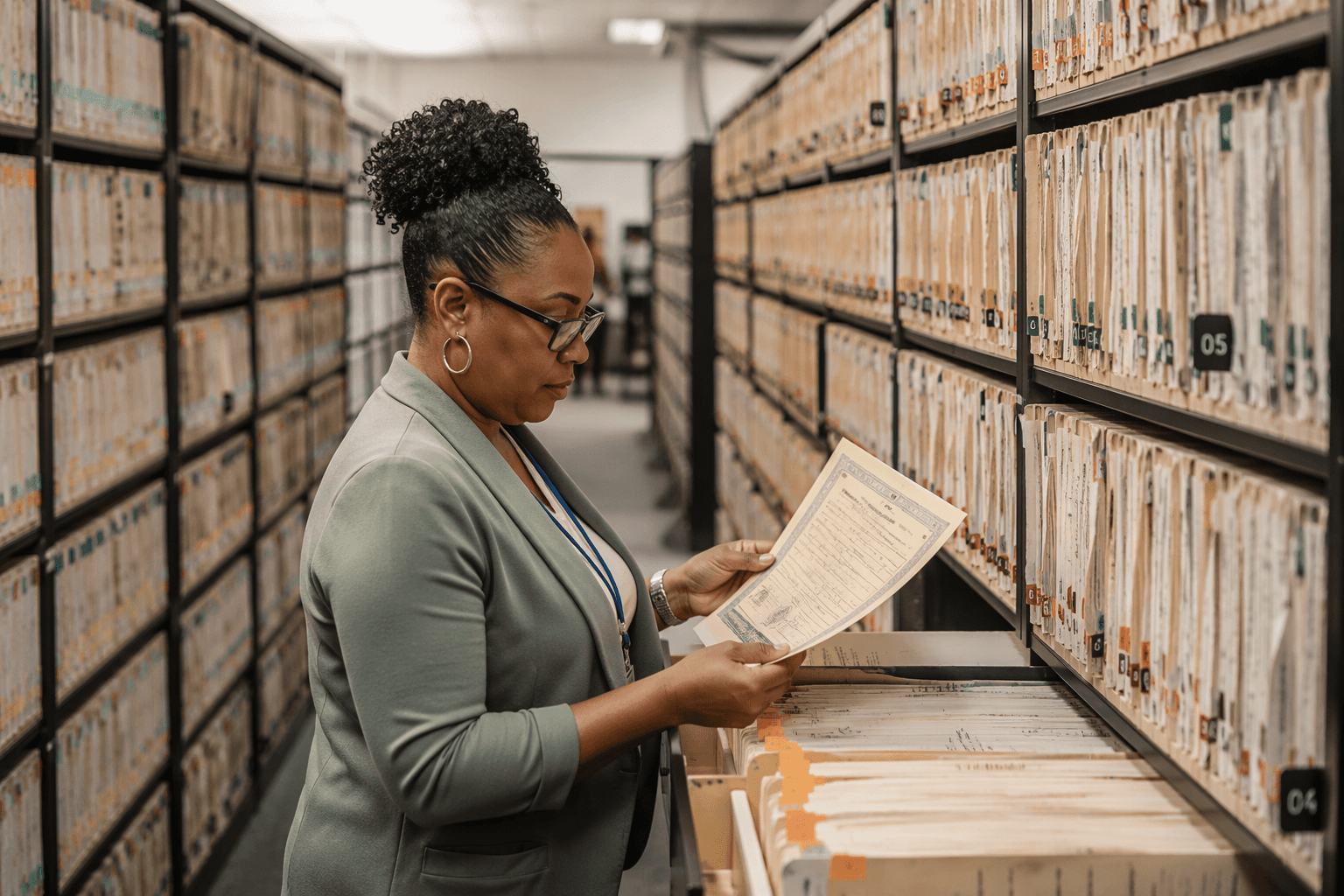
A Minnesota noncertified birth record application posted by another county states that anyone who willingly and knowingly, without authority and with intent to deceive, obtains a vital record is guilty of a gross misdemeanor under Minnesota Statutes, section 144.227.
Fastest way to request a vital record
If you need a birth, death or marriage record quickly, a short checklist helps:
1. Call 218-726-2559 and confirm which office can issue the record.
2. Ask whether you need a certified copy, a non-certified copy, or Tangible Interest approval.
3. Gather exact names, dates and, for a marriage request, the county where the license was issued.
4. For marriages, check the Minnesota Official Marriage System first so you do not request from the wrong county.
Real estate records and title work
The Recorder maintains a searchable index of recorded real-estate documents and, when applicable, issues new land Certificates of Title. Copies of real estate documents and Certificates of Title can be viewed and purchased by the public.
The Registrar of Titles has an Examiner of Titles appointed by the District Court. The county’s setup separates the recording function from the title-oversight function.
For a home sale, cabin transfer or estate distribution, that distinction can make or break timing. A lender, title company or probate attorney may need a specific recorded deed, a title certificate or a clean search of the chain of ownership before anything else moves.
Common title-search mistakes that cause delays
One of the most common mistakes is assuming the Recorder’s Office holds every record you need in the same place. It does not. Vital records, real estate recording and title administration are related, but they are not interchangeable, and the county’s system reflects that separation.
Other mistakes are more specific:
- Ordering a marriage record from the wrong county instead of the county that issued the license.
- Forgetting that pre-1935 Minnesota birth records may take longer.
- Confusing a certified copy with a non-certified copy when probate, court or a lender requires certification.
- Skipping the searchable real-estate index and assuming a document was never recorded.
Fees worth knowing before you file
St. Louis County lists one certified copy of a birth certificate at $26 and one non-certified copy at $13. For marriage records, one certified copy is $9, and each additional copy is also $9. On the death-certificate page, the county lists one certified copy at $13 and one non-certified copy at $13, with each additional copy of the same record purchased at the same time costing $6.
Real-estate copying costs are different. The county fee sheet lists certified copies at $10 per document. For non-certified copy, image and microfilm requests, the fee is determined by the County Board, with a $5 minimum and $1 per page after three pages for copies in St. Louis County.
A record system with deep local roots
The Minnesota Historical Society’s finding aid for Saint Louis County Recorder marriage records lists microform records dating to 1871.
This article was produced by Prism’s automated news system from verified source data, official records, and press releases, then run through automated quality and moderation checks before publishing. The system is built and supervised by the people who set the standards it runs under. Read our full AI policy.
Did this article answer your question?