St. Scholastica, Essentia Health partnership boosts Northland health workforce
More than 800 St. Scholastica alumni already work at Essentia, a pipeline leaders say could help ease Northland staffing shortages and keep more nurses in Duluth.

More than 800 College of St. Scholastica alumni now work across Essentia Health, a number that puts real weight behind the claim that the Duluth partnership is more than ceremonial. At Friday’s CSS at Essentia Health Day, leaders framed the relationship as a workforce pipeline that could help ease shortages, shorten waits and keep more nurses and clinicians in St. Louis County and the wider Northland.
The partnership also carries a deep local history. St. Scholastica says it was founded in Duluth in 1912 by Benedictine Sisters and began with six young women. Essentia says the Benedictine Sisters established St. Mary’s Hospital in Duluth in 1888, and that the St. Mary’s Hospital Training School for Nurses was organized in 1908 and graduated its first students in 1912. That shared Benedictine legacy has shaped both institutions for more than a century.
Their modern collaboration was formalized through a nursing clinical affiliation agreement in 2013 and then expanded into a formal Academic Practice Partnership in 2022. In 2024, the two institutions received an AACN Exemplary Academic-Practice Partnership Award, one of the clearest signs yet that the relationship has moved beyond tradition into active workforce planning. Essentia said it earned two AACN exemplary partnership awards that year, including recognition tied to St. Scholastica and the University of Minnesota.
The investments have not been symbolic. A 2023 St. Scholastica announcement said Essentia committed $1.2 million to create a permanently endowed deanship, a move made as health systems nationwide struggled to recruit and retain workers and rural communities faced especially steep gaps. Michael Winnaker, dean of the School of Health Professions at St. Scholastica, pointed to those shortages and urged people considering health care careers, including adults looking at a midlife change, to explore their options carefully before committing. He also emphasized that students who train in rural settings are more likely to stay there.
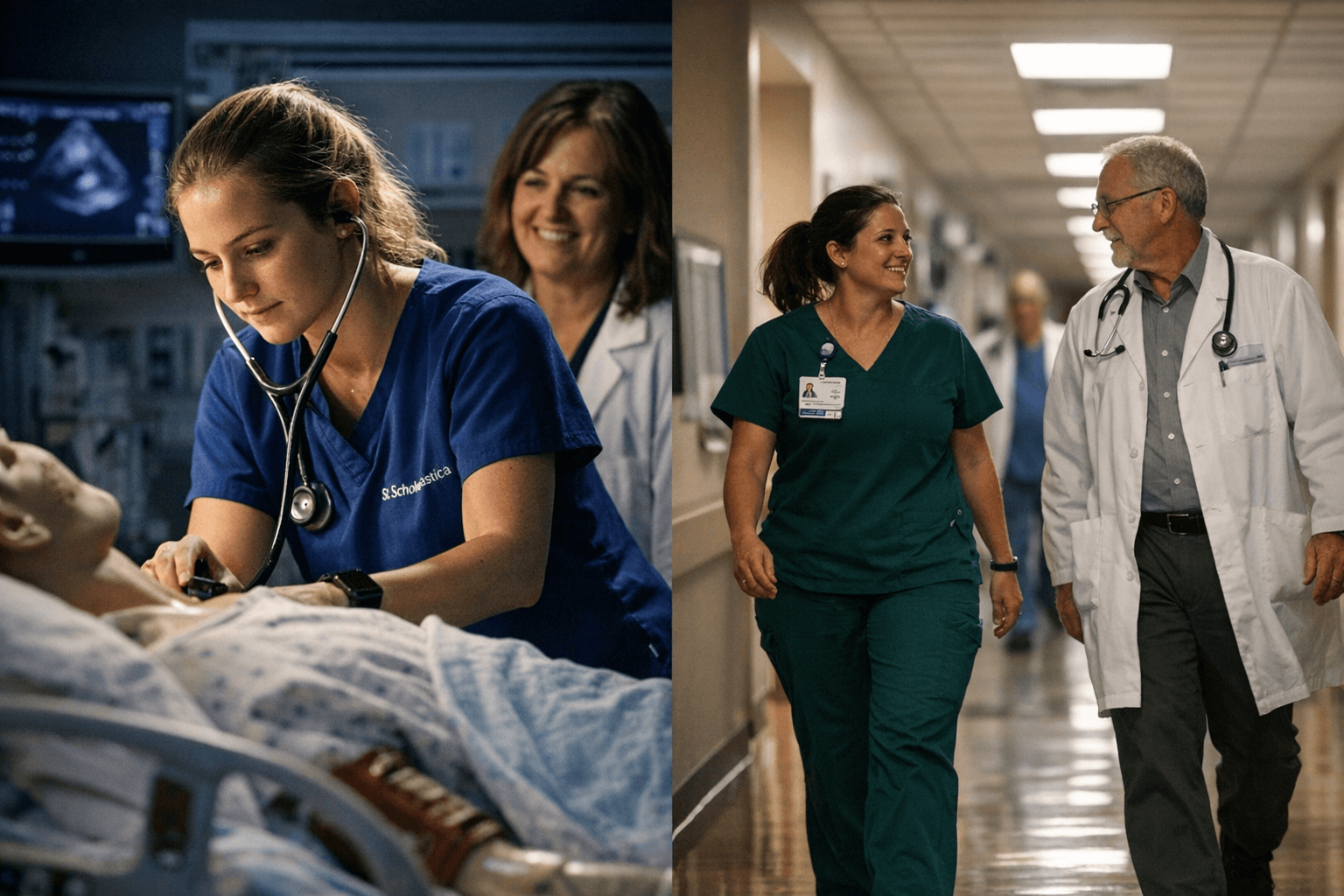
Rose Carpenter, St. Scholastica’s director of alumni engagement, said the event was a way to show how education, workforce development and community health connect. That connection matters in practical terms. St. Scholastica says it graduates more than 1,100 students in a recent spring class, and many of them go on to serve regional health partners in nursing, physical therapy, occupational therapy, physician assistant studies and related fields.
Essentia’s reach extends across Minnesota, North Dakota and Wisconsin, and its new St. Mary’s Medical Center in Duluth opened in 2023 with 342 single-patient rooms, 344 rooms overall. The question now is whether the pipeline that starts in classrooms and clinical rotations can keep enough graduates close to home to strengthen care from West Duluth to the farthest rural clinics.
This article was produced by Prism’s automated news system from verified source data, official records, and press releases, then run through automated quality and moderation checks before publishing. The system is built and supervised by the people who set the standards it runs under. Read our full AI policy.
Did this article answer your question?