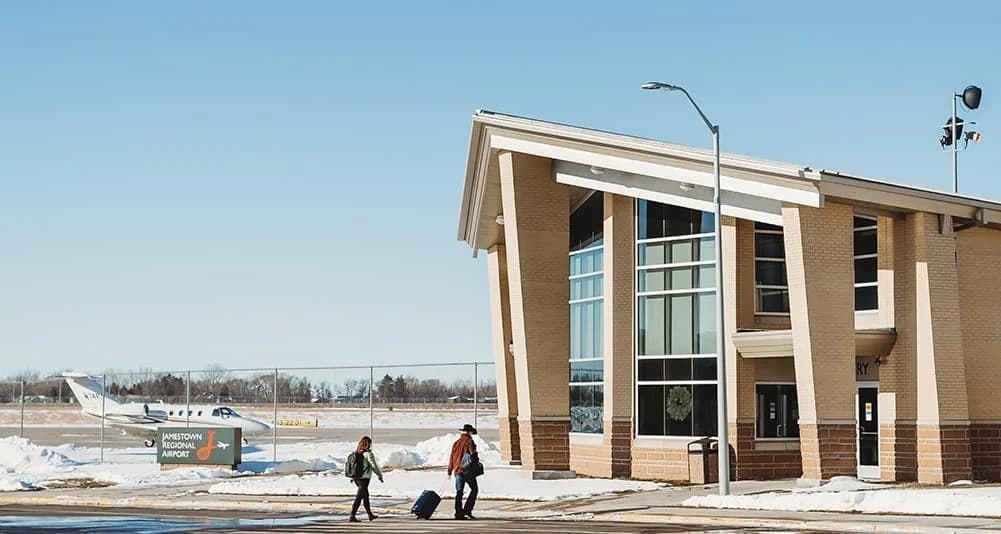
Jamestown Regional Airport links Stutsman County to Denver hub
Jamestown Regional Airport gives Stutsman County its direct Denver link, with 12 weekly EAS round trips that keep business travel and hub access local.

Jamestown Regional Airport is one of Stutsman County’s most important pieces of infrastructure because it is the county’s direct commercial link to a major hub. The airport is a Part 139-certified commercial airport in Jamestown, and United Express, operated by SkyWest Airlines, connects it to Denver International Airport under an Essential Air Service contract that runs through June 30, 2027.
The Denver link that keeps Stutsman County connected
For a county that covers 2,298 square miles and has 21,593 residents, that connection does more than make vacations easier. It gives local travelers, business owners, and visitors a way into the national air network without turning the first leg of a trip into a long highway drive. Jamestown’s location at Interstate 94 and Highway 281 makes it a regional crossroads on the ground; the airport serves the same function in the air.
The service level matters. The current SkyWest agreement provides 12 round trips per week to Denver using 50-seat Canadair Regional Jet 200 aircraft, a schedule that effectively keeps Jamestown tied to one of the country’s biggest connecting hubs. The airport site also describes the route as two daily flights to Denver, underscoring how central the service is to the county’s travel pattern.
What passengers find when they fly from Jamestown
Jamestown Regional Airport is built for routine use, not occasional novelty. The terminal has an A-frame design with natural light, and the passenger side includes free parking, a boarding bridge, a self-service kiosk, and a water bottle filling station after security. Those are small details, but they shape how usable the airport is for families, business travelers, and residents who need a nearby departure point.
The aircraft itself is part of that practical picture. The Bombardier CRJ-200 seats 50 passengers and includes a restroom and flight attendant service, which makes the Jamestown route feel like standard commercial service rather than a stripped-down commuter operation. The airport asks passengers to arrive 90 minutes before flight time, and ground transportation options include taxis, rental cars, and James River Transit.
Why the airport matters beyond airline tickets
The passenger terminal is only one part of the story. On the general aviation side, the airport supports fuel services, aircraft maintenance, flight training, hangars, and other aviation needs through First Class Aviation and High Plains Aviation. The field includes eight airport-owned T-hangars, land leases for privately owned storage, and space for new hangar construction.
That mix gives the airport a role in the county’s broader economy. It serves pilots, farm operators, and business users who need local aircraft access, and the airport says it also offers shovel-ready lots for industrial, commercial, and aviation business. In practice, that means Jamestown Regional Airport functions as both a transportation asset and a development site, with the Jamestown/Stutsman County Development Corporation building its growth strategy around jobs and business expansion in the region.
Runway work, passenger counts, and recovery
The airport’s recent operating history shows how fragile that connection can be when infrastructure goes out of service. The North Dakota Aeronautics Commission said Jamestown’s primary runway was closed from May 7 through June 16, 2024, for major pavement rehabilitation, and commercial flights were suspended during that period. The crosswind runway stayed open for general aviation, which kept part of the field active even while airline service was down.
Passenger numbers reflect that disruption. Jamestown Regional Airport recorded 9,346 paid passenger boardings in 2024, falling just short of a 10,000-passenger goal that airport leadership had set. By October 2024, the airport had reached 939 passenger boardings for the month and 7,499 year-to-date boardings, showing that traffic was rebuilding but still working back from the five-week closure.
The wider state picture helps put those numbers in context. North Dakota’s eight commercial service airports posted a statewide record of 1,322,791 revenue passengers in 2025, according to the North Dakota Aeronautics Commission. That record shows the state’s air system remained strong overall even as Jamestown worked through runway rehabilitation and a recovery in local boardings.
What local leaders are emphasizing
The federal contract extension through June 30, 2027 gave Jamestown a stable runway for the Denver service, and local leaders framed that stability as an economic issue, not just a travel convenience. U.S. Sen. John Hoeven said continued service is vital for economic growth and for the needs of the traveling public, while airport director Katie Hemmer said the airport was pleased to secure SkyWest’s partnership for three more years and hoped to set new passenger records. North Dakota Aeronautics Commission Executive Director Kyle Wanner said access to the global air transportation network improves quality of life and supports business and economic growth.
Those comments line up with the airport’s physical and commercial footprint. Jamestown Regional Airport is not only a place to catch a flight to Denver International Airport; it is the county’s link to medical appointments, business itineraries, aviation services, and outside investment that would otherwise be harder and slower to reach. As long as the Denver connection, the runway system, and the general aviation base hold, the airport remains one of Stutsman County’s clearest examples of infrastructure that carries economic weight far beyond the terminal door.
This article was produced by Prism’s automated news system from verified source data, official records, and press releases, then run through automated quality and moderation checks before publishing. The system is built and supervised by the people who set the standards it runs under. Read our full AI policy.
Did this article answer your question?