North Dakota Lawmakers Study Nuclear Waste Storage Rules and State Law Changes
North Dakota's current law bans high-level radioactive waste storage, but that may have to change — Nucleon Energy says any nuclear future for the state requires rewriting the rules.
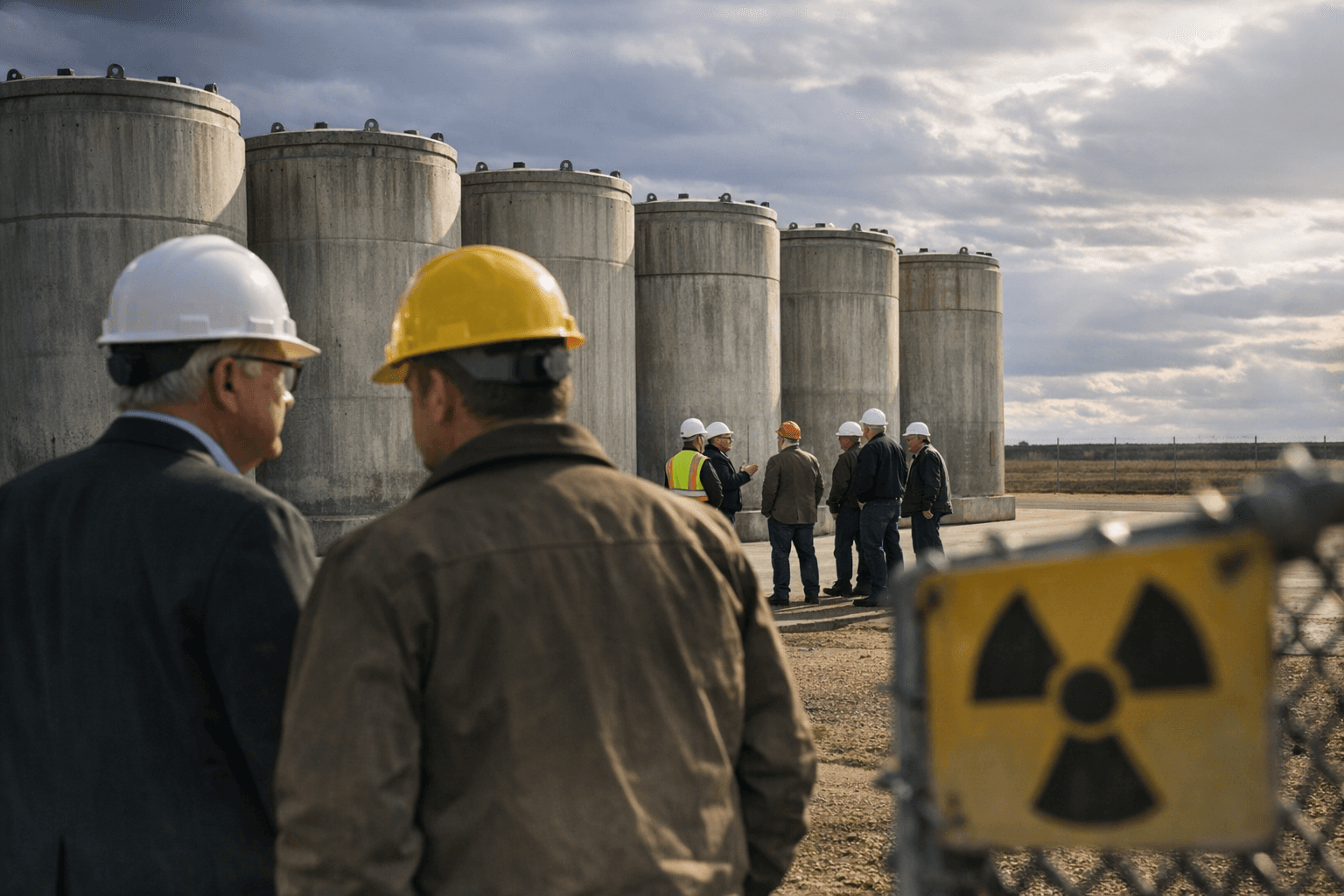
North Dakota's Advanced Nuclear Energy Committee convened Tuesday to hear from officials across the country dealing with nuclear power, as Nucleon Energy presented two reports outlining both the economic potential of new reactors and the thorny question of what happens to the waste they produce.
Current state law prohibits any storage of high-level radioactive waste in North Dakota, and representatives of Nucleon Energy, the Canadian nuclear power developer the state hired as a consultant, said that would have to change if policymakers hope to encourage nuclear development. Nucleon will present more information at a June meeting of the Advanced Nuclear Energy Committee, which includes lawmakers and representatives of state agencies and utilities, on what changes to state law would be necessary to make a nuclear power industry possible.
"We would need to address it," said Sen. Dale Patten, R-Watford City. Will Bridge, chief technology officer of Nucleon Energy, pointed to Wyoming as a model. Wyoming had a similar statutory prohibition but amended it in recent years to allow temporary storage of radioactive waste produced within the state, though Wyoming law still bars storage of waste generated by power plants in other states.
Bridge was direct about the broader challenge of long-term waste planning. "Examining the long-term waste plan is as critical as any other aspect of the economics, or the constructability, or any of those other things. Some of them are quite challenging and still need a lot of development to think through," he said. On workforce estimates included in Nucleon's reports, Bridge added: "A large portion of some of the existing staff at nuclear facilities is security, and that's a question of how much that would scale down. From a planning standpoint, we think these are reasonable numbers."
Nucleon's reports estimate that a large reactor could create 260 full-time jobs and bring in $5 million per year in taxes, while a smaller reactor could create 100 jobs and generate $1.7 million per year in taxes. The proposed reactors range in size from 200 megawatts to 600 megawatts. Building a reactor would cost more than one billion dollars. Bridge acknowledged that cost remains a serious obstacle: "Right now, natural gas is more economic than that. At some point, those two may cross over, but the nuclear industry still needs to bring the costs down."
The entire process, from start to operation, can take roughly a decade, and no project has been proposed for North Dakota at this time. Nucleon will release additional reports later this year focusing on the feasibility of small modular reactors in North Dakota and which parts of state law may need to be adjusted to allow developers to start the building process. In December, Nucleon released a report citing seven areas of the state that could support small modular reactors.
The storage question is complicated nationally. Spent nuclear fuel is stored at 113 sites across 39 states, according to Nucleon's presentation. The fuel is typically held in multi-layered dry casks of stainless steel to contain the radioactivity, with 97,000 metric tons sitting in temporary on-site storage near reactors. That storage is supposed to be temporary, pending transportation to a national underground storage repository, but that repository has never been built. The federal government's first plan, Yucca Mountain in Nevada, has been stalled for more than a decade.
Rod McCullum of the Nuclear Energy Institute told the committee that federal regulators have determined existing dry casks will be safe for another 100 years, and that deep underground geological storage remains the best permanent option because rock effectively contains radiation over geologic timescales. "To put it another way, if the dinosaurs had had nuclear energy, and had they disposed of the waste properly, we would never even know about it," McCullum said. McCullum argued the biggest reason the federal government failed to build a national repository in Nevada was that it pursued a top-down approach rather than building local support first. "We call it moving at the speed of trust, which is what will have to happen with future nuclear waste disposal," he said.
Laura Hermann, deputy executive director of the Energy Communities Alliance, a nonprofit representing local governments affected by nuclear development, offered a cautionary note about the legacy of federal nuclear programs. The Department of Energy is still involved in cleaning up 15 sites stemming from the Manhattan Project and other early initiatives, a process Hermann said will cost an estimated $500 billion and take up to 75 years to complete. "It's stored safely where it is," Hermann said of spent fuel currently sitting at reactor sites.
Sen. Tim Mathern, D-Fargo, said he wonders if the committee is making the same mistake as federal regulators by not starting with local communities and stakeholders who would be affected by any proposal to build a nuclear power plant in the state. Bridge responded that developers "certainly don't want to push an SMR into a community that doesn't want it."
Sen. David Hogue, R-Minot, who chairs the Legislative Management and oversees Nucleon's contract, offered a distinctive frame for thinking about nuclear risk in North Dakota. The U.S. Air Force maintains more than 100 intercontinental ballistic missiles armed with nuclear warheads in the north central area of the state, Hogue noted, and he suggested a formal risk assessment comparing the danger to nearby populations from those weapons, from operational nuclear power plants, and from long-term radioactive waste storage. "I would be interested to know," Hogue said.
The relevant state statute, Chapter 38-23 of the North Dakota Century Code, prohibits the "placement, storage, exploration, testing, or disposal of high-level radioactive waste within the exterior boundaries" of the state. House Concurrent Resolution 3034, passed by the 2023 legislature, directed the Legislative Management to consider studying sustainable energy policies, assess future electricity demands, and determine the feasibility of advanced nuclear energy development in the state — laying the groundwork for the committee's current work. Whether that work ultimately requires reopening Chapter 38-23 will be a central question when Nucleon returns in June.
This article was produced by Prism’s automated news system from verified source data, official records, and press releases, then run through automated quality and moderation checks before publishing. The system is built and supervised by the people who set the standards it runs under. Read our full AI policy.
Did this article answer your question?