LaLota warns East Hampton sanctuary policies could cost federal earmarks
LaLota threatened to pull support for East Hampton earmark requests after sanctuary-style rules drew pushback from town and village leaders. The fight reaches Suffolk budgets first.
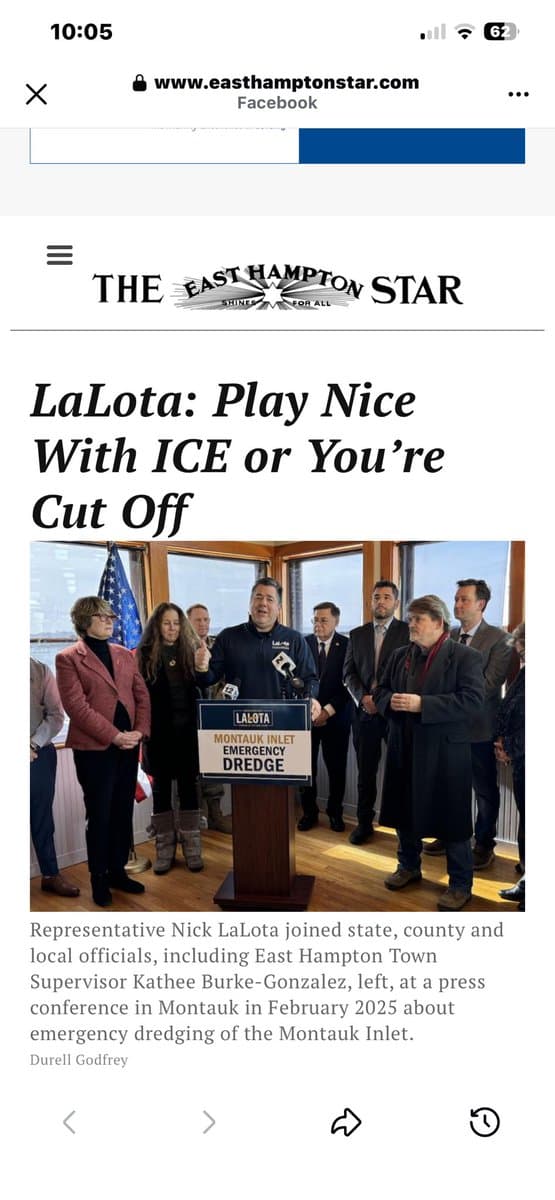
Nick LaLota has turned East Hampton’s immigration policy fight into a question of federal dollars, warning that municipalities with sanctuary-style rules should not expect his support for community project funding requests worth millions. In a June 18 letter, the Suffolk congressman said he would not back requests from towns that “deliberately obstruct, impede, or refuse lawful cooperation” with federal immigration authorities.
For East Hampton, the first consequence is not at the border or in Washington but in local budgets, town hall negotiations, and police policy. LaLota’s leverage runs through earmark support in Congress, not through direct control of East Hampton’s town or village laws, which means the immediate pressure falls on local officials seeking federal money for projects that can shape Suffolk taxpayers’ bills and capital plans.

East Hampton Village Mayor Jerry Larsen said the village would not be intimidated into abandoning its law, while Town Supervisor Kathee Burke-Gonzalez said the town measure was meant to protect public safety and clarify what local police are supposed to do. Organizacion Latino Americana of Eastern Long Island, known as OLA, said the policies are designed to increase transparency and rebuild community trust.
The town board unanimously passed its Public Safety and Accountability Law on May 13, after 24 residents spoke in favor at a public hearing and none opposed. The law bars East Hampton Town Police from entering 287(g) agreements and says town personnel and resources cannot be used to investigate, detain, question, arrest or transport anyone solely for civil immigration enforcement without a judicial warrant. The town also created a 12-member public safety task force.
East Hampton Village had already held a public hearing on April 22 on its own nonparticipation proposal. That measure would bar the use of village resources, equipment, property, databases or funds for civil immigration enforcement without a judicial warrant, and it specifically says Flock license plate reader data cannot be accessed or shared for civil immigration enforcement. It would also create an advisory task force and require quarterly reporting.
The dispute has been building since February 2025, when East Hampton Town said its police focus on violent criminals, repeat DWI offenders and sex offenders, do not hold people on ICE detainers alone, and need a judicial warrant. The town cited New York law and the Wells v. DeMarco ruling in that explanation. Suffolk County was later named on a May 29, 2025 federal sanctuary-jurisdiction list, and both the county and East Hampton rejected that designation.
LaLota had already taken aim at sanctuary jurisdictions earlier in 2025, when he reintroduced the No Bailout for Sanctuary Cities Act and said federal dollars should not subsidize places that defy immigration law. In East Hampton, though, the practical stakes are closer to home: whether police keep their current limits, whether local leaders keep their federal advocates, and whether future Suffolk projects lose support in Washington.
This article was produced by Prism’s automated news system from verified source data, official records, and press releases, then run through automated quality and moderation checks before publishing. The system is built and supervised by the people who set the standards it runs under. Read our full AI policy.
Did this article answer your question?