Plum Island Coalition Unveils Plan to Preserve Island, Expand Public Access
A 94-year-old unnamed donor is willing to fund Plum Island's management if conserved, as a coalition pushes to preserve the 840-acre federal property off Orient Point.
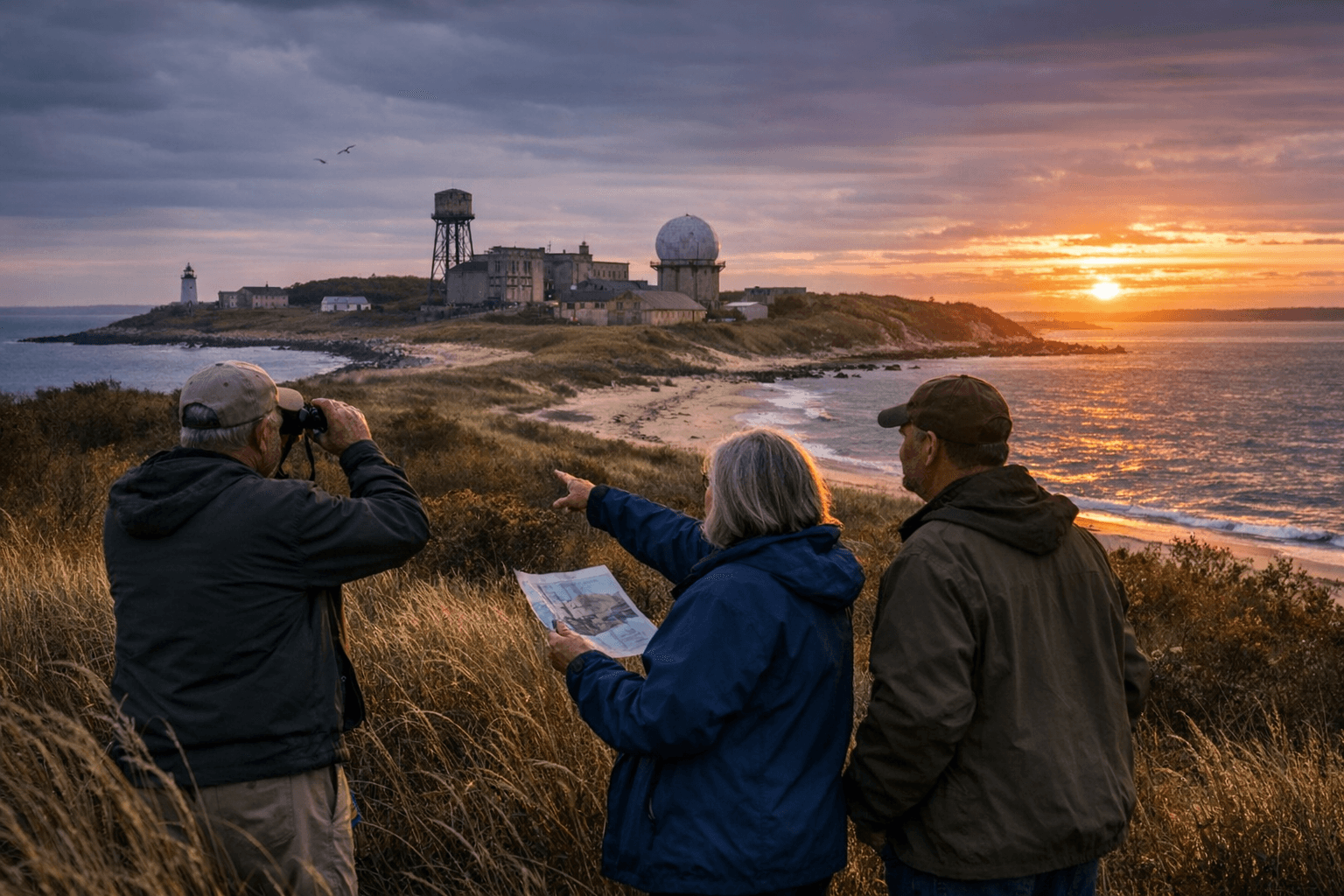
The Preserve Plum Island Coalition brought its conservation vision to the Long Island Regional Planning Council on March 16, presenting a detailed plan to permanently protect the 840-acre federally owned island sitting just a mile and a half off Orient Point in Gardiners Bay while opening it to carefully managed public access for the first time.
The coalition, which includes municipalities, wildlife advocates, and organizations from Long Island and Connecticut, wants Plum Island designated as a wildlife refuge, national monument, or equivalent protected status. Its 2020 report laid out a framework: a 640-acre preserve, a 125-acre research complex, and a small museum highlighting the island's heritage, with access through nature trails, guided tours, and educational exhibits. The Plum Island Lighthouse and Fort Terry, a coastal defense installation built in the late 19th century and expanded in the early 20th, would be restored and interpreted under the plan.
"We're trying to secure the permanent protection of the significant natural and historical and cultural resources of Plum Island," said Robert DeLuca, president of the Group for the East End, which is part of the coalition. "This has been a long journey, but it's a journey worth taking."
The ecological stakes are considerable. The island supports nearly 230 bird species and provides habitat for the state-endangered piping plover across coastal and freshwater wetland environments that have survived largely intact despite decades of federal research activity. Much of the island's 840 acres remains undeveloped.
The coalition also disclosed a significant potential funding source: an unnamed 94-year-old woman willing to fund management of the island if the acreage is conserved. Louise Harrison, New York National Areas Coordinator at Save the Sound, said the donor "would like to see this settled soon."
Harrison made clear why state and local political alignment matters to the coalition's preferred legal pathway, the Antiquities Act, which allows a president to declare a national monument. "Our president is going to want to know that our governor supports that. No president is going to declare a national monument in a state unless that state is in favor of it. We know that any governor of New York is not going to make that kind of a declaration without approaching the town. Here you are," Harrison said at a recent town work session where Group for the East End and Save the Sound representatives also presented.
New York State has not shown direct interest in owning the island, but the state commissioners of Parks, Recreation and Historic Preservation and the Department of Environmental Conservation have sent a letter saying they would like to help see the site preserved. State Assemblyman Fred Thiele (I-Sag Harbor) offered to write a letter of support and circulate it among fellow legislators and to the governor's office following the coalition's appearance at an environmental roundtable. Rep. Nick LaLota and Suffolk County have also voiced support for keeping the island public and protected.
The coalition has met with the U.S. Department of the Interior and the White House Council on Environmental Quality to press its case. The General Services Administration will ultimately decide whether the property transfers to a public agency, a nonprofit, or goes to private sale. The Plum Island Animal Disease Center, which multiple outlets reported shut down in 2025, still has a formal closure process underway: the Department of Homeland Security is expected to finish decommissioning the facility by 2028 at a reported cost of $150 million.
The Long Island Regional Planning Council, which helps allocate state grants and advocates for regional development issues, voted after the presentation to support preservation efforts. Council members did raise financial questions, asking whether buying and sustaining the island would be viable and how the public would reach it. The coalition suggested private ferries as one option for tourist access and said it hopes whatever entity takes on the island will thoroughly assess the costs of long-term upkeep.
The coalition is also forming a new nonprofit, Friends of Plum Island, to support ongoing advocacy. The group has been building toward this moment since 2018 and 2019, when Save the Sound, The Nature Conservancy, and coalition members convened regional stakeholders to shape a preservation vision. That work produced the July 2020 report to Congress and the public, and helped prompt Congress in December 2020 to repeal a 2009 law that had been steering the Department of Homeland Security and the GSA toward auctioning the island out of public ownership entirely.
This article was produced by Prism’s automated news system from verified source data, official records, and press releases, then run through automated quality and moderation checks before publishing. The system is built and supervised by the people who set the standards it runs under. Read our full AI policy.
Did this article answer your question?