Vanderbilt Museum in Centerport blends history, science, and local heritage
The Vanderbilt Museum & Planetarium gives Suffolk families one outing that mixes mansion tours, science shows, and North Shore history in Centerport.
In Centerport, the Vanderbilt Museum & Planetarium still delivers something Suffolk families can feel immediately: one visit can cover a mansion tour, a science lesson, and a walk through North Shore history without leaving Long Island. That mix is why Eagle’s Nest remains more than a preserved estate. It works as a repeat-use community asset.
A North Shore landmark with staying power
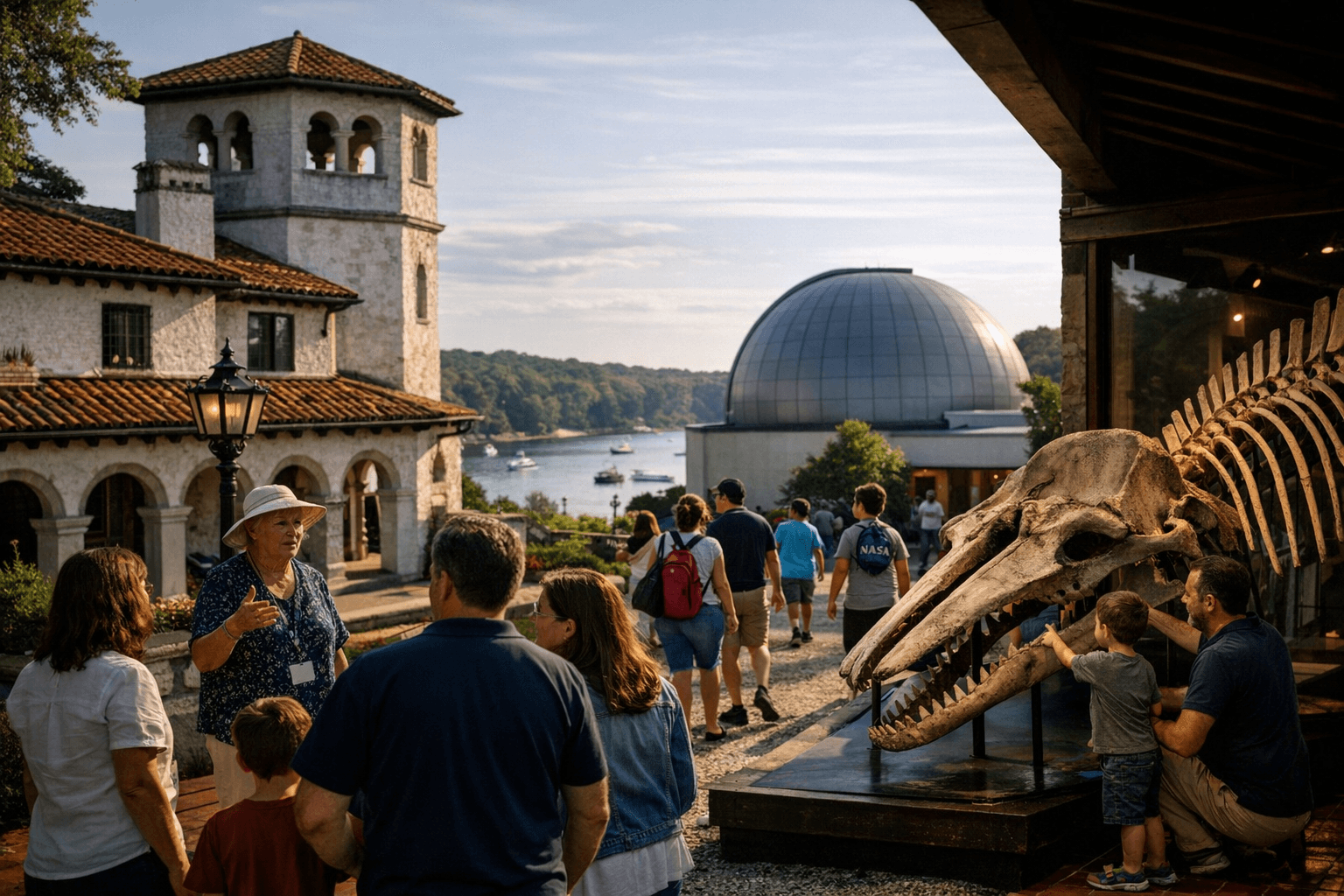
William K. Vanderbilt II began building the waterfront estate in 1910 on 43 acres in Centerport, and the scale of that project still shapes the site’s identity today. The estate was later associated with the name Eagle’s Nest, a reminder that the museum is rooted in the Gold Coast era that left so many marks along the North Shore of Long Island. What survives now is not just a house but a preserved piece of the region’s social and architectural history.
Vanderbilt did not treat the property as a private retreat to be closed off forever. He established it as a museum for the use, education and enjoyment of the general public, then deeded the estate to Suffolk County and created a trust fund to support it after his death in 1944. Suffolk County opened the museum to the public in 1950, turning a private estate into a public institution with a long civic afterlife. That transition gives the museum uncommon local weight: it is both a remnant of an older Long Island and a living county resource.
The museum’s identity reflects that dual role. It describes itself as a combination of mansion, marine and natural history museum, planetarium, and park. That combination matters because it turns a single site into a full-day destination, especially for families weighing the cost and hassle of entertainment options across a crowded region. The draw is not only the setting in Centerport, but the range of experiences packed into one address.
Why families keep returning
The Vanderbilt Museum & Planetarium works because it answers different needs at once. History-minded visitors come for the estate itself, which speaks to the era when grand waterfront properties defined parts of the North Shore. Children come for the kind of visit that feels like an outing but lands as education, with science and history presented in a setting that is far more memorable than a standard classroom wall.
That flexibility gives the museum practical value for Suffolk households. A trip to Manhattan can mean traffic, parking, higher costs, and a long day. A trip to Centerport offers culture, space, and learning closer to home. For parents trying to keep school-break plans affordable and meaningful, that proximity matters as much as the programming.
The museum’s education work is especially important here. It offers hands-on programs for children in preschool, kindergarten, and grades 1 through 3, which makes it a natural fit for early learners who benefit from tactile, visual experiences. It also can send a representative to schools to provide programming for one or two classes at a time, extending the museum’s reach beyond the grounds in Centerport. The staff can also provide customized programs for particular classes or groups, giving schools a way to tailor the visit to age level or curriculum.
The planetarium is a major reason the site still feels current
The Reichert Planetarium gives the museum a strong science identity alongside the historic mansion. Reopened in 2013, it is described by the museum as one of the finest and most advanced planetariums in the United States. That modern component keeps the institution from being frozen in the past; it makes the site useful for science education as well as preservation.
The planetarium’s 60-foot dome is a major part of that experience, creating an immersive setting for shows that can capture children’s attention and still hold adults in the room. The museum also offers observatory viewing of the night sky, which connects the indoor programming to the real sky above Suffolk County. That link between built space and open sky is one of the site’s quiet strengths: it turns astronomy from an abstract subject into something local and immediate.
The museum’s public programming reflects that same range. Visitors can find historic mansion tours, Shakespeare in the courtyard, school programs, and other offerings that stretch across seasons and interests. That mix helps the museum function as a year-round venue rather than a place people visit once and check off a list.
Why the setting still matters to Suffolk County
Part of the Vanderbilt Museum’s appeal is that it still feels distinctly of Suffolk County. The location in Centerport ties it to the North Shore’s waterfront heritage, and the estate itself helps explain how wealth, land, and cultural ambition shaped this part of Long Island. The museum is not a generic attraction placed on local soil. It is a site whose history is inseparable from the county’s development.
That is why the museum remains relevant even when it is not tied to a news cycle. It gives residents and visitors a way to engage with Suffolk’s past through a place that still functions in the present. The National Register of Historic Places listing adds formal preservation significance, but the real value is simpler: the site keeps attracting people because it still has something useful to offer.
The museum’s mission, as it describes it, is education and enjoyment for the people of Long Island and beyond. That broad language fits what the campus actually does. It preserves a landmark, teaches children, supports schools, and gives families a reason to return to Centerport for another planetarium show or another walk through the estate. In a county where time and money are always part of the calculation, that combination keeps the Vanderbilt Museum worth the trip.
This article was produced by Prism’s automated news system from verified source data, official records, and press releases, then run through automated quality and moderation checks before publishing. The system is built and supervised by the people who set the standards it runs under. Read our full AI policy.
Did this article answer your question?