Claremont planning board approves 25-apartment redevelopment of historic Water Street building
Claremont cleared 25 apartments for 17 Water Street, but the downtown reuse still hinges on parking, historic review and tax-credit approval.
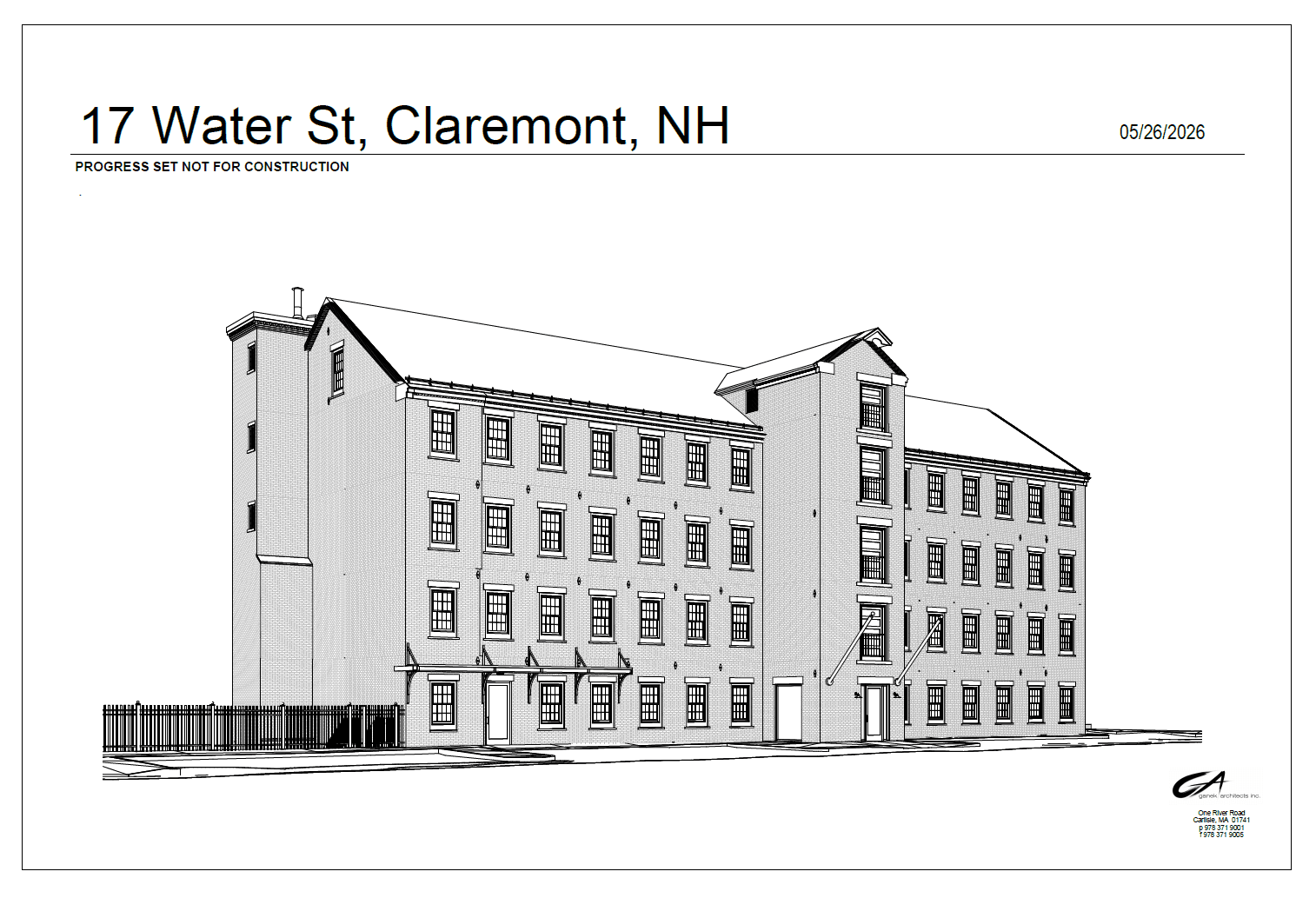
Claremont’s Planning Board approved the site plan Monday for a 25-apartment conversion of the vacant former state office building at 17 Water Street. The plan calls for 17 one-bedroom units and eight two-bedroom units inside the 32,000-square-foot, four-story brick building, and developer 1852 MB2 Claremont plans to finish the $4.8 million redevelopment late next year.
Built in the 1830s as part of Monadnock Mills along the Sugar River, the building was taken over by the state in 1980 and renovated for offices that later housed the DMV and health and human services. Those offices closed in early 2023 after flooding and other issues, leaving the city with a prominent property that had gone unused.

Claremont bought the building from the state for $700,000 in March 2025 after former City Manager Yoshi Manale urged officials to control its future, then sold it to the developer for $807,000 in December. The price had initially been set at $1.015 million in August 2025, before inspections found additional repair needs, especially on the Sugar River side. The city’s 2024 surplus-land review called 17 Water Street a roughly 0.25-acre state office building and identified likely private reuse, without major renovation, as a multi-tenant office or mixed-use building.
The plan now goes to the Historic District Commission for a Certificate of Appropriateness for exterior work. Because the building is listed on the National Register of Historic Places, the developer also needs approval through the state and the National Park Service to qualify for federal historic rehabilitation tax credits, which can cover 20% of qualifying costs for income-producing historic buildings. Ganek Architects is the architect on the job, and Franklin Savings Bank is financing construction.

Parking remains the biggest unresolved hurdle. City rules call for one space per unit, or 25 spaces total, while the developer currently controls 13. Claremont owns parking spaces on Crescent and Water streets and had bought additional spaces across from the building to support redevelopment, and the city will work toward a final parking solution before any certificate of occupancy is issued.
This article was produced by Prism’s automated news system from verified source data, official records, and press releases, then run through automated quality and moderation checks before publishing. The system is built and supervised by the people who set the standards it runs under. Read our full AI policy.
Did this article answer your question?