How the railroad transformed Newport from 1871 onward
Newport’s depot, rail trail, and downtown blocks still show where the railroad arrived in 1871 and remade the town’s work, travel, and street pattern.
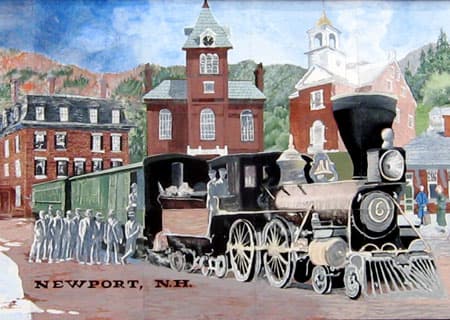
The railroad’s imprint on Newport is still easy to trace on the ground: the rebuilt depot at the base of Depot Street, Railroad Square, the Train Heritage Mural, and the Sugar River Trail that now follows the old rail bed toward Claremont. What began with the first train crossing Main Street on the night of November 21, 1871, became the force that reorganized the town’s commerce, industry, and daily movement for generations.
The day Newport became a rail town
Newport did not start as a railroad town from nothing. Before the tracks arrived, the town already sat where two stagecoach turnpikes met, and the Eagle Block began life as the Eagle Hotel in 1826, a reminder that Newport had long served travelers moving through western New Hampshire. The railroad arrived in 1871 and 1872, but the real turning point was how quickly it changed the way people moved, worked, and did business around Main Street and Depot Street.
That shift gave Newport a new center of gravity. The town’s rail era linked the old traveler economy to a wider industrial one, with goods, workers, and visitors flowing through a corridor that now still defines the downtown landscape. A New Hampshire railroad historic context statement notes that railroads had become the state’s biggest employer by the end of the 19th century, which helps explain why a line through Newport could reshape the local economy so deeply.
What grew around the tracks
Once the trains began running, Newport’s downtown filled with businesses and institutions that made sense in a rail-connected town. Names like Krans Department Store, Peerless Manufacturing Co., Dorr Woolen, Richards’ Woolen, McElwain Shoe, Newport House, Eagle Block, and American Express fit that era of freight, travel, and manufacturing. The railroad did not just move people through town, it helped create the commercial and industrial density that clustered around the downtown core.
The historical society’s Newport railroad history project ties that growth to visible landmarks that still anchor the story today. The Train Heritage Mural and Railroad Square are not decorative afterthoughts, they are markers of the place the railroad carved out in the town’s public memory and built environment. When you stand near those sites, you are looking at the remains of an economy that depended on rail connections for shipping, labor, and passenger traffic.
Fire, rebuilding, and the depot that remains
The most tangible reminder of Newport’s rail age is the depot story itself. The original depot was built as part of the town’s rail expansion, then a fire in 1897 changed the structure’s fate. The rebuilt depot still stands at the base of Depot Street, a physical link between the town’s 19th-century rail surge and its present-day streetscape.
That rebuilding matters because it shows the town did not lose its rail identity when one structure burned. Instead, Newport adapted, and the depot remained part of the town’s working geography even as the rail era matured and later faded. For readers walking the district today, the depot is not a distant relic, it is one of the clearest pieces of evidence that the railroad once set the terms for downtown development.
How to read the town today
The easiest way to understand Newport’s railroad legacy is to walk the places it still shapes. The Newport Downtown Historic District, listed on the National Register of Historic Places in 1985, preserves the commercial and civic heart of town along Main Street near Depot Street and the Sugar River. That designation underscores what locals can still see, the rail story is embedded in a broader historic landscape rather than isolated in one building.
The Sugar River Trail / Recreation Path makes that continuity especially clear. The trail runs about 8 to 10 miles from Newport to Claremont along the old train bed, crossing many bridges, including two historic covered bridges. The route turns the former rail corridor into a public path for walking, biking, and everyday movement, which means the same strip of land that once carried freight and passengers now carries recreation and local travel.
Why the rail story belongs in Newport’s bigger history
Evan Hill’s town chronology stretches from 1724 to 2007 and places the railroad inside a longer story of Newport’s growth. The town’s historical chronology also tracks waterpowered mills and the rise of sawmills, scythe shops, tanneries, woolen and cotton mills, which shows that Newport’s economy changed in layers rather than in a single leap. The railroad accelerated that transition by making it easier for local industry to reach outside markets and for outside goods to reach Newport.
That broader context is what makes the railroad story more than nostalgia. Newport’s identity was already tied to movement before the tracks, then the railroad intensified that role, and today the trail, the depot, the mural, and the downtown district show how one corridor can shift from stagecoach route to rail line to public path. The result is a town that still wears its transportation history on Main Street, at Depot Street, and all the way out to the trail toward Claremont.
This article was produced by Prism’s automated news system from verified source data, official records, and press releases, then run through automated quality and moderation checks before publishing. The system is built and supervised by the people who set the standards it runs under. Read our full AI policy.
Did this article answer your question?