Newport’s Corbin covered bridge stands as a restored community landmark
Newport rebuilt the Corbin bridge after arson, keeping it a working crossing, park, and neighborhood stop on Corbin Road.

The Corbin Wooden Truss Covered Bridge is more than a restored span over the Sugar River. In Newport, it works as a crossing, a park entrance, and a familiar gathering place on Corbin Road, where residents and visitors stop for a look, a picnic, a cast of a fishing line, or a walk beside the water.
A bridge built into Newport’s memory
Local history places the original Corbin Covered Bridge around 1835, and covered-bridge inventories note earlier construction on the site beginning in October 1843 under Anson Warren. It carried traffic across the Sugar River for roughly 158 years and stood as the sole survivor of Newport’s six highway covered bridges, a rare remnant of the town’s older road network.
The bridge’s long run ended in a deliberate act of destruction. On May 25, 1993, fire set by arson erased the historic structure, and with it a landmark that had been listed on the National Register of Historic Places on December 12, 1976. After the fire, the bridge was removed, but the loss did not end the story. It set off a civic decision about whether Newport would settle for a standard replacement or rebuild the bridge as a landmark worth preserving in daily use.
Choosing restoration over a modern span
About six months after the fire, Newport held a special town meeting and chose reconstruction. The town decided against accepting a conventional state-funded bridge and instead committed to a covered-bridge replica that would match the old character of the site as closely as possible. That choice turned the project into a statement about what mattered locally: continuity, memory, and the value of keeping a familiar crossing in the same form people remembered.
Arnold Graton Associates was hired in 1994 to rebuild the bridge, and the effort tied Newport to one of the best-known names in wooden bridge building. David Wright, then president of the National Society for the Preservation of Covered Bridges, helped the town find Arnold Graton in Ashland, New Hampshire. Graton had begun building wooden bridges with his father, Milton, in the 1950s, bringing decades of craft to a project that had become as much about community will as carpentry.
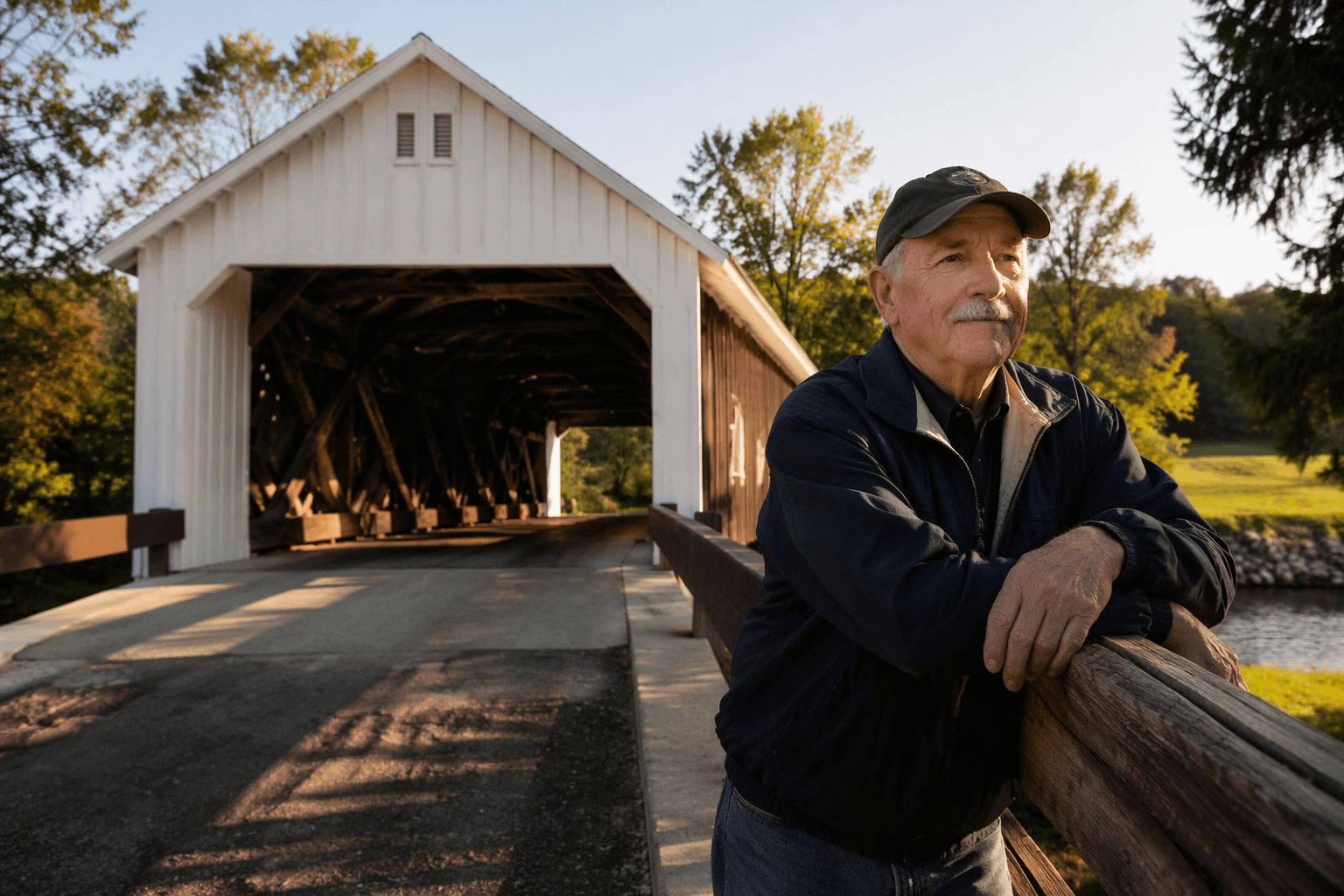
The reconstruction also rested on public and private support. The Newport Historical Society points to fundraising, volunteer labor, and sweat equity from residents who treated the bridge as a shared project rather than a distant capital work. The rebuilding was aided in part by a federal Historic Preservation Fund matching grant through the National Park Service and the New Hampshire Division of Historical Resources, showing how local preservation depended on both neighborhood effort and outside funding.
A separate bridge history in Newport shows that this kind of stewardship was not new. In May 1979, state officials suggested closing the bridge, but Newport chose another path and lowered the posted weight limit from six tons to three tons to keep it open. The bridge was then rehabilitated in 1980 for $43,000, again with matching-grant help. That earlier repair helps explain why the 1993 fire struck so hard: the town had already shown that it was willing to invest in keeping the crossing usable rather than treating it as a relic.
How the rebuild came together
The rebuilt bridge became a point of attention far beyond town lines. One source says more than 9,000 people watched the bridge move over the river during the reconstruction period, a reminder that a local project can draw wide interest when it preserves a structure with deep regional meaning. The bridge was completed on January 7, 1995, and opened to traffic after a dedication ceremony the next day.
The town’s historic-walking-tour page describes the new bridge as a 1994 replica of the c. 1835 original destroyed by arson in 1993. That framing matters because it tells readers how Newport understands the structure now: not as a museum piece sealed off from use, but as a rebuilt civic asset that still does the work a bridge is meant to do. It is part replica, part continuity, and fully embedded in the town’s street life.
Corbin Park as a place to stop, not just pass through
The bridge’s setting is a large part of why it remains relevant. The Town of Newport places the Corbin Wooden Truss Covered Bridge and Park on Corbin Road off Route 10, about a mile north of Newport High School. That location makes the site easy to reach and easy to fold into an ordinary trip through town, whether someone is heading toward school, the river, or the Route 10 corridor.
The park itself gives the bridge a practical public function. Newport’s parks and forests listing notes picnic tables, fishing, and Sugar River access at Corbin Covered Bridge & Park, which means the site serves more than traffic moving from one side of the river to the other. People stop there because it offers a place to sit, to fish, to watch the water, and to spend time in a setting that still feels rooted in Newport rather than generic or remote.
That kind of use is what keeps the bridge from becoming a decorative object. A covered bridge that can be crossed, photographed, fished from nearby, and approached as part of a park does more for a town than a preserved structure behind a fence. At Corbin Road, preservation translated into a usable piece of local infrastructure, one that supports everyday movement and gives the neighborhood a recognizable shared space.
Why the landmark still matters
The Corbin bridge story carries the mark of loss, but it is remembered in Newport as a story of decision and return. The original span lasted for generations, the fire removed it in a single night, and the town chose to rebuild rather than let the site become a blank space in its road map. That decision preserved an important link between the Sugar River, Newport High School, Route 10, and the community identity wrapped around the bridge itself.
What stands there now is a working landmark with a public purpose. It tells the story of an old crossing, a 1993 arson, a 1994 rebuilding campaign, and a town that treated preservation as something practical, not ornamental. As long as Corbin Road remains open and Corbin Park remains in use, the bridge will continue to function as both infrastructure and memory.
This article was produced by Prism’s automated news system from verified source data, official records, and press releases, then run through automated quality and moderation checks before publishing. The system is built and supervised by the people who set the standards it runs under. Read our full AI policy.
Did this article answer your question?