The Fort at No. 4 brings Charlestown’s colonial frontier to life
The Fort at No. 4 gives Charlestown families a hands-on colonial day trip, with living-history programs, set admission prices, and a stop that keeps local dollars moving.

At The Fort at No. 4, a visit on Springfield Road turns Charlestown’s colonial past into a real half-day outing. The open-air museum gives you living history instead of static display cases: demonstrations, reenactments, hands-on workshops, and lectures that make the Upper Connecticut River Valley frontier easier to understand for families, teachers, and day-trippers alike. With general admission set, no advance ticket required, and a visit that takes at least an hour, it is built for people who want a meaningful stop without planning a whole day around it.
What you get from the visit
The Fort at No. 4 is not a quick roadside look. The site says the fort, museum, and grounds take at least an hour, which makes it a practical anchor for a Charlestown day trip rather than a pass-through stop. Adults pay $15, seniors and military visitors $12, students ages 6 to 18 pay $10, and children 5 and under are free. Advance ticket purchase is not required for general admission, which makes it easy to fit into a family schedule or a spontaneous weekend drive.
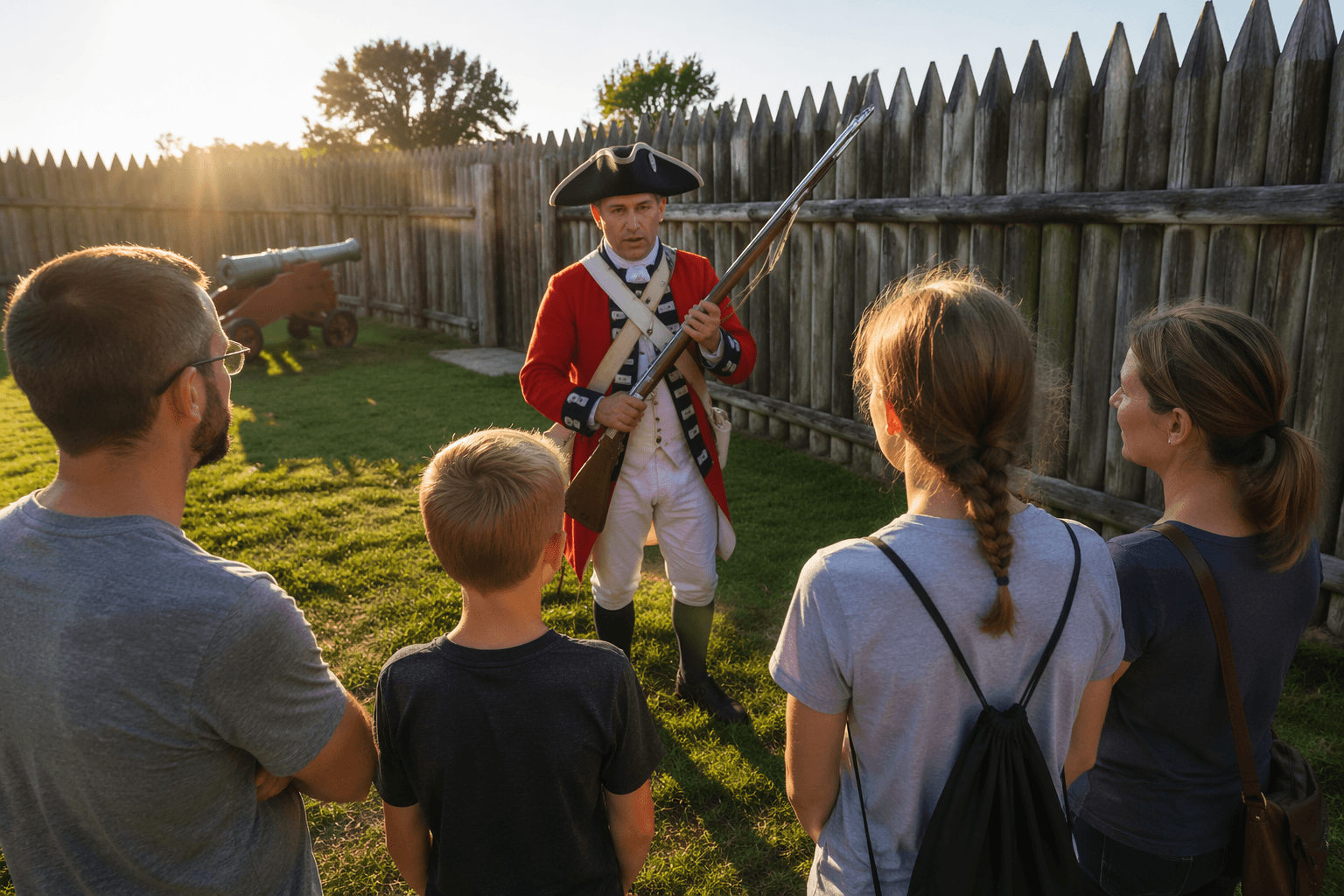
That setup helps the site work for different kinds of visitors. Younger children get the most from the hands-on pieces and outdoor setting, while older students and adults can use the lectures and reenactments to connect the place to the wider story of New England’s colonial borderlands. Because the museum presents history through active interpretation, it offers more than a photo stop. It gives visitors a reason to stay long enough to understand why Number Four mattered.
- Address: 267 Springfield Road, Charlestown, NH 03603
- Admission: $15 adults, $12 seniors and military, $10 students 6 to 18, free for children 5 and under
- Timing: plan on at least an hour
- Tickets: no advance purchase required for regular admission
Why Number Four mattered in the first place
The story begins with Plantation No. 4, the fourth in a line of forts on the Connecticut River border established as trading posts by Massachusetts Governor Belcher in 1735. That detail matters because the river was more than scenery. It was the transportation corridor, trade route, and political boundary that shaped settlement in the Upper Connecticut River Valley.
The original buyers of Plantation No. 4 purchased the grant in 1735, but they did not settle the area themselves. By 1740, several families bought grants from the original land speculators and made the arduous move from Rutland, Lunenburg, and Groton, Massachusetts. Stephen Farnsworth and his brothers Samuel and David Farnsworth were the first settlers of No. 4, and the Stevens, Hastings, Willard, Parker, and Johnson families also played key roles in the settlement’s history. That mix of names gives the site a human scale that makes the frontier story feel local, not abstract.
Charlestown’s state community profile places Number Four at the center of the town’s origin story, which is why the fort matters far beyond museum walls. It links the town to the broader politics of the colonial border and to the people who built homes, farms, and family networks in a place that was still being defined.
A reconstruction built to explain the past
The Fort at No. 4 says it was founded in 1947, but what visitors see today is based on a 1746 map of the original fort. That distinction is important. This is a historically grounded reconstruction, not an untouched original structure, and the New Hampshire Division of Historical Resources describes the current complex that way as well. The point is not to pretend time stopped. It is to show what the original mid-18th-century fort along the Connecticut River looked like and how the settlement worked.
The Fort’s own history materials frame the story through the colonial era from 1735 to 1770, which gives the site a clean narrative arc. It starts with land grants and river-border defense, moves through settlement by named families, and ends with the broader sweep of colonial expansion in western New Hampshire. That makes the museum useful even for visitors who do not arrive with a deep background in early American history. The site explains the frontier in plain view, one building and one demonstration at a time.
Why the site still matters to Charlestown now
The Fort at No. 4 describes itself as an independent nonprofit museum supported through admissions, donations, grants, memberships, fundraising activities, and volunteers. That funding mix is more than a back-office detail. It shows how a heritage site survives in a small town: through paying visitors, community backing, and the labor of people who keep the place open and active.
That support also gives Charlestown a civic asset, not just a tourist stop. The museum draws people onto Springfield Road, keeps them in town for at least an hour, and gives local businesses a chance to benefit from the foot traffic that comes with a real destination. For a community like Charlestown, that kind of steady visitation matters because it turns history into something visible, active, and financially useful without losing its educational purpose.
The calendar keeps that relevance current. The Fort continues to stage special programming tied to Revolutionary War history and the 250th anniversary of the Declaration of Independence, including living-history weekends such as Return to No. 4: Revolutionary War Weekend and themed events like Out of Time and Clash of Cultures. Those programs keep the museum moving through the year and give repeat visitors a reason to come back.
For anyone planning a Charlestown stop, the value is straightforward. You get a defined admission price, a manageable visit length, a hands-on history experience, and a place where the town’s colonial origins are interpreted in public rather than stored behind glass. The Fort at No. 4 makes the frontier legible, and it does so in a way that still fits neatly into a family day trip.
This article was produced by Prism’s automated news system from verified source data, official records, and press releases, then run through automated quality and moderation checks before publishing. The system is built and supervised by the people who set the standards it runs under. Read our full AI policy.
Did this article answer your question?