Park City climate conference spotlights innovators, fintech solutions, venture capital
Investors and entrepreneurs packed a Park City climate conference, but the real test is whether the money can cut emissions in Summit County.
A climate conference built around capital, not protest
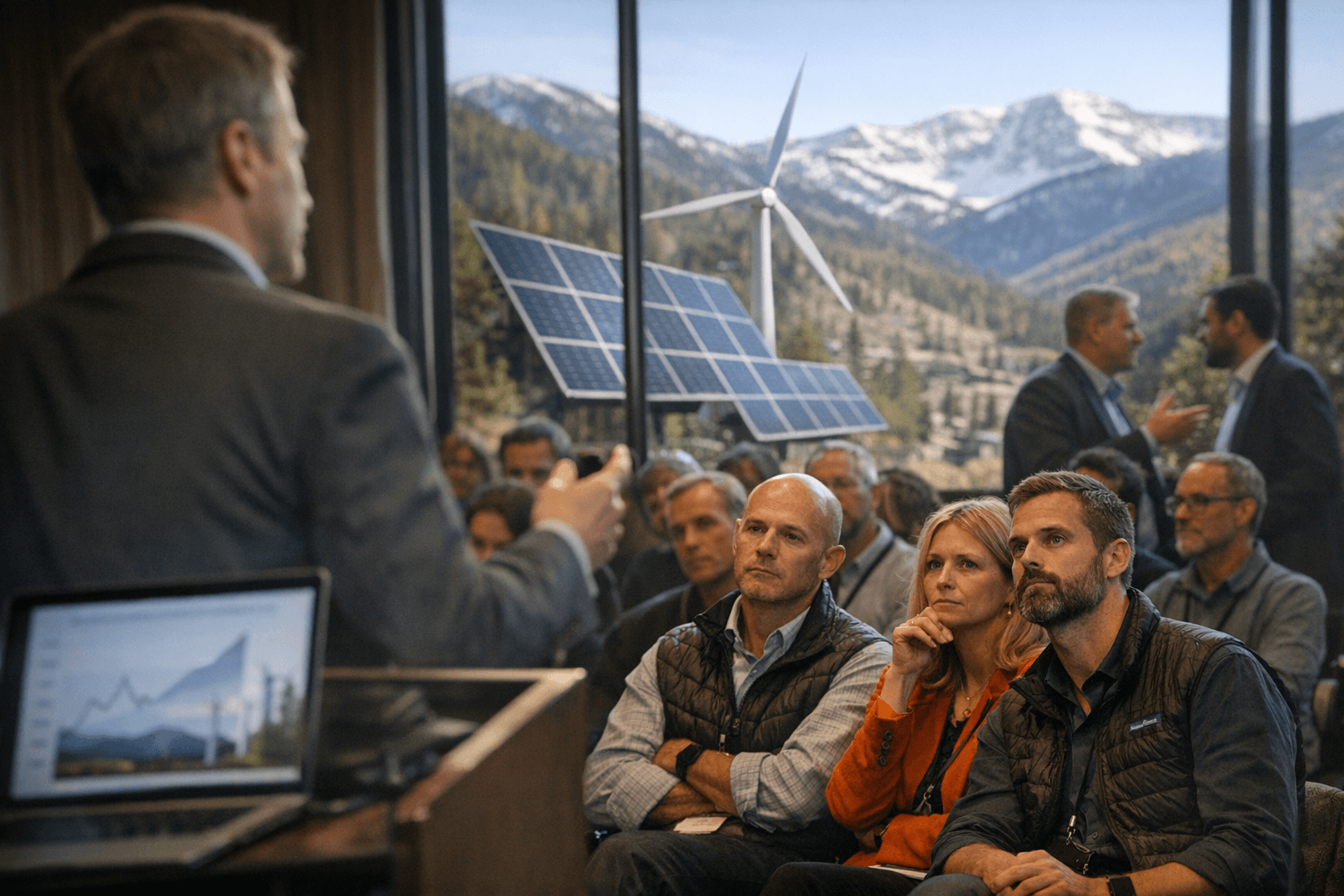
Progression2026 turned Park City into a showroom for climate bets, with entrepreneurs pitching investors at the U.S. Ski & Snowboard USANA Center of Excellence on April 2 and 3, 2026. Former Harvard business professor Robert G. Eccles said the gathering felt unlike the climate conferences he usually attends because the conversation centered on innovation, technology, and the role of finance, not the usual politics-first script.
That framing matters in Summit County because the region has already set a hard benchmark for itself. Park City committed to net-zero carbon emissions by 2030 in 2016, and Mountain Towns 2030 launched in Park City in 2019 to help mountain communities move faster. A conference that celebrates venture capital and startup energy only becomes meaningful here if it can connect those investment stories to real cuts in emissions, lower bills, and measurable resilience.
What the pitches were really selling
The event, described as Progression’s third annual gathering, brought together about a dozen entrepreneurs, climate researchers, and snow sport leaders. The pitch deck of the day was broad: eco-friendly epoxy resins, software that uses artificial intelligence to redistribute demand across the electric grid, and a range of climate technologies aimed at making hard problems look investable.
That mix shows how climate tech has expanded beyond the old image of solar panels and electric cars. Some ideas are materials-focused, some are software-driven, and some are rooted in the mechanics of energy markets, which is where the finance angle becomes central. For investors, the promise is not only environmental improvement but products that can scale, generate returns, and attract capital fast enough to matter.
The most local example was Rainmaker, a cloud-seeding company pitching technology designed to increase snowfall in the Wasatch. Founder Augustus Doricko argued that technology can address climate change without requiring “sacrifice,” a line that captures the optimism of the room and the marketing logic behind it. Rainmaker also pointed to a possible benefit for the Great Salt Lake, tying its business model to a familiar regional worry.
Where the optimism runs into physics
Cloud-seeding is not new. It is a decades-old practice, and the Mountain West has seen rising interest in it as snowpack, water supply, and winter recreation face more pressure. But the studies remain unclear on how transformative it can actually be, which is why the sector draws attention from both investors and skeptics.
That uncertainty is exactly why the conference’s accountability test matters. A pitch can sound visionary and still fall short on the metric that matters most to scientists: whether it reduces greenhouse gases enough to keep the planet livable. KPCW noted that few of the conference’s innovations were focused directly on emissions cuts, and that gap is hard to ignore when the whole event is framed as climate action.
Max Seawright of the University of Utah’s Wilkes Center for Climate Science & Policy put that tension plainly. He called the solutions “a bandage on a bullet hole,” but added that they are still “a start.” His comment is the right local skepticism for this conversation: useful tools are not the same as a complete answer, and a high-energy pitch room does not erase the scale of the problem.
Why Summit County should measure the claims, not the buzz
The question for Summit County is not whether climate innovation sounds exciting. It is whether these ideas can be translated into outcomes residents can feel: lower energy bills, faster building retrofits, cleaner transit, and stronger wildfire resilience. Those are the places where climate finance either proves itself or fades into branding.
That is also where Park City’s own climate commitments become the measuring stick. A net-zero goal by 2030 is not a slogan, it is a deadline. Mountain Towns 2030 was created here to help mountain communities share tactics and accelerate action, so local policymakers, sustainability staff, and residents have every reason to ask whether the companies in rooms like this are helping move the county closer to that goal or simply selling a better story.
The setting itself underscored the contrast. The USANA Center of Excellence opened on May 1, 2009, and spans 85,000 square feet on five acres, with training spaces, sports science resources, and recovery facilities built for elite athletes. It is a fitting stage for high-performance messaging, but Summit County’s climate challenge is not an athletic competition. It is a long, expensive race against rising temperatures, uncertain snow, and the practical costs of adapting homes, infrastructure, and public systems.
Progression2026 made clear that climate conversation in Park City is shifting toward the language of venture capital and product-market fit. The next test is harsher and simpler: whether those investments can do more than raise money, and whether they can deliver measurable climate gains in the place that hosted them.
This article was produced by Prism’s automated news system from verified source data, official records, and press releases, then run through automated quality and moderation checks before publishing. The system is built and supervised by the people who set the standards it runs under. Read our full AI policy.
Did this article answer your question?

