Beer City reveals Texas County's lawless pre-statehood frontier
Beer City shows how Texas County’s earliest boom years ran on weak law, scattered settlements and frontier commerce before statehood brought county government.

Beer City was not just a notorious name on the edge of the Oklahoma Panhandle. It was a clue to how Texas County worked before statehood, when a lightly governed borderland drew travelers, ranchers, laborers and outlaws through a landscape with few settled rules. Long before county offices and courts took hold in Guymon, places like Beer City helped organize daily life in the old Public Land Strip.
Beer City and the frontier economy
Oklahoma Today described Beer City in October 2021 as a pre-statehood Panhandle community that openly advertised itself as having “absolutely no law.” That blunt pitch captures more than local color. It points to a place where commerce, movement and risk mixed in the same narrow corridor of the Panhandle, far from the kind of stable institutions that later defined Texas County.
Secondary accounts place Beer City in the late 1880s and say it was established in 1888, about 27 miles east of Guymon. That location matters because it put the settlement inside the traffic flow of the wider Panhandle, where scattered stops could serve as informal gathering points for people moving livestock, supplies and information across a thinly populated region. The result was a community remembered less for permanence than for how it reflected the frontier conditions around it.
No Man’s Land set the terms
Beer City only makes sense inside the larger story of No Man’s Land. The Oklahoma Historical Society notes that in the Compromise of 1850, Texas ceded to the U.S. government a vast region it had claimed as a republic, and by 1854 that cession had been apportioned among the territories of New Mexico, Kansas and Nebraska. The Panhandle remained outside normal territorial control for decades, which left settlement patterns looser and law enforcement weaker than in much of the rest of the region.
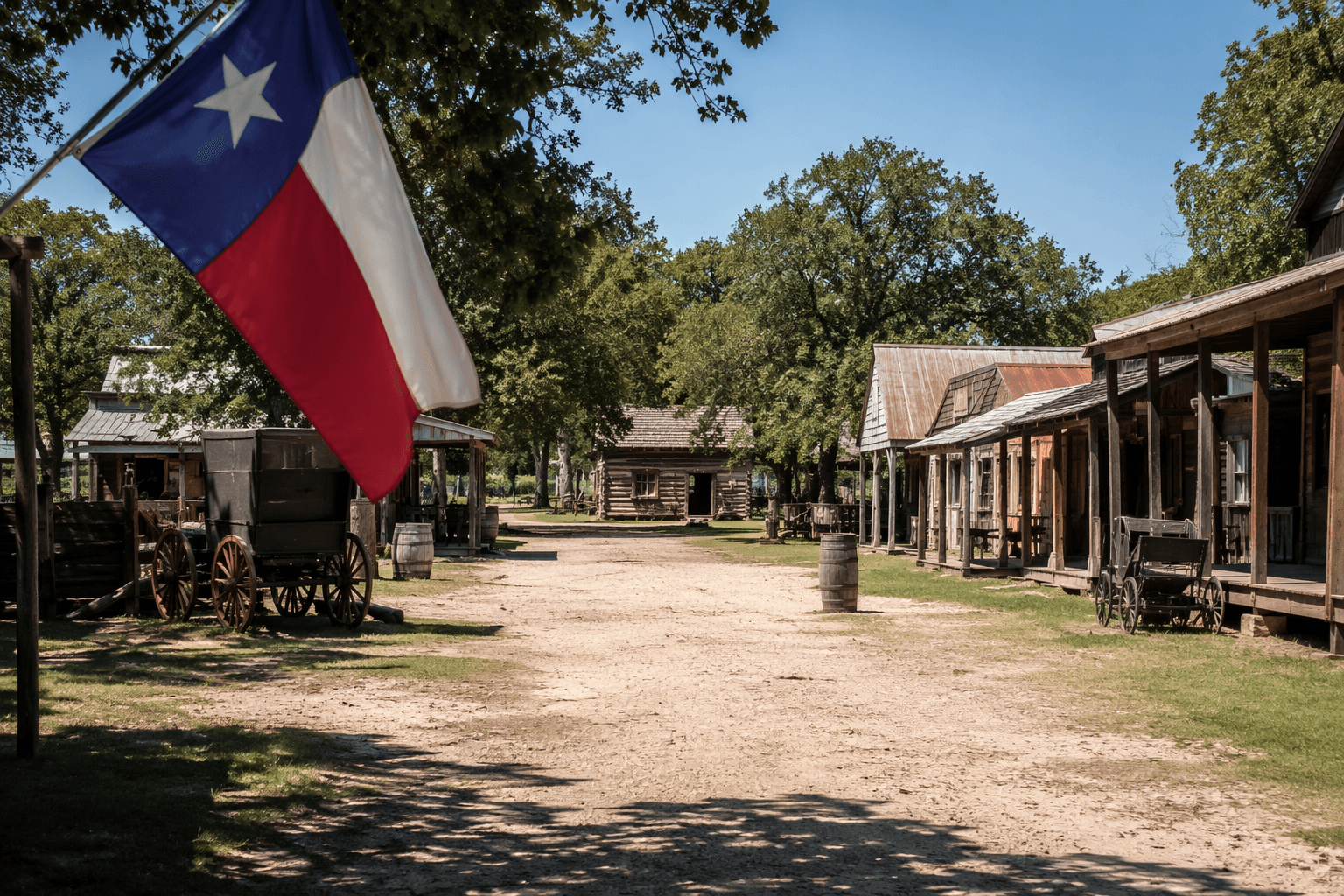
That ambiguity shaped what could happen on the ground. In a place where boundaries, oversight and jurisdiction were still being sorted out, a settlement like Beer City could become a magnet for people who wanted fewer restrictions. The old name “The Sodom and Gomorrah of the Plains” stuck because it fit the reputation that grew around the town in regional memory: rough, mobile and defiantly unconstrained.
What Beer City reveals about Texas County’s beginnings
Texas County itself was created at Oklahoma statehood in 1907 from Beaver County, which had been the Public Land Strip. That shift from disputed borderland to formal county government is the real historical arc behind Beer City’s notoriety. The county’s later identity, centered on Guymon and its civic institutions, grew out of a landscape that had first been organized by movement, trade and improvisation.
The contrast is stark. Today Texas County operates through county offices, courts, roads and schools. In the Beer City era, the basic framework of authority was still being assembled, and the social order depended far more on who showed up, who could claim a patch of ground and who was willing to enforce a rule if no official did. That is why Beer City matters in county history: it shows the earlier system before it hardened into government.
Why the story lasted
Beer City has lasted in memory because it sits at the intersection of documented frontier conditions and the kind of stories that grow up around them. HPPR ran a 2015 feature about an 82-year-old Oklahoman who kept the memory of Beer City alive, a reminder that the town still circulates through family recollection and local storytelling long after its brief life ended.
The most colorful version of that memory involves Marshal Lewis “Brushy” Bush and Pussy Cat Nell. Oklahoma Gazette repeated the legend that Nell fired a loaded double-barrel shotgun at Bush in Beer City, and that others allegedly shot at him too. The point of the tale is not just the drama. It shows how Beer City became a stand-in for a period when law was shaky enough that a single settlement could turn into regional legend.
How to read Beer City now
For Texas County, Beer City is useful because it explains how the county’s settlement pattern developed before formal institutions caught up. It helps connect Guymon’s later role as the county seat to an earlier era when the Panhandle’s economy ran through scattered stops and informal networks rather than settled municipal power. It also shows why the county’s identity has always included more than agriculture and government.
Read Beer City as a frontier business and governance story first. The name survived because it marks a place where geography, weak jurisdiction and constant movement shaped daily life, and because Texas County’s earliest boom years were built in that uncertain space before statehood turned the borderland into a county.
This article was produced by Prism’s automated news system from verified source data, official records, and press releases, then run through automated quality and moderation checks before publishing. The system is built and supervised by the people who set the standards it runs under. Read our full AI policy.
Did this article answer your question?