Dale-Engle-Walker House brings Union County's farm history to life
The Dale-Engle-Walker House turns one Union County farmstead into a record of immigrant settlement, enslaved labor, tenant farming, and dairy work that still shapes the county’s landscape.
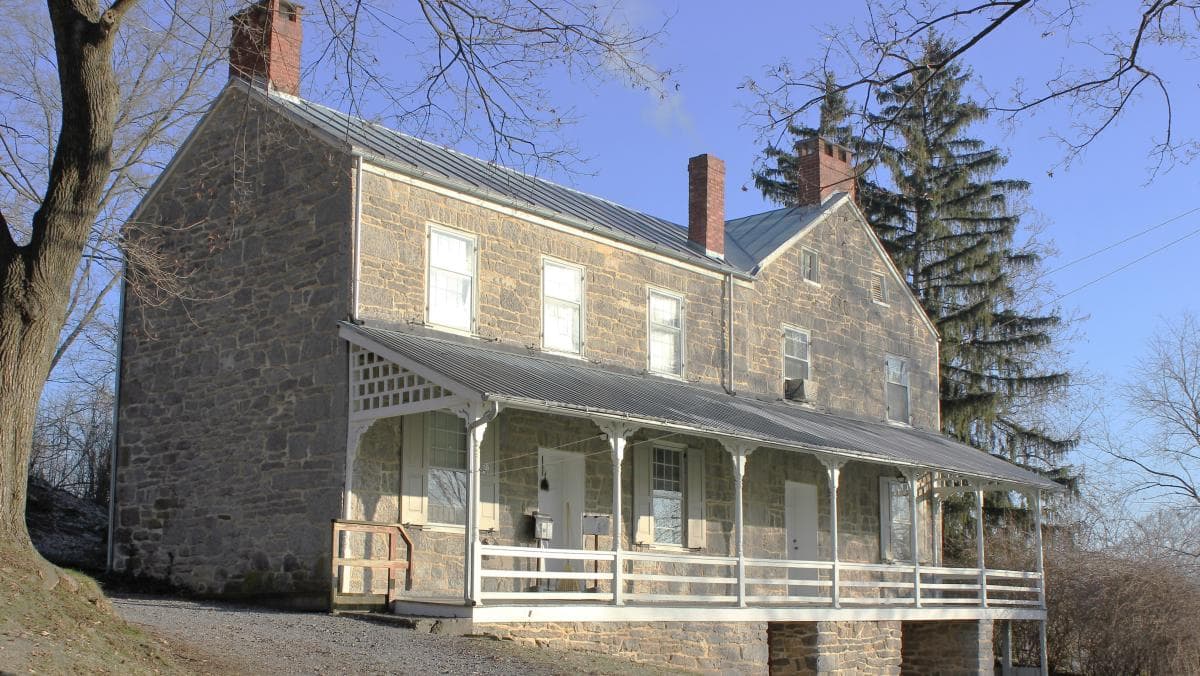
The Dale-Engle-Walker House is one of the few places in Union County where the county’s farm economy, labor history, and class divisions can still be read in the same yard. On Strawbridge Road near Lewisburg, a c. 1793 stone house stands beside an Engle dairy shed, a replica Wagon Shed, and a c. 1789 log cabin reassembled on the property, making the site feel less like a preserved house than a working map of how the county changed.
A farm bought by an immigrant, then passed through generations of labor
Samuel Dale, a Scots-Irish immigrant, bought the 137-acre farm in 1785 after settling in the Susquehanna Valley. Around eight years later, a four-room limestone house rose where an earlier log cabin had stood, and the property became tied to a man who also served repeatedly in the state legislature. That detail matters because the site was never just an isolated farmhouse: it sat at the intersection of land ownership, political influence, and the agricultural wealth that shaped early Union County.
The property stayed in the Dale family and was worked by tenant farmers until 1929. That long continuity tells a story many county residents still recognize today, even if the names have changed: land held by one family, worked by others, then handed from one economic era to another. The Dales’ role in the landscape helps explain why family names still carry weight across the county, and why old farm boundaries, road names, and surviving stone houses remain part of everyday Union County geography.
What visitors can actually see
The house itself still shows the material choices of an 18th-century farmstead. Tour materials note original chestnut and pine floors, a front door fanlight with original glass, twelve-over-twelve windows on the first floor, eight-over-twelve windows on the second floor, and an early kitchen and hearth. The stonework is laid in an uncoursed, roughly squared pattern with larger corner stones, a detail visitors can see immediately once they are standing in front of the building.
The grounds add layers that make the property easier to understand than a single house ever could. The restored Engle dairy shed recalls the property’s 20th-century working life, while the replica Wagon Shed holds historic farm implements and vehicles that help show how much labor moved through one farmstead. Since 2019, the c. 1789 Milne Log Cabin has also been part of the site, reassembled there to deepen the interpretation of pioneer life. The Union County Historical Society says its collection includes more than 10,000 artifacts, including farm tools, buggies, sleighs, and dairy-industry items used in tours on the farm.
The story the site refuses to leave out
The Dale-Engle-Walker House does not flatten the past into a simple pioneer story. An audio station by the basement hearth tells the story of Dinah, an enslaved domestic worker owned by Mrs. Anne Futhey Dale, placing slavery directly inside the domestic space of the house. That interpretive choice aligns with the historical society’s broader publications, including a title on African Americans in Union County: Slave and Free, and a chapter in Samuel Dale’s estate history titled Slavery and the Underground Railroad at the Dale House, 1793-1840.
That matters because Union County’s history is not only a record of farms and family names. It is also a record of labor that was coerced, unpaid, and often hidden behind the language of heritage. Pennsylvania’s own slavery and Underground Railroad research resources reinforce that this history belongs in the county’s public memory, not at the margins. At the Dale-Engle-Walker House, that history sits beside the hearth, where it is hardest to ignore.
How the Engles changed the farm in the 20th century
The next major chapter began in 1929, when Jacob and Maude Engle bought the property. They raised ten children there and operated the Dale’s Ridge Dairy from about 1935 to 1944 before selling the farm in 1957. The historical society describes Jacob Engle as the first farmer in Buffalo Township to use contour farming to control soil erosion, an innovation that connects the site to modern conservation practices still relevant on local hillsides and creek banks.
The family’s life also shows how much work a farm household required. The society notes that there was no electricity and no indoor plumbing in the main house, and that the children slept in tight quarters, with six boys in three bunk beds in the big bedroom and four girls sharing the back ell bedroom. The original barn burned in the mid-1930s, a replacement later collapsed, and only the limestone foundation walls remain, a visible reminder that even the best-known farmsteads are built as much from loss as from preservation.
Why the landscape still feels current
The Dale’s Ridge Trail makes the property’s land use history visible in a way that still resonates with present-day Union County. The trail rises nearly 160 feet above Buffalo Creek and passes through a creek floodplain, fields in succession, mature forest, and former agricultural fields. That mix shows what county land does over time when farms shrink, fields rest, and tree cover returns, a pattern residents see in parcels all over the region.
That is why the site remains useful now, not just interesting. It shows how one farm connected immigrant settlement, enslaved domestic labor, tenant farming, dairy production, erosion control, and changing land use into a single property history. The Dale-Engle-Walker House does more than preserve a house: it shows the forces that built Union County, and the ones the county is still living with today.
This article was produced by Prism’s automated news system from verified source data, official records, and press releases, then run through automated quality and moderation checks before publishing. The system is built and supervised by the people who set the standards it runs under. Read our full AI policy.
Know something we missed? Have a correction or additional information?
Submit a Tip